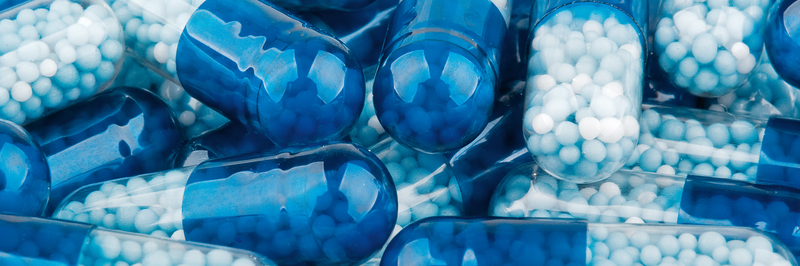
Reliable lipid-based system transports poorly soluble drugs in dissolved form in the gastrointestinal tract
Whether or not a drug helps depends on more than just its active ingredient. That ingredient first has to get to the place where it needs to work. The human body only has about four hours to absorb nutrients, vitamins and drugs from the stomach and small intestine. After that, whatever we ingest reaches the large intestine, where very little is absorbed before being excreted.
In order to get as much of the medicine as possible into the blood, active ingredients must be in a dissolved form. With water-soluble molecules such as sugar or vitamin C this is no problem as the body can easily absorb them. However many medicines are poorly soluble in water since they either crystallise or do not mix with water at all. Ibuprofen, an active ingredient in many painkillers, is one example. “Some substances are as poorly soluble as a stone”, says Martin Kuentz of the Institute of Pharma Technology and Biotechnology. “What is crystallised in the stomach or intestine is usually lost”.
For the last ten years he has been developing new drug formulations at the FHNW School of Life Sciences. Formulations in this case means how medicines are assembled: in addition to the drug itself, medicines contain other components which, for example, increase shelf life or suppress side effects. One of the most important jobs of these components is to ensure absorption of the active ingredient into the bloodstream.
In cooperation with the firm DSM, Kuentz and his research team have developed a new technology which effectively prevents crystallization of the active ingredient. Designed Lipid Micro Domains (DLM) absorb active substances like a sponge, except that they are only a few microns across. The micro domains stabilise the drug molecules by keeping them separate; if they get too close the substances crystallise because of their high affinity.
DLMs consist of several components, which are combined with the active substance by melt extrusion – a polymer technology process. The product of this method is a solid dispersion, i.e. a mixture of substances which normally do not bond. Polymers have traditionally been used as a dispersant to absorb the active ingredient.
However, since this can lead to the problem of active ingredient crystallisation in the drug or later in the gastrointestinal tract, Kuentz and his team now use lipids and an inorganic substrate (aluminium-magnesium silicate) in addition to the polymers. The lipids usually absorb the active ingredient well but during melt extrusion they can also crystallise and thus no longer be used by the active ingredient.
“To avoid this, we need the inorganic substrate. This interacts with the lipids to keep their long hydrocarbon chains apart”, explains Kuentz. “Since the active ingredient is highly liposoluble, after heating and intensive mixing during melt extrusion its droplets easily make their way into the spaces between the lipid chains.”
The researchers used a range of analytical methods to establish how well these mechanisms actually work. In addition to spectroscopic techniques such as nuclear resonance spectrometry and infrared spectroscopy to investigate organic components, they also worked with imaging techniques. They wanted to see whether and to what extent crystalline areas were present in DLM. “The answer to this question lies in a combination of highly specific methods,” says Kuentz. The most important of these is atomic force microscopy (AFM), in which a tiny leaf spring tip scans the sample nanometre by nanometre. The deflection of the spring shows the surface texture of the sample.
The hardness of the material can be determined by penetrating the sample with the scanning tip. This is called phase contrast, since the crystalline phases are generally harder than the non-crystalline ones and produce a contrast in the image. However only in combination with other analytical methods such as conventional scanning electron microscopy is it possible to determine whether hard areas in the sample are actually crystalline.
Kuentz and his team analysed the chemical composition of the micro domains, using a scanning electron microscope and X-ray diffraction. After the melt extrusion, the active substance is present in the DLM as an amorphous material, i.e. in a solid but not crystalline form. In modern pharmaceutical technology this form has proved to be the best at enabling the absorption of drugs with water-insoluble active substances into the bloodstream via the gastrointestinal tract.
“Apart from the fact that the DLM ensure a long enough shelf life of the active ingredients, they remain highly stable as an aqueous dispersion under natural conditions in the stomach and intestine”, explains Kuentz. Thus the body can absorb the amorphous active ingredients from the DLM before they are excreted.
For Kuentz, the challenge of active substance absorption in the gastrointestinal tract has been achieved: “Once it is absorbed, we have fulfilled our pharmaceutical and technological mission.” Kuentz is clear about the potential of DLM: “The drug delivery system we developed is designed for small doses of highly potent drugs but it can also be used for other substances that have a tendency to crystallise.” For example he and his team carried out DLM tests on very poorly water-soluble beta carotene, a precursor of vitamin A. Their success in these experiments shows that the new technology is not limited to medical applications; dietary supplements could also benefit from it in the future.
Methods
- Solid dispersion technology and lipid-based systems
Infrastructure
- Pharmaceutical extruder (“Hot Melt Extrusion”)
- “Time Domain” Nuclear Magnetic Resonance Spectroscopy (TD-NMR)
Support
- Industry
Contact

Prof. Dr. Martin Kuentz
- Phone
- +41 61 228 56 42
- martin.kuentz@fhnw.ch