Shedding light on an alarming mechanism by which bacteria not only survive treatment with antibiotics but also use them as nutrition
Scientists and politicians agree: antibiotic-resistant bacteria are a major challenge for medicine, both now and in the future. The World Health Organization estimates that by 2050 more people will die as a result of infection by multi-resistant bacteria than from cancer.
A team of researchers at the FHNW School of Life Sciences have shed light on a particularly alarming mechanism by which bacteria not only survive treatment with antibiotics but even use them as nutrition.
Sulphonamides are among the oldest synthetic antibiotics and have been used for over 70 years. They interfere with folic acid metabolism by blocking the formation of tetrahydrofolic acid, which bacteria need for DNA synthesis. However sulphonamides do not harm human cells; we absorb folic acid as a vitamin in our food. Various sulphonamides have been used in human medicine, for example against urinary tract infections; in veterinary medicine they are used against parasites.
“About 20,000 tonnes of sulphonamides reach the environment every year” reports Philippe Corvini of the Institute Chemistry and Bioanalytics, who is leading several projects looking at sulphonamide resistant bacteria. He explains: “The first step to the environment is the sewage treatment plant. The sludge there contains large quantities of bacteria which break down the organic pollutant input, i.e. hydrocarbons. Sulphonamides enter the sewage treatment plant at low concentrations — they are present but not effective. This allows bacteria to adapt to them perfectly.”
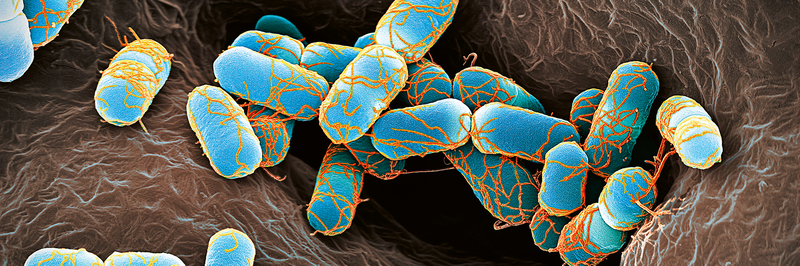
Corvini’s research team have shown this by cultivating bacteria from sewage treatment plants in a nutrient medium and adding different sulphonamides. A few years ago, they were able to detect sulphonamide resistant bacterial cultures. The bacteria are not only resistant however; they can also feed on sulphonamides and metabolize them completely to carbon dioxide. “So the bacteria are doubly resistant to the antibiotic”, Corvini concludes. “We call these cases super-resistance.” In cases of antibiotic resistance which scientists have dealt with up to now, resistant bacteria enzymes have led either to small structural changes in antibiotics or are themselves no longer antibiotic-sensitive.
Together with researchers from Switzerland, Portugal and Germany, Corvini’s group have now clarified how sulphamethoxazole — an active ingredient for urinary tract infections and pulmonary infections — is broken down in sewage treatment plants. Corvini and his team first had to collect activated sludge from sewage treatment plants. From the resulting resistant bacteria, the researchers then transferred genes which encode decomposition enzymes into coliform bacteria and fed them with sulphamethoxazole. “We were not only able to characterize the intermediate products of the decomposition, but also to identify three genes and the enzymes they encoded”, says Corvini.
The first two enzymes — a flavin reductase and a mono- oxygenase — form an enzyme system. For its the next reaction the flavin reductase takes a pair of electrons from an energy source in the body. The resulting electrons are transferred to another enzyme, monooxygenase, which the sulphamethoxazole hydroxylates with oxygen and breaks up. After an abiotic reduction, the starting material for the third enzyme, another monooxygenase, is formed. This converts the intermediate into trihydroxybenzene, which the bacteria use as food and convert to CO2.
“The extraordinary thing about the process is that the bacteria gain energy and small molecules to boost their fight against the antibiotic. Usually the opposite is true and resistance costs the bacteria energy. It could be a completely new resistance mechanism”, Corvini said.
This understanding of the breakdown mechanism is also the basis for industrial applications. Corvini adds: “By understanding these mechanisms on a molecular level, we can look at new sulphonamides from a different angle. In future, it may be possible to predict whether these new sulphonamides are easier to break down or more stable.”
According to Corvini, the newly explained breakdown mechanism is critical: “We are worried: our experiments suggest that this process is not limited to this one antibiotic. Studies of other sulphonamides reveal exactly the same spectrum of degradation products and the molecular structure of other sulphonamides is also vulnerable to the first reaction in the degradation process.” This first hydroxylation reaction is a key step in breaking down sulphonamides, as researchers have shown.
Corvini and his team are now investigating whether bacteria are resistant to and can break down other antibiotics. To this end, they take samples from the in- and outflows of wastewater treatment plants, add them to the antibiotics and measure the residual concentration of active ingredients in the waste- water bacterial cultures. These monitoring studies have enabled Corvini's team to track bacteria that are super-resistant to sulphamethoxazole. “We are working on five different sewage treatment plants in different locations and, most importantly, with different sewage treatment processes. We want to find out whether some processes are better at preventing the spread of antibiotic resistance than others.” In addition to the research at sewage treatment plants, the researchers are also studying soil samples to see whether this super-resistance has reached the environment.
There are two vital questions about the link between resistance and the ability to break down antibiotics: “On one hand we want to know if the bacteria can only break down sulphonamides if they are already resistant. This would mean that the bacteria can evolve, so that after several generations they produce precisely those enzymes which break down antibiotics. The second question is: if a bacterium can feed on an antibiotic whilst having a resistance gene for it, does the bacterium’s ability to metabolise it lead to a more rapid spread of resistance genes?” The researchers have already found the first evidence of this link between resistance and the ability to break down antibiotics.
The fact that super-resistant bacteria can break down antibiotics may however be useful in the future. Knowing the precise molecular structure of the enzymes means that they can be manufactured using biotechnology and thus used deliberately to break down the antibiotics. This would prevent resistance being passed on to disease-causing bacteria. This enzyme-based process would probably be too expensive for conventional sewage treatment but Corvini believes that targeted applications are feasible: “You have to consider the benefits for society, for industry and for the environment. You could treat badly affected industrial waste water using this technology."
Methods
- Cell cultures
- Resting cells
- DNA extraction
- Genome sequencing, quantitative PCR
- Proteome analysis
- Radio analysis and classical mass spectrometry
- Enzyme testing
- Digestion by trypsin
Infrastructure
- HPLC-MS
- HPLC radio detector
- Illumina Miseq NGS
- qPCR
- MALDI
Support
- EU FP7, SNF, Porto University, EAWAG
Collaboration
- EAWAG, RWTH Aachen
- MPI Magdeburg, ICTP
Contact

Prof. Dr. Philippe Corvini
- Phone
- +41 61 228 54 85
- philippe.corvini@fhnw.ch