Skip to main contentSkip to search barSkip to navigationSkip to footer
Logo of the University of Applied Sciences and Arts Northwestern Switzerland
  • DE
  • EN
  • Home

Ten Schools One Goal

The FHNW comprises 10 schools with different specializations. Select a school to see its specific courses, study programmes and information.

Applied Psychology

Architecture, Construction and Geomatics

Art and Design

Music

Computer Science

Life Sciences

School of Education

Social Work

Engineering and Environment

Business

  • Study offerings

    • All degree programmes
    • Master in Life Sciences
    • Master in Medical Informatics
    • Joint Degree Master in Biomedical Engineering
    • Info events
  • About degree programmes

    • Tuition fees and scholarships
    • Digital Life Sciences
  • International

    • Outgoing Students
    • Incoming Students
    • Double Degree
    • Partner universities
    • Student stories
    • Buddy programme
    • News and stories
  • Continuing education offerings

    • All continuing educations
    • CAS - Certificate of Advanced Studies
    • Modules and Seminars
    • Info events
  • Organisation

    • Consulting services
    • Legal information and terms & conditions
  • Research

    • Research fields
    • Projects
  • Collaboration

    • Process Technology Centre
    • Services
    • Tech Transfer Office
    • Student projects
  • International

    • Study abroad
    • International research projects
  • Updates and insights

    • News and stories
    • Research highlights
  • Events

    • All events
    • Info events
  • Media corner

  • About the School of Life Sciences

    • Strategy and values
    • Management board
    • Staff
    • Advisory board
    • People directory
    • Diversity and equal opportunities
    • Media corner
    • Infrastructure and campus
  • Institutes and centres

    • Institute for Chemistry and Bioanalytics
    • Institute for Ecopreneurship
    • Institute for Medical Engineering and Medical Informatics
    • Institute for Pharma Technology and Biotechnology
    • Centre for Teaching and Learning
    • Process Technology Centre
Logo of the University of Applied Sciences and Arts Northwestern Switzerland
  • About the School
    • School
    • Degree Programmes
    • Continuing Education
    • Research
    • Events
  • Social Media
    • Facebook
    • Instagram
    • YouTube
    • LinkedIn
  • About FHNW
    • Organisation
    • Schools
    • Locations
    • FHNW Library
    • Media Relations
  • Support
    • IT Support
    • Inside FHNW
    • Webmail
  • Data Protection
  • Imprint
  • Accessibility
  • Study offerings

    • All degree programmes
    • Master in Life Sciences
    • Master in Medical Informatics
    • Joint Degree Master in Biomedical Engineering
    • Info events
  • About degree programmes

    • Tuition fees and scholarships
    • Digital Life Sciences
  • International

    • Outgoing Students
    • Incoming Students
    • Double Degree
    • Partner universities
    • Student stories
    • Buddy programme
    • News and stories
  • Continuing education offerings

    • All continuing educations
    • CAS - Certificate of Advanced Studies
    • Modules and Seminars
    • Info events
  • Organisation

    • Consulting services
    • Legal information and terms & conditions
  • Research

    • Research fields
    • Projects
  • Collaboration

    • Process Technology Centre
    • Services
    • Tech Transfer Office
    • Student projects
  • International

    • Study abroad
    • International research projects
  • Updates and insights

    • News and stories
    • Research highlights
  • Events

    • All events
    • Info events
  • Media corner

  • About the School of Life Sciences

    • Strategy and values
    • Management board
    • Staff
    • Advisory board
    • People directory
    • Diversity and equal opportunities
    • Media corner
    • Infrastructure and campus
  • Institutes and centres

    • Institute for Chemistry and Bioanalytics
    • Institute for Ecopreneurship
    • Institute for Medical Engineering and Medical Informatics
    • Institute for Pharma Technology and Biotechnology
    • Centre for Teaching and Learning
    • Process Technology Centre

Type a search term and search continuing education,degree programmes, events, documents and other content.

  • Life Sciences
  • News and events
  • News and Stories
  • All news and stories
All news and stories

How well do industrial companies know their wastewaters?, FHNW School of Life Sciences

30.4.2025 – School of Life Sciences, Institute for Ecopreneurship


A tool developed by Miriam Langer’s team is helping industry better answer this question.

  • Story

The metal, pharmaceutical, chemical, cleaning and waste management industries all need to understand their wastewater and comply with environmental norms. While chemical analyses can indicate the presence and concentration of targeted substances, they cannot predict the responses of organisms or cells to a combination of these substances. Nor do chemical analyses reveal whether unknown substances, residues and metabolites are present if they are not specifically searched for.

Taking inspiration from gaps identified in an industry workshop, Prof. Dr. Miriam Langer and Research Associate Dr. Xenia Klaus first collected national and international knowledge about industrial wastewater screening with bioassays. To answer the challenges that companies face, they came up with the idea to create a panel of biological tests.
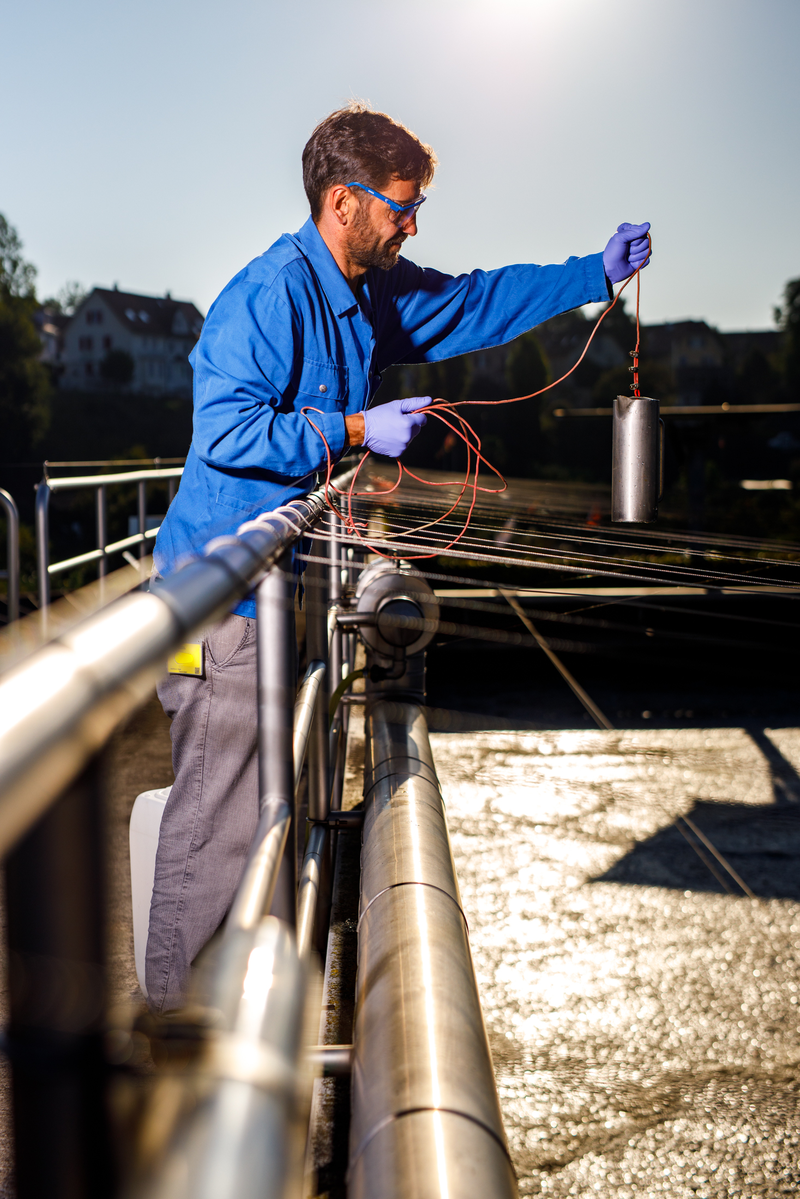
Technical specialist Patrik Eckert takes wastewater samples for the FHNW Institute for Ecopreneurship.

Their tool, ABIScreen, combines a time-efficient biodegradation test with a battery of robust, broad-based bioassays, including toxicity to the bacteria in the wastewater treatment plant, and effects on luminous bacteria, daphnia and algae. If desired, an Ames-test can be included to determine whether substances in the wastewater have mutagenic potential.

ABIScreen is currently being deployed in five Swiss cantons. Companies collect samples of their wastewater from a combined waste stream or a sub-stream of interest. The flasks are picked up by the Institute for Ecopreneurship and analysed in its labs, with the cost covered by the Federal Office for the Environment and the Swiss cantons involved in the project. Langer’s team provides a readout of key parameters in a comprehensible report, which the company can use to both treat and prevent problems – or in many cases, confirm the success of their wastewater treatment performance.

Since the project began in 2023, over 50 companies have participated. They value the information they receive about their wastewater, the confidentiality of the process and the ability to take matters into their own hands. Some have requested follow-up screening of sub-streams so they can zero in on specific issues. The contact between members of Langer’s team and industry helps stimulate dialogue.

“We’re very happy with what we’ve achieved” says Klaus. “Companies have realised that performing bioassays is not as long, complex or expensive as they might think, and it complements chemical analysis nicely. The project is encouraging them to measure more often and check that their treatment processes are working.”

Industry clients and government agencies agree. “In future, ABIScreen could help us to identify critical substances in our wastewater more easily and eliminate them at source wherever possible” says Christine Wegmann from dsm-firmenich.

The combination of degradability tests and bioassays in ABIScreen enables a holistic characterisation of a specific wastewater in addition to chemical analyses and simultaneous evaluation of the company’s own wastewater treatment. Tracing toxic and non-biodegradable substances in wastewater back to their source helps companies to find out about the required state-of-the-art techniques and therefore represents added value.
Saskia Zimmermann-Steffens, Water Division, Federal Office for the Environment

In the last phase of the project, Langer’s team compiled biotest results anonymously in a database. Live since 2025, the database can help industry decide whether to review their wastewater treatment processes. The data is accessible to participating companies upon request, allowing them to compare metrics within their industry sector.

As more companies see value in these tests and the volume of testing increases, the FHNW School of Life Sciences plans to transfer the knowhow to private sector labs, helping them expand their service offerings.

“This project truly illustrates the value of the FHNW’s applied research expertise for Swiss industry and government, and is an active contribution to future good water quality” says Langer.

Key facts


Community:

Switzerland (Cantons AG, BL, GE, VD, ZH)

Water system:

Industrial wastewater

Partners:

Verband Schweizer Abwasser- und Gewässerschutzfachleute

Financing:

Federal Office for the Environment (FOEN) Switzerland; Cantons of Argau, Basellandschaft, Geneva, Vaud and Zurich


Contact

Miriam Langer

Prof. Dr. Miriam Langer

Dean of BSc environmental sciences and technology
Phone
+41 61 228 58 83
E-Mail
miriam.langer@fhnw.ch
Xenia Klaus

Xenia Klaus

Research Associate
Phone
+41 61 228 56 35
E-Mail
xenia.klaus@fhnw.ch

School of
Life Sciences FHNW University of Applied Sciences and Arts Northwestern Switzerland

  • About the School
    • School
    • Degree Programmes
    • Continuing Education
    • Research
    • Events
  • Social Media
    • Facebook
    • Instagram
    • YouTube
    • LinkedIn
  • About FHNW
    • Organisation
    • Schools
    • Locations
    • FHNW Library
    • Media Relations
  • Support
    • IT Support
    • Inside FHNW
    • Webmail
Logo FHNW - 20 Years
Logo Swiss Universities
Logo European University Association
© University of Applied Sciences and Arts Northwestern Switzerland (FHNW)
  • Data Protection
  • Imprint
  • Accessibility
  • DE
  • EN