Skip to main contentSkip to search barSkip to navigationSkip to footer
Logo of the University of Applied Sciences and Arts Northwestern Switzerland
  • DE
  • EN
  • Home

Ten Schools One Goal

The FHNW comprises 10 schools with different specializations. Select a school to see its specific courses, study programmes and information.

Applied Psychology

Architecture, Construction and Geomatics

Art and Design

Music

Computer Science

Life Sciences

School of Education

Social Work

Engineering and Environment

Business

  • Study offerings

    • All degree programmes
    • Master in Life Sciences
    • Master in Medical Informatics
    • Joint Degree Master in Biomedical Engineering
    • Info events
  • About degree programmes

    • Tuition fees and scholarships
    • Digital Life Sciences
  • International

    • Outgoing Students
    • Incoming Students
    • Double Degree
    • Partner universities
    • Student stories
    • Buddy programme
    • News and stories
  • Continuing education offerings

    • All continuing educations
    • CAS - Certificate of Advanced Studies
    • Modules and Seminars
    • Info events
  • Organisation

    • Consulting services
    • Legal information and terms & conditions
  • Research

    • Research fields
    • Projects
  • Collaboration

    • Process Technology Centre
    • Services
    • Tech Transfer Office
    • Student projects
  • International

    • Study abroad
    • International research projects
  • Updates and insights

    • News and stories
    • Research highlights
  • Events

    • All events
    • Info events
  • Media corner

  • About the School of Life Sciences

    • Strategy and values
    • Management board
    • Staff
    • Advisory board
    • People directory
    • Diversity and equal opportunities
    • Media corner
    • Infrastructure and campus
  • Institutes and centres

    • Institute for Chemistry and Bioanalytics
    • Institute for Ecopreneurship
    • Institute for Medical Engineering and Medical Informatics
    • Institute for Pharma Technology and Biotechnology
    • Centre for Teaching and Learning
    • Process Technology Centre
Logo of the University of Applied Sciences and Arts Northwestern Switzerland
  • About the School
    • School
    • Degree Programmes
    • Continuing Education
    • Research
    • Events
  • Social Media
    • Facebook
    • Instagram
    • YouTube
    • LinkedIn
  • About FHNW
    • Organisation
    • Schools
    • Locations
    • FHNW Library
    • Media Relations
  • Support
    • IT Support
    • Inside FHNW
    • Webmail
  • Data Protection
  • Imprint
  • Accessibility
  • Study offerings

    • All degree programmes
    • Master in Life Sciences
    • Master in Medical Informatics
    • Joint Degree Master in Biomedical Engineering
    • Info events
  • About degree programmes

    • Tuition fees and scholarships
    • Digital Life Sciences
  • International

    • Outgoing Students
    • Incoming Students
    • Double Degree
    • Partner universities
    • Student stories
    • Buddy programme
    • News and stories
  • Continuing education offerings

    • All continuing educations
    • CAS - Certificate of Advanced Studies
    • Modules and Seminars
    • Info events
  • Organisation

    • Consulting services
    • Legal information and terms & conditions
  • Research

    • Research fields
    • Projects
  • Collaboration

    • Process Technology Centre
    • Services
    • Tech Transfer Office
    • Student projects
  • International

    • Study abroad
    • International research projects
  • Updates and insights

    • News and stories
    • Research highlights
  • Events

    • All events
    • Info events
  • Media corner

  • About the School of Life Sciences

    • Strategy and values
    • Management board
    • Staff
    • Advisory board
    • People directory
    • Diversity and equal opportunities
    • Media corner
    • Infrastructure and campus
  • Institutes and centres

    • Institute for Chemistry and Bioanalytics
    • Institute for Ecopreneurship
    • Institute for Medical Engineering and Medical Informatics
    • Institute for Pharma Technology and Biotechnology
    • Centre for Teaching and Learning
    • Process Technology Centre

Type a search term and search continuing education,degree programmes, events, documents and other content.

  • Life Sciences
  • News and events
  • News and Stories
  • All news and stories
All news and stories

Improving wound healing after C-sections, FHNW School of Life Sciences

30.4.2025 – School of Life Sciences, Institute for Medical Engineering and Medical Informatics


Reto Wildhaber’s team has developed a visualisation technology to better illuminate corrective surgery after caesarian sections

  • Story

In Switzerland, 32% of babies are delivered by caesarean section. While hospitals are working to reduce the number of procedures that are not medically necessary, Switzerland’s rate remains one of the highest in Europe.

Caesarean sections pose several risks to the mother, one of which is poor healing of the uterine scar. Unknown tissue factors can lead to hampered wound healing and gaps in the anterior uterine wall. These gaps, also called niches, weaken the uterus in a subsequent pregnancy. It can take 1-2 years for women to observe pain and other complications from improper wound healing, which might require follow-up corrective surgery. Chronic pain and multiple surgical interventions can prevent women from performing childcare duties and returning to the workforce, and can considerably reduce their quality of life. If the niche breaks during a subse­quent pregnancy, there are significant risks for both mother and baby.

Surgeons at the University Hospital Zürich approached Prof. Dr. Reto Wildhaber with the idea of integrating a light source into a uterine manipu­lator, a tool used during gynaecological surgery. Current laparoscopic tools and camera systems for imaging the uterus during corrective surgery emit light only outside the uterus, and provide an unclear view of different layers of tissue inside the uterus.

Wildhaber, who specialises in signal analysis and digital biomarkers, came up with the idea to use a pulsing light that is inserted into the uterus through the vagina and cervix. He supported the development of the first prototype while working at the Berner Fachhochschule (BFH). In 2021 he joined the Institute for Medical Engineering and Medical Informatics and continued to work on the project in collaboration with BFH, with whom a joint patent has now been filed.
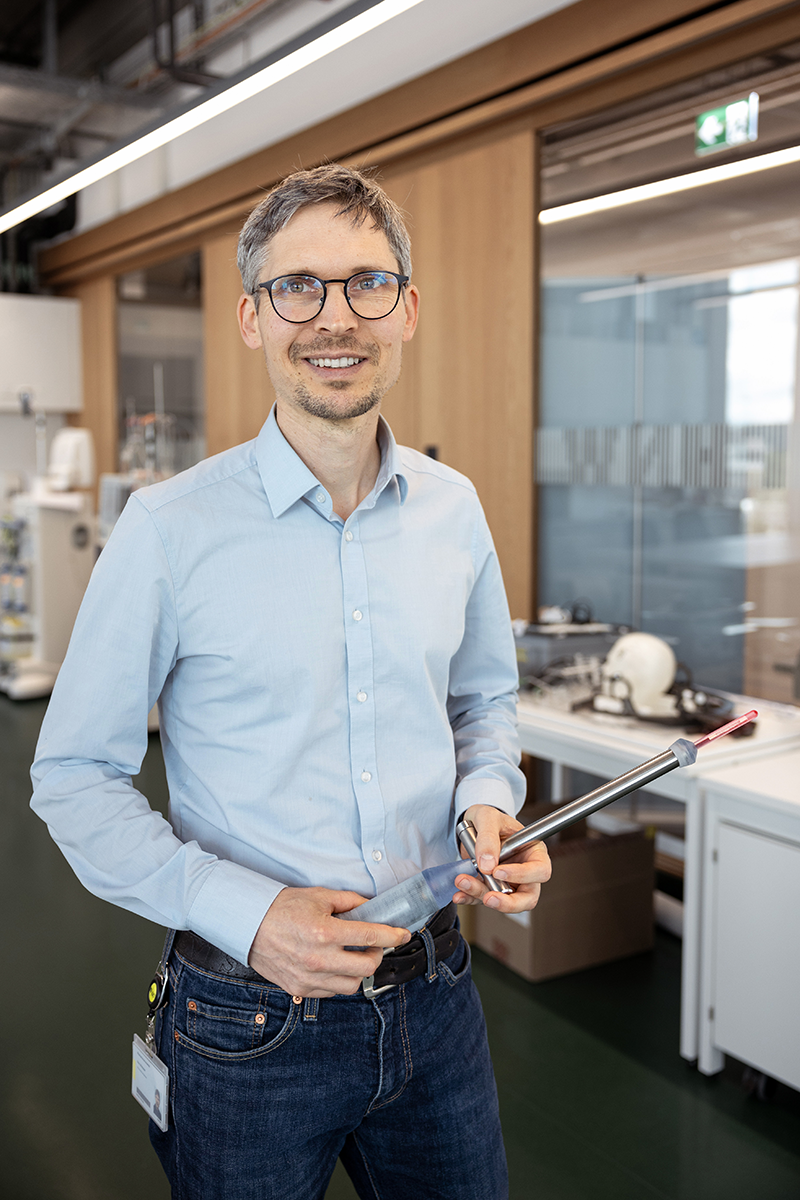
  • Reto_Wildhaber_Visualisation_800X1200.png
    Reto Wildhaber developed a prototype that will help surgeons see different types of tissues inside the uterus during surgery.
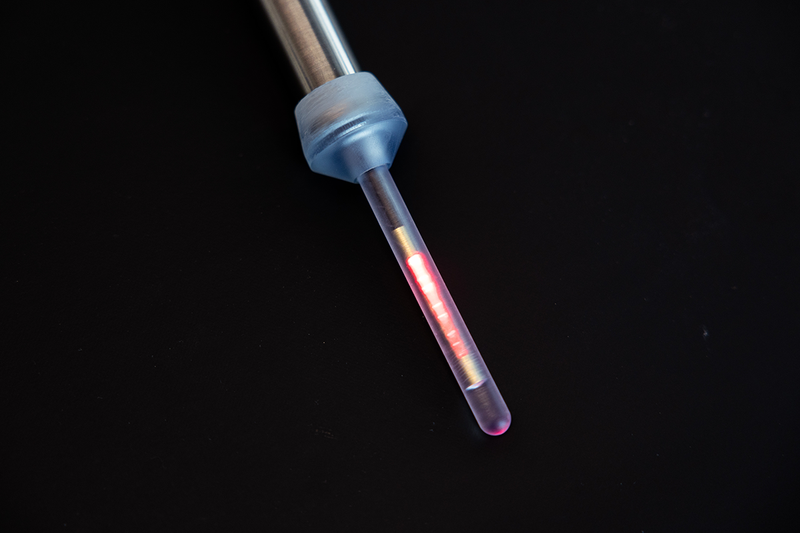
  • Niche_Visualisation_1200X800.png
    A pulsing red LED light in the tip of the instrument is used in digital enhancement equations to generate a 2D augmented reality during surgery.

First, Wildhaber’s team tackled the physical challenges of refining the prototype. They selected the material and process to produce the instrument tip where the pulsing red LED light source is housed: 3D printed biocompatible polymethyl methacrylate. The tips were subjected to mechani­cal force testing to ensure they can bend during surgery without snapping.

To facilitate sterilisation, the instrument can be disassembled into components and laid flat in an autoclave. The conical design of one component acts as a ‘plug’ for the cervix, stabilizing the instru-ment and preventing gas injected into the abdo­men during surgery from escaping the uterus. To keep the tip of the instrument cool and prevent damage to uterine cell tissue, fibre optic cables are used to transmit light from the pulsing red LEDs into the uterus.

The team then put mathematics into action, developing a digital enhancement equation that exploits the difference between the pulsing interior light emitted by the prototype, and the exterior light emitted by laparoscopic tools, to create an image overlay on the surgical monitoring screen. The 2D augmented reality will help guide surgeons by displaying the boundary of different tissues in the uterus and the location of the surgical tool. It will enable them to see the niche and precisely remove scar tissue.

Overall, the instrument provides an intrauterine light source that allows direct localisation of the niche while stabilizing the uterus, and is compati­ble with the DaVinci robot that assists the correc­tive surgery. The small computer required to perform the digital enhancement equations and the screen that displays the 2D visualisation can be easily integrated into existing laparoscopic set-ups.

The visualisation technology underwent a proof-of-concept pilot study in Wildhaber’s lab in the summer of 2024, which will be followed by clinical studies at the Department of Gynecology at the University Hospital Zürich after approval by Swissmedic and the local ethics authorities.

We believe that women with lower abdominal symptoms and women with a niche that wish to conceive a second child will profit from the new device. We are looking forward to applying the so-called scar light device in a first clinical trial. It will enhance the surgical technique and we expect it will yield a good outcome for mothers and children.
Prof. Dr. med. Cornelia Betschart Meier

“This device has the potential to simplify a medically necessary procedure, and make it safer and more reliable, thanks to today’s technology” says Wildhaber. If clinical tests are successful, a spin-off company at USZ could be formed, or the technology could be licenced to a surgical or imaging instruments firm in order to bring it to the market.

Key facts


Patients / Target Groups:

Gynaecological health

Partners:

University Hospital Zürich, Fachhochschule Bern

Financing:

Innosuisse 101.964 IP-LS


Contact

Reto Wildhaber

Prof. Dr. sc. ETH, Dr. med. Reto Wildhaber

Team leader, Signal Analysis and Digital Biomarkers
Phone
+41 61 228 61 25
E-Mail
reto.wildhaber@fhnw.ch

School of
Life Sciences FHNW University of Applied Sciences and Arts Northwestern Switzerland

  • About the School
    • School
    • Degree Programmes
    • Continuing Education
    • Research
    • Events
  • Social Media
    • Facebook
    • Instagram
    • YouTube
    • LinkedIn
  • About FHNW
    • Organisation
    • Schools
    • Locations
    • FHNW Library
    • Media Relations
  • Support
    • IT Support
    • Inside FHNW
    • Webmail
Logo FHNW - 20 Years
Logo Swiss Universities
Logo European University Association
© University of Applied Sciences and Arts Northwestern Switzerland (FHNW)
  • Data Protection
  • Imprint
  • Accessibility
  • DE
  • EN