Skip to main contentSkip to search barSkip to navigationSkip to footer
Logo of the University of Applied Sciences and Arts Northwestern Switzerland
  • DE
  • EN
  • Home

Ten Schools One Goal

The FHNW comprises 10 schools with different specializations. Select a school to see its specific courses, study programmes and information.

Applied Psychology

Architecture, Construction and Geomatics

Art and Design

Music

Computer Science

Life Sciences

School of Education

Social Work

Engineering and Environment

Business

  • Study offerings

    • All degree programmes
    • Master in Life Sciences
    • Master in Medical Informatics
    • Joint Degree Master in Biomedical Engineering
    • Info events
  • About degree programmes

    • Tuition fees and scholarships
    • Digital Life Sciences
  • International

    • Outgoing Students
    • Incoming Students
    • Double Degree
    • Partner universities
    • Student stories
    • Buddy programme
    • News and stories
  • Continuing education offerings

    • All continuing educations
    • CAS - Certificate of Advanced Studies
    • Modules and Seminars
    • Info events
  • Organisation

    • Consulting services
    • Legal information and terms & conditions
  • Research

    • Research fields
    • Projects
  • Collaboration

    • Process Technology Centre
    • Services
    • Tech Transfer Office
    • Student projects
  • International

    • Study abroad
    • International research projects
  • Updates and insights

    • News and stories
    • Research highlights
  • Events

    • All events
    • Info events
  • Media corner

  • About the School of Life Sciences

    • Strategy and values
    • Management board
    • Staff
    • Advisory board
    • People directory
    • Diversity and equal opportunities
    • Media corner
    • Infrastructure and campus
  • Institutes and centres

    • Institute for Chemistry and Bioanalytics
    • Institute for Ecopreneurship
    • Institute for Medical Engineering and Medical Informatics
    • Institute for Pharma Technology and Biotechnology
    • Centre for Teaching and Learning
    • Process Technology Centre
Logo of the University of Applied Sciences and Arts Northwestern Switzerland
  • About the School
    • School
    • Degree Programmes
    • Continuing Education
    • Research
    • Events
  • Social Media
    • Facebook
    • Instagram
    • YouTube
    • LinkedIn
  • About FHNW
    • Organisation
    • Schools
    • Locations
    • FHNW Library
    • Media Relations
  • Support
    • IT Support
    • Inside FHNW
    • Webmail
  • Data Protection
  • Imprint
  • Accessibility
  • Study offerings

    • All degree programmes
    • Master in Life Sciences
    • Master in Medical Informatics
    • Joint Degree Master in Biomedical Engineering
    • Info events
  • About degree programmes

    • Tuition fees and scholarships
    • Digital Life Sciences
  • International

    • Outgoing Students
    • Incoming Students
    • Double Degree
    • Partner universities
    • Student stories
    • Buddy programme
    • News and stories
  • Continuing education offerings

    • All continuing educations
    • CAS - Certificate of Advanced Studies
    • Modules and Seminars
    • Info events
  • Organisation

    • Consulting services
    • Legal information and terms & conditions
  • Research

    • Research fields
    • Projects
  • Collaboration

    • Process Technology Centre
    • Services
    • Tech Transfer Office
    • Student projects
  • International

    • Study abroad
    • International research projects
  • Updates and insights

    • News and stories
    • Research highlights
  • Events

    • All events
    • Info events
  • Media corner

  • About the School of Life Sciences

    • Strategy and values
    • Management board
    • Staff
    • Advisory board
    • People directory
    • Diversity and equal opportunities
    • Media corner
    • Infrastructure and campus
  • Institutes and centres

    • Institute for Chemistry and Bioanalytics
    • Institute for Ecopreneurship
    • Institute for Medical Engineering and Medical Informatics
    • Institute for Pharma Technology and Biotechnology
    • Centre for Teaching and Learning
    • Process Technology Centre

Type a search term and search continuing education,degree programmes, events, documents and other content.

  • Life Sciences
  • News and events
  • News and Stories
  • All news and stories
All news and stories

Iron detection method based on high-resolution magnetic field camera, FHNW School of Life Sciences

1.11.2024 – School of Life Sciences


Iron detection is important in many areas, from the food industry to health research and machine maintenance. However, the precise measurement and localization of iron particles is technically challenging because of the low magnetic field they generate.

  • News

Prof. Dr. Joris Pascal, head of the ‘Sensor systems for diagnosis and therapy’ research group, and PhD students Céline Vergne and Hugo Nicolas from Pascal's research group, have developed an innovative new iron detection method. Presented at the IEEE Sensors 2024 Conference in Kobe, Japan, this method uses a special magnetic field camera that can visualize iron using high-resolution magnetic field sensors.
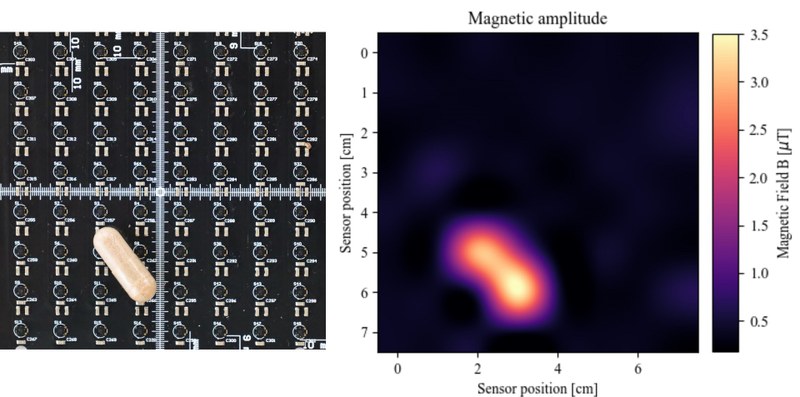
Magnetic camera with colour map
Magnetic field camera and color map

Magnetic field camera and color map

How does the magnetic field camera work?
The magnetic field camera consists of an array of 64 highly sensitive magnetic sensors in an 8 x 8 grid. Each sensor can register small changes in the magnetic field: if iron is near the camera, it disturbs the magnetic field, similar to a tiny magnet. The sensors record these disturbances and display them as a digital image, revealing the exact location and quantity of the iron.
Thanks to their high resolution, the sensors can detect weak magnetic fields with a precision of 42 nanotesla (nT) - less than one hundred thousandth of the magnetic field of a household magnet. Moreover, the camera measures up to 110 times per second, which means that it can even reliably recognize moving iron particles. Such high-resolution and high-speed measurements have not been available until now and open up completely new possibilities for reliably detecting iron.

Where is this technology used?
This innovative magnetic field camera could significantly improve performance in a wide range of applications:

1. Food analyses: iron is an essential trace element and is particularly important for assessing nutritional quality. The camera can measure the iron content in food and check for harmful particles. This technology could, for example, help with quality control to ensure that food contains the necessary amount of iron or is free of impurities.

2. Medicine and research: the magnetic field camera could be an important aid in tumor diagnostics. Researchers are working on applying iron nanoparticles to biological samples in order to make tumor cells visible. The camera could record the smallest changes in magnetic fields and thus help to recognize malignant tissue accumulations.

3. Mechanical engineering and technology: iron particles in engines or machines are often a sign of wear. The magnetic field camera can be used to detect ferrous particles in engine oil that could indicate problems. In this way, maintenance work can be initiated at an early stage, thus avoiding damage to equipment. This technology is also relevant for inspecting buildings, equipment or cables, as it can make the smallest cracks or worn areas identifiable via tiny iron particles.

How was the camera tested?
 The research team carried out a range of tests with the magnetic field camera to confirm its precision and functionality. In one such test, thanks to its high sensitivity the camera was able to precisely detect the magnetic signatures of food samples. In another experiment, iron particles 200 micrometres in diameter were placed on a plate. The magnetic field camera was able to determine the exact number of particles and visualize their precise locations.

What makes the magnetic field camera so special?
The combination of high resolution, fast measurement rate and high sensitivity gives this magnetic field camera enormous potential for many areas. With this groundbreaking technology, iron particles can be detected with a completely new level of precision and speed, which could improve both quality control and safety assessment in many industries.

This method opens up promising possibilities for detecting iron quickly and efficiently and could become the basis for many modern measuring systems.

School of
Life Sciences FHNW University of Applied Sciences and Arts Northwestern Switzerland

  • About the School
    • School
    • Degree Programmes
    • Continuing Education
    • Research
    • Events
  • Social Media
    • Facebook
    • Instagram
    • YouTube
    • LinkedIn
  • About FHNW
    • Organisation
    • Schools
    • Locations
    • FHNW Library
    • Media Relations
  • Support
    • IT Support
    • Inside FHNW
    • Webmail
Logo FHNW - 20 Years
Logo Swiss Universities
Logo European University Association
© University of Applied Sciences and Arts Northwestern Switzerland (FHNW)
  • Data Protection
  • Imprint
  • Accessibility
  • DE
  • EN