Skip to main contentSkip to search barSkip to navigationSkip to footer
Logo of the University of Applied Sciences and Arts Northwestern Switzerland
  • DE
  • EN
  • Home

Ten Schools One Goal

The FHNW comprises 10 schools with different specializations. Select a school to see its specific courses, study programmes and information.

Applied Psychology

Architecture, Construction and Geomatics

Art and Design

Music

Computer Science

Life Sciences

School of Education

Social Work

Engineering and Environment

Business

  • Study offerings

    • All degree programmes
    • Master in Life Sciences
    • Master in Medical Informatics
    • Joint Degree Master in Biomedical Engineering
    • Info events
  • About degree programmes

    • Tuition fees and scholarships
    • Digital Life Sciences
  • International

    • Outgoing Students
    • Incoming Students
    • Double Degree
    • Partner universities
    • Student stories
    • Buddy programme
    • News and stories
  • Continuing education offerings

    • All continuing educations
    • CAS - Certificate of Advanced Studies
    • Modules and Seminars
    • Info events
  • Organisation

    • Consulting services
    • Legal information and terms & conditions
  • Research

    • Research fields
    • Projects
  • Collaboration

    • Process Technology Centre
    • Services
    • Tech Transfer Office
    • Student projects
  • International

    • Study abroad
    • International research projects
  • Updates and insights

    • News and stories
    • Research highlights
  • Events

    • All events
    • Info events
  • Media corner

  • About the School of Life Sciences

    • Strategy and values
    • Management board
    • Staff
    • Advisory board
    • People directory
    • Diversity and equal opportunities
    • Media corner
    • Infrastructure and campus
  • Institutes and centres

    • Institute for Chemistry and Bioanalytics
    • Institute for Ecopreneurship
    • Institute for Medical Engineering and Medical Informatics
    • Institute for Pharma Technology and Biotechnology
    • Centre for Teaching and Learning
    • Process Technology Centre
Logo of the University of Applied Sciences and Arts Northwestern Switzerland
  • About the School
    • School
    • Degree Programmes
    • Continuing Education
    • Research
    • Events
  • Social Media
    • Facebook
    • Instagram
    • YouTube
    • LinkedIn
  • About FHNW
    • Organisation
    • Schools
    • Locations
    • FHNW Library
    • Media Relations
  • Support
    • IT Support
    • Inside FHNW
    • Webmail
  • Data Protection
  • Imprint
  • Accessibility
  • Study offerings

    • All degree programmes
    • Master in Life Sciences
    • Master in Medical Informatics
    • Joint Degree Master in Biomedical Engineering
    • Info events
  • About degree programmes

    • Tuition fees and scholarships
    • Digital Life Sciences
  • International

    • Outgoing Students
    • Incoming Students
    • Double Degree
    • Partner universities
    • Student stories
    • Buddy programme
    • News and stories
  • Continuing education offerings

    • All continuing educations
    • CAS - Certificate of Advanced Studies
    • Modules and Seminars
    • Info events
  • Organisation

    • Consulting services
    • Legal information and terms & conditions
  • Research

    • Research fields
    • Projects
  • Collaboration

    • Process Technology Centre
    • Services
    • Tech Transfer Office
    • Student projects
  • International

    • Study abroad
    • International research projects
  • Updates and insights

    • News and stories
    • Research highlights
  • Events

    • All events
    • Info events
  • Media corner

  • About the School of Life Sciences

    • Strategy and values
    • Management board
    • Staff
    • Advisory board
    • People directory
    • Diversity and equal opportunities
    • Media corner
    • Infrastructure and campus
  • Institutes and centres

    • Institute for Chemistry and Bioanalytics
    • Institute for Ecopreneurship
    • Institute for Medical Engineering and Medical Informatics
    • Institute for Pharma Technology and Biotechnology
    • Centre for Teaching and Learning
    • Process Technology Centre

Type a search term and search continuing education,degree programmes, events, documents and other content.

Navigating the brain, FHNW School of Life Sciences

30.4.2025 – School of Life Sciences, Institute for Medical Engineering and Medical Informatics


  • Life Sciences
  • News and events
  • News and Stories
  • All news and stories
All news and stories
Celine_Vergne_DBS_1920X640.png

Céline Vergne has developed an intelligent electromagnetic navigation system for precise implantation of deep brain stimulation electrodes

  • Story

The success of deep brain stimulation (DBS) depends on precision, both in positioning the electrodes and stimulating specific brain regions. Currently, pre-operative imaging and stereotactic techniques are the gold standard for the insertion of DBS electrodes into the brain, but they do not offer tracking during surgery.

Céline Vergne, who is completing a PhD at the Institute for Medical Engineering and Medical Informatics with a joint enrolment at the Universi­ties of Basel and Strasbourg, has developed an electromagnetic navigation system aiming at the precise tracking of electrodes during their implan­tation. “The chip integrated into the stimulation device, coupled with our visualisation system, will allow surgeons to see the angle and position of the DBS electrode” says Vergne.

She first integrated a tiny magnetometer into the electrode. Less than 1 mm across, the magnetic sensor can be detected by generating low magnetic fields and using a tracking algorithm to determine its position. Prof. Dr. Joris Pascal’s team contribut­ed to the sensor’s development, while Prof. Dr. Simone Hemm’s team was responsible for the system set-up and testing in the surgical environment. In collaboration with the University of Strasbourg, Vergne is investigating machine learning algorithms to optimise the sensor’s tracking performance.
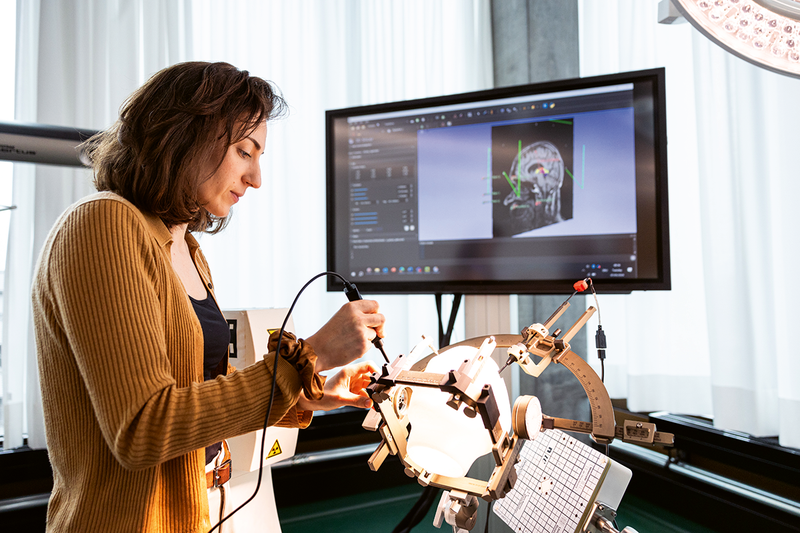
Céline Vergne tests her electromagnetic navigation system for localisation of electrodes in the brain, using a head phantom inside a stereotactic headset.

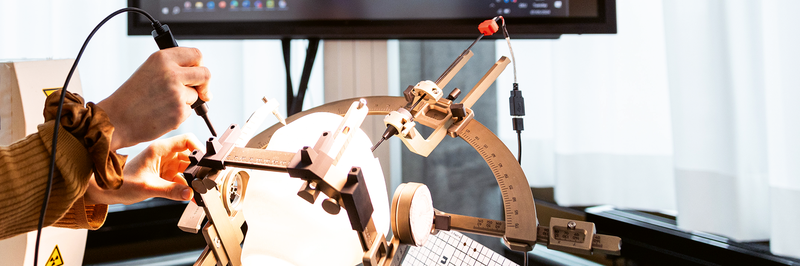
Vergne then set out to ensure the compatibility of her prototype with the surgical environment. In the operating lab at the FHNW School of Life Sciences in Muttenz, she recreated a DBS surgical set-up using a head phantom inside a stereotactic headset. For the electromagnetic navigation system, called ManaDBS, she added a system control unit, a magnetic field generator and a sensor interface unit connected to the DBS lead.

Electromagnetic perturbations from the magnetic field can throw off tracking. To address this, Vergne applied a new tracking principle to limit electromagnetic disturbances and ensure correct tracking of the electrode.

Implantation trials on an eggplant simulating brain tissue were performed in a recreated DBS surgical setup. This gave an initial idea of the sensor’s performance. The final step before transfer to the clinical environment is user-friendly software to visualise tracking in the operating room.

The system will then be tested at the University Hospital Basel during a surgical dress rehearsal. This environment can simulate the compatibility of the technology with the unique DBS operating the­atre, helping translate the prototype to the clinic.

If successful, a team of neurosurgeons at the University of Basel will test the technology in patients. Ultimately, the system may go through medical device approvals, led by a producer of neurosurgical or navigation instruments.

“It’s very exciting to have three fields coming together in this project: electronics, computer science and neuroscience” says Vergne. “This multidisciplinary approach and collaboration with partners are driving innovation forward.”

“This electromagnetic navigation system is a promising tool for the localisation of the DBS electrodes. We are hopeful that it will be integrat­ed into the surgical procedure and bring advan­tages for both patients and medical teams” says Dr. Ethan Taub, Neurosurgeon at the University Hospital Basel and external expert of the project.

Key facts


Patients / Target Groups:

Parkinson’s disease, essential tremor, dystonia, epilepsy, chronic pain

Partners and PhD Co-Directors:

University of Basel: Prof. Dr. med. Raphael Guzman, Chairman, Department of Neurosurgery

Université de Strasbourg: Prof. Dr. Morgan Madec,

Simulation and electronics systems

Financing:

SNSF 204448

Deep brain stimulation - Did you know?

In the late 1980s, a French breakthrough in neurosurgery, deep brain stimulation (DBS), opened new avenues for the treatment of movement disorders. DBS involves the implantation of electrodes and tiny neurostimulators in the brain. These devices send signals to specific targets in the motor regions, to help alleviate motor symptoms. 

DBS was approved by the FDA in 1997 for the treatment of Parkison’s Disease and essential tremor. It is now also used to treat dystonia, some obsessive-compulsive disorders, epilepsy and chronic pain. It may be combined with taking medicines, or offer an alternative to them. 


Contact
Simone Hemm-Ode

Prof. Dr. Simone Hemm-Ode

Lecturer in neural engineering
Phone
+41 61 228 56 89
E-Mail
simone.hemm@fhnw.ch
Joris Pascal

Prof. Dr. Joris Pascal

Team leader, Sensor Systems for Diagnosis and Therapy
Phone
+41 61 228 56 47
E-Mail
joris.pascal@fhnw.ch

School of
Life Sciences FHNW University of Applied Sciences and Arts Northwestern Switzerland

  • About the School
    • School
    • Degree Programmes
    • Continuing Education
    • Research
    • Events
  • Social Media
    • Facebook
    • Instagram
    • YouTube
    • LinkedIn
  • About FHNW
    • Organisation
    • Schools
    • Locations
    • FHNW Library
    • Media Relations
  • Support
    • IT Support
    • Inside FHNW
    • Webmail
Logo FHNW - 20 Years
Logo Swiss Universities
Logo European University Association
© University of Applied Sciences and Arts Northwestern Switzerland (FHNW)
  • Data Protection
  • Imprint
  • Accessibility
  • DE
  • EN