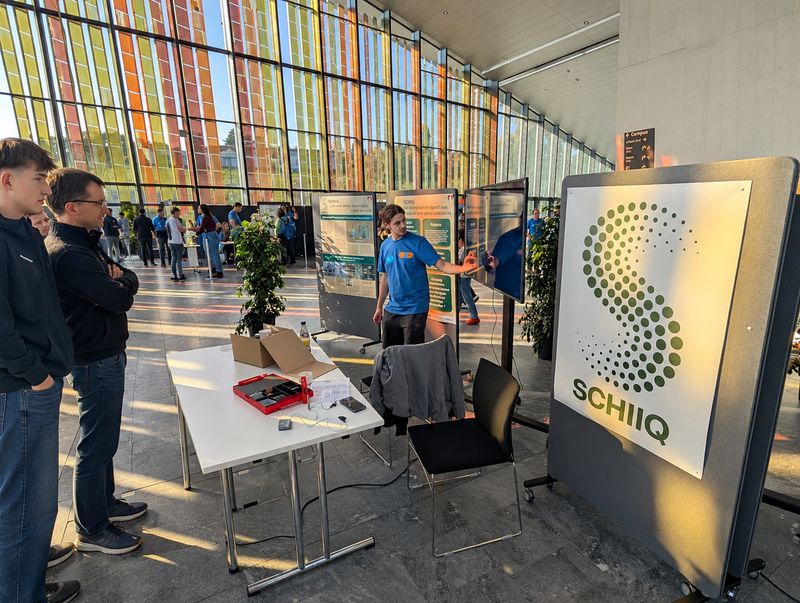
Quantum computers could fundamentally transform medicine and the development of new drugs, but the technology is expensive and remains accessible to only a few. Researchers at the FHNW School of Life Sciences and the EPFL want to change this. They are developing a quantum computer that fits on a desk, is expected to cost around CHF 2 000 and will give students worldwide hands-on access to quantum technology.
Bringing high-tech from the lab to the desk
A quantum computer which is accessible to most people. One that fits on an ordinary desk and needs just a drop of liquid to perform its first quantum computations. This unusual ambition lies at the heart of Schiiq, a project bringing together a team from the FHNW School of Life Sciences (HLS) and the École Polytechnique Fédérale de Lausanne (EPFL).
Behind the idea at the HLS is Prof. Clément Javerzac, who leads the Applied Quantum Compu-ting research group at the Institute for Medical Engineering and Medical Informatics. Together with the EPFL, the team aims to develop a quantum computer that is easy to use, portable and, above all, affordable.
The project has been accepted into EPFL's MAKE programme, which supports students in turn-ing innovative technical ideas into practical solutions. Schiiq is the first MAKE project dedicated to quantum computing.
The HLS is responsible for the overall scientific leadership and technical coordination. At the FHNW Muttenz campus, researchers are developing and testing the quantum computer's key components, supported by students from both institutions.
How can a quantum computer work with liquid?
Conventional computers process information using bits, which can have a value of either 0 or 1. Quantum computers work differently. They use so-called qubits, which, thanks to the laws of quantum physics, can exist in a combination of states simultaneously. This could one day enable quantum computers to solve certain highly complex problems much faster than conventional computers.
For Schiiq, the researchers are using a technology that has been applied in medicine for dec-ades: nuclear magnetic resonance (NMR). This also forms the basis of magnetic resonance imaging (MRI), which is used to produce images of the inside of the human body for example.
But what does this have to do with liquid?
Water consists of hydrogen and oxygen atoms. The nuclei of hydrogen atoms have a property that can be influenced by magnetic fields and this is precisely what the researchers are exploiting: by controlling the atomic nuclei with targeted signals, they can perform simple quantum computations.
What makes this approach particularly interesting is that the technology works at room temperature. This eliminates the need for the complex cooling systems required by many other quantum computers.
Although this method is not suitable for building particularly powerful quantum computers with large numbers of qubits, it is ideal for education and exploring fundamental quantum principles.
Precision engineering at the Muttenz campus
Building a quantum computer that is expected to cost just CHF 2 000 is a considerable technical challenge. This is where the expertise of the HLS comes into play.
Chevalier Kwon, a physicist and research associate in Applied Quantum Computing in Life Sciences is leading the project.
Specialised in quantum hardware, he coordinates the project's technical development and, along with other experts, supervises students from both the HLS and the EPFL.
One particular challenge is controlling atomic nuclei with high precision without relying on ex-pensive laboratory equipment.
To achieve this, the team is developing tiny coils measuring just a few millimetres across. These generate signals that allow the researchers to precisely manipulate the atomic nuclei in a drop of water.
The researchers also programme the necessary electronics themselves. They then compare the performance of their low-cost components with the highly precise measuring instruments available in the HLS labs in Muttenz.
The aim is not to outperform large quantum computers. Instead, the team wants to create a de-vice that allows students and researchers to experiment independently and understand how a quantum computer works.
What does quantum computing have to do with life sciences?
At first glance, quantum computing and life sciences may seem to have little in common but in fact, there are several important connections.
One lies in medical engineering. The technology on which Schiiq is based is already used for medical examinations and chemical analyses. Developing increasingly compact and affordable devices could therefore also benefit medical diagnostics.
For example, portable analytical devices could one day make it possible to examine blood or urine samples directly in a doctor's surgery, without the need for a large laboratory.
Quantum computers could have an even greater impact on biomedical research.
When developing new medicines, researchers need to understand how molecules are structured and how they interact. These calculations are extremely complex, pushing even powerful conventional computers to their limits.
In the future, quantum computers could help simulate these processes more accurately. This could be particularly valuable for developing new drugs, studying proteins or creating innovative medical materials.
The technology is still in its early stages. However, Prof. Dr. Clément Javerzac believes it is essential for future professionals in life sciences and medical engineering to engage with quantum computing early. This is why he already teaches the fundamentals of quantum computing in his courses at the HLS.
With Schiiq, students will not only learn how a quantum computer works in theory but will also have the opportunity to experiment with one themselves.
Advancing research in collaboration with the EPFL
Schiiq brings together the expertise of two higher education institutions. The HLS contributes its experience in quantum technologies, magnetic resonance and the development of medical engineering devices. EPFL complements these strengths with its expertise in physics, computer science and engineering.
The project idea emerged thanks to joint work between the FHNW School of Life Sciences and the EPFL. Today, students and researchers from both institutions are working together to bring it to life.
The Open Quantum Institute (OQI) at CERN is also part of the network. Its mission is to make quantum computing accessible to people around the world.
An important aspect of Schiiq is therefore its open-source approach. This means that the quantum computer's design and software will be freely available. Schools, universities and other interested parties will be able to build their own devices, develop them further and share their improvements with others.

First prototype expected in 2027
By the end of 2026, the researchers aim to complete the three main components of the quantum computer: a small probe, a device for generating and analysing signals, and the associated control software.
These components are expected to be assembled into the first functional quantum computer in 2027.
The crucial test will then follow: using a simple water sample, the computer will attempt to perform its first quantum operation. If successful, the team plans to develop the device further, gradually enabling it to operate with multiple qubits.
With Schiiq, the HLS and the EPFL aim to demonstrate that quantum computing does not have to remain confined to expensive specialist laboratories. At the same time, the project strengthens research in applied quantum technologies and opens up new opportunities for educating future professionals.
After all, those who want to help shape tomorrow's technologies should have the opportunity to understand and experiment with them today.

Applied quantum computing in life sciences
- Institute
- Institute for Medical Engineering and Medical Informatics
Contact

Prof. Dr. Clément Javerzac
- Phone
- +41 61 228 51 89
- clement.javerzac@fhnw.ch