Skip to main contentSkip to search barSkip to navigationSkip to footer
Logo of the University of Applied Sciences and Arts Northwestern Switzerland
  • DE
  • EN
  • Home

Ten Schools One Goal

The FHNW comprises 10 schools with different specializations. Select a school to see its specific courses, study programmes and information.

Applied Psychology

Architecture, Construction and Geomatics

Art and Design

Music

Computer Science

Life Sciences

School of Education

Social Work

Engineering and Environment

Business

  • Study offerings

    • All degree programmes
    • Master in Life Sciences
    • Master in Medical Informatics
    • Joint Degree Master in Biomedical Engineering
    • Info events
  • About degree programmes

    • Tuition fees and scholarships
    • Digital Life Sciences
  • International

    • Outgoing Students
    • Incoming Students
    • Double Degree
    • Partner universities
    • Student stories
    • Buddy programme
    • News and stories
  • Continuing education offerings

    • All continuing educations
    • CAS - Certificate of Advanced Studies
    • Modules and Seminars
    • Info events
  • Organisation

    • Consulting services
    • Legal information and terms & conditions
  • Research

    • Research fields
    • Projects
  • Collaboration

    • Process Technology Centre
    • Services
    • Tech Transfer Office
    • Student projects
  • International

    • Study abroad
    • International research projects
  • Updates and insights

    • News and stories
    • Research highlights
  • Events

    • All events
    • Info events
  • Media corner

  • About the School of Life Sciences

    • Strategy and values
    • Management board
    • Staff
    • Advisory board
    • People directory
    • Diversity and equal opportunities
    • Media corner
    • Infrastructure and campus
  • Institutes and centres

    • Institute for Chemistry and Bioanalytics
    • Institute for Ecopreneurship
    • Institute for Medical Engineering and Medical Informatics
    • Institute for Pharma Technology and Biotechnology
    • Centre for Teaching and Learning
    • Process Technology Centre
Logo of the University of Applied Sciences and Arts Northwestern Switzerland
  • About the School
    • School
    • Degree Programmes
    • Continuing Education
    • Research
    • Events
  • Social Media
    • Facebook
    • Instagram
    • YouTube
    • LinkedIn
  • About FHNW
    • Organisation
    • Schools
    • Locations
    • FHNW Library
    • Media Relations
  • Support
    • IT Support
    • Inside FHNW
    • Webmail
  • Data Protection
  • Imprint
  • Accessibility
  • Study offerings

    • All degree programmes
    • Master in Life Sciences
    • Master in Medical Informatics
    • Joint Degree Master in Biomedical Engineering
    • Info events
  • About degree programmes

    • Tuition fees and scholarships
    • Digital Life Sciences
  • International

    • Outgoing Students
    • Incoming Students
    • Double Degree
    • Partner universities
    • Student stories
    • Buddy programme
    • News and stories
  • Continuing education offerings

    • All continuing educations
    • CAS - Certificate of Advanced Studies
    • Modules and Seminars
    • Info events
  • Organisation

    • Consulting services
    • Legal information and terms & conditions
  • Research

    • Research fields
    • Projects
  • Collaboration

    • Process Technology Centre
    • Services
    • Tech Transfer Office
    • Student projects
  • International

    • Study abroad
    • International research projects
  • Updates and insights

    • News and stories
    • Research highlights
  • Events

    • All events
    • Info events
  • Media corner

  • About the School of Life Sciences

    • Strategy and values
    • Management board
    • Staff
    • Advisory board
    • People directory
    • Diversity and equal opportunities
    • Media corner
    • Infrastructure and campus
  • Institutes and centres

    • Institute for Chemistry and Bioanalytics
    • Institute for Ecopreneurship
    • Institute for Medical Engineering and Medical Informatics
    • Institute for Pharma Technology and Biotechnology
    • Centre for Teaching and Learning
    • Process Technology Centre

Type a search term and search continuing education,degree programmes, events, documents and other content.

  • Life Sciences
  • News and events
  • News and Stories
  • All news and stories
All news and stories

Testing brain medicines in the fast lane, FHNW School of Life Sciences

30.4.2025 – School of Life Sciences, Institute for Chemistry and Bioanalytics


New in vitro model of the blood-brain barrier helps pharma identify promising candidates

  • Story

The need for brain therapeutics is great, and many pharmaceutical companies are developing drugs. To test these novel medicines, clinically relevant models that measure their ability to cross the blood-brain barrier are needed.

In vitro models are cells grown inside a special device that mimics how an organ, or part of it, functions. Prof. Dr. Laura Suter-Dick’s team at the Institute for Chemistry and Bioanalytics has deep expertise in developing liver models to test the safety of new medicines, while reducing and replacing the need to use animals for example.

Backed by this strong foundation in advanced in vitro models and new approach methodologies (NAMs), postdoctoral researcher Dr. Floriana Burgio from Suter-Dick’s cell biology group, in collaboration with scientists from UCB Pharma Belgium, set out to create a model of the blood-brain barrier using induced pluripotent stem cells (iPSC). These immature cells can be differen­tiated into any cell type, making them versatile for research.

  • Floriana_Burgio_BBB_Model_1200X800.png
    Research associate Floriana Burgio seeds brain microvascular endothelial cells in an OrganoPlate-3 lane (Mimetas) to create a model of the blood-brain barrier.
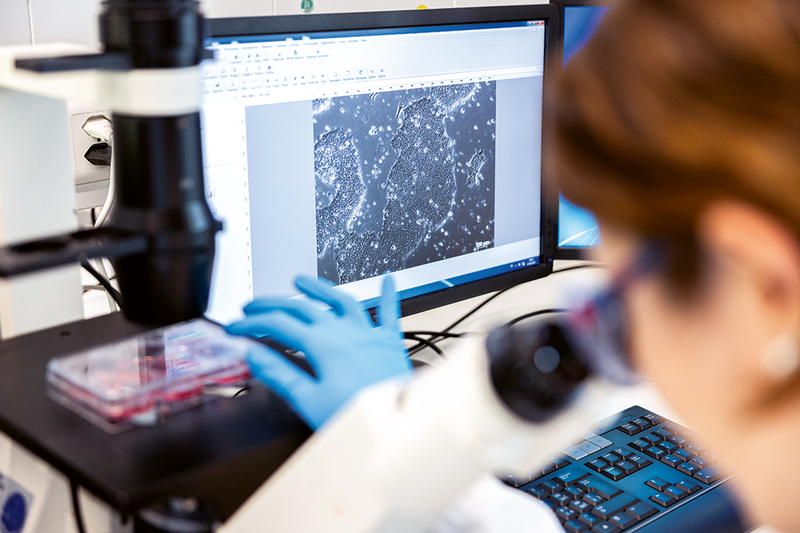
  • Floriana_Burgio_BBB_Model_Differentiation_1200X800.png
    Burgio assesses if the induced pluripotent stem cells are dense enough to start differentiation into brain microvascular endothelial cells.

The model implemented by Dr. Burgio features a single cell type: brain microvascular endothelial cells (BMEC) derived from iPSC. She grew the model in an OrganoPlate® (Mimetas) and con­ducted tests to confirm that it mimics barrier tightness. The model features a top channel with endothelial cells, a middle channel with extra-cel­lular matrix, and an empty bottom channel. Test molecules are perfused into the top channel; those that bind and pass are collected in the bottom channel. The system is compatible with automated fluid handling and allows the evalua­tion of 40 chips simultaneously.

“When tested in our BBB model, we showed that a molecule which binds to the transferrin receptor has an 11-fold increase in crossing the barrier compared to a control molecule that does not bind” says Burgio. “This established that our model exhibits functional transferrin receptor-mediated uptake and transcytosis.”

The project was conducted in collaboration with UCB Pharma Belgium, a leader in medicines for neurological, immune and rare diseases.

“Not only did this project enable us to develop a model that UCB Pharma Belgium can use as part of their drug screening process; it also allowed the FHNW School of Life Sciences to break new ground in designing in vitro models with induced pluripotent stem cells, propelled by the latest microfluidic technologies” says group leader Prof. Dr. Laura Suter Dick.

The FHNW’s model of the BBB represents a great step forward towards testing the ability of potential drug candidates to enter the brain. In the end, such a model can improve preclinical testing of future medicines from both an efficacy but also a safety point of view.
Rainer Class, Associ­ate Director of In vitro ADME, UCB Pharma

Key facts


Partners:

UCB Pharma Belgium

The blood-brain barrier: Did you know?

Our brain is protected by a layer of tightly woven endothelial cells that line the brain’s blood vessels, called the blood-brain barrier. These cells block foreign agents such as pathogens from entering our body’s command centre. At the same time, nutrients that the brain needs are allowed to pass, via a process called receptor-mediated transcytosis (RMT). Receptors on the surface of endothelial cells recognise and bind to nutrients, and carry them into the brain.

The barrier also prevents some therapeutics from reaching disease targets in the brain. Medicines that can successfully enter the brain include anesthetics, antidepressants and antipsychotics. A great need remains however for therapies to treat Alzheimer’s, ALS, Parkinson’s, brain cancers and more. Biologic drugs could offer hope, but strategies must be devised to sneak these large molecules past the barrier using RMT.


Contact
Laura Suter-Dick

Prof. Dr. Laura Suter-Dick

Team Leader, Cell Biology and in vitro Toxicology
Phone
+41 61 228 56 59
E-Mail
laura.suterdick@fhnw.ch

School of
Life Sciences FHNW University of Applied Sciences and Arts Northwestern Switzerland

  • About the School
    • School
    • Degree Programmes
    • Continuing Education
    • Research
    • Events
  • Social Media
    • Facebook
    • Instagram
    • YouTube
    • LinkedIn
  • About FHNW
    • Organisation
    • Schools
    • Locations
    • FHNW Library
    • Media Relations
  • Support
    • IT Support
    • Inside FHNW
    • Webmail
Logo FHNW - 20 Years
Logo Swiss Universities
Logo European University Association
© University of Applied Sciences and Arts Northwestern Switzerland (FHNW)
  • Data Protection
  • Imprint
  • Accessibility
  • DE
  • EN