Skip to main contentSkip to search barSkip to navigationSkip to footer
Logo of the University of Applied Sciences and Arts Northwestern Switzerland
  • DE
  • EN
  • Home

Ten Schools One Goal

The FHNW comprises 10 schools with different specializations. Select a school to see its specific courses, study programmes and information.

Applied Psychology

Architecture, Construction and Geomatics

Art and Design

Music

Computer Science

Life Sciences

School of Education

Social Work

Engineering and Environment

Business

  • Study offerings

    • All degree programmes
    • Master in Life Sciences
    • Master in Medical Informatics
    • Joint Degree Master in Biomedical Engineering
    • Info events
  • About degree programmes

    • Tuition fees and scholarships
    • Digital Life Sciences
  • International

    • Outgoing Students
    • Incoming Students
    • Double Degree
    • Partner universities
    • Student stories
    • Buddy programme
    • News and stories
  • Continuing education offerings

    • All continuing educations
    • CAS - Certificate of Advanced Studies
    • Modules and Seminars
    • Info events
  • Organisation

    • Consulting services
    • Legal information and terms & conditions
  • Research

    • Research fields
    • Projects
  • Collaboration

    • Process Technology Centre
    • Services
    • Tech Transfer Office
    • Student projects
  • International

    • Study abroad
    • International research projects
  • Updates and insights

    • News and stories
    • Research highlights
  • Events

    • All events
    • Info events
  • Media corner

  • About the School of Life Sciences

    • Strategy and values
    • Management board
    • Staff
    • Advisory board
    • People directory
    • Diversity and equal opportunities
    • Media corner
    • Infrastructure and campus
  • Institutes and centres

    • Institute for Chemistry and Bioanalytics
    • Institute for Ecopreneurship
    • Institute for Medical Engineering and Medical Informatics
    • Institute for Pharma Technology and Biotechnology
    • Centre for Teaching and Learning
    • Process Technology Centre
Logo of the University of Applied Sciences and Arts Northwestern Switzerland
  • About the School
    • School
    • Degree Programmes
    • Continuing Education
    • Research
    • Events
  • Social Media
    • Facebook
    • Instagram
    • YouTube
    • LinkedIn
  • About FHNW
    • Organisation
    • Schools
    • Locations
    • FHNW Library
    • Media Relations
  • Support
    • IT Support
    • Inside FHNW
    • Webmail
  • Data Protection
  • Imprint
  • Accessibility
  • Study offerings

    • All degree programmes
    • Master in Life Sciences
    • Master in Medical Informatics
    • Joint Degree Master in Biomedical Engineering
    • Info events
  • About degree programmes

    • Tuition fees and scholarships
    • Digital Life Sciences
  • International

    • Outgoing Students
    • Incoming Students
    • Double Degree
    • Partner universities
    • Student stories
    • Buddy programme
    • News and stories
  • Continuing education offerings

    • All continuing educations
    • CAS - Certificate of Advanced Studies
    • Modules and Seminars
    • Info events
  • Organisation

    • Consulting services
    • Legal information and terms & conditions
  • Research

    • Research fields
    • Projects
  • Collaboration

    • Process Technology Centre
    • Services
    • Tech Transfer Office
    • Student projects
  • International

    • Study abroad
    • International research projects
  • Updates and insights

    • News and stories
    • Research highlights
  • Events

    • All events
    • Info events
  • Media corner

  • About the School of Life Sciences

    • Strategy and values
    • Management board
    • Staff
    • Advisory board
    • People directory
    • Diversity and equal opportunities
    • Media corner
    • Infrastructure and campus
  • Institutes and centres

    • Institute for Chemistry and Bioanalytics
    • Institute for Ecopreneurship
    • Institute for Medical Engineering and Medical Informatics
    • Institute for Pharma Technology and Biotechnology
    • Centre for Teaching and Learning
    • Process Technology Centre

Type a search term and search continuing education,degree programmes, events, documents and other content.

Tracking the patterns, FHNW School of Life Sciences

12.12.2017 – School of Life Sciences, Institute for Medical Engineering and Medical Informatics


  • Life Sciences
  • News and events
  • News and Stories
  • All news and stories
All news and stories
header_Muster.png

Evaluation program makes CT and MRI scans cheaper and more ecological

  • Story

Imaging with computer tomography and magnetic resonance tomography is an integral part of modern medicine. In 2014, Swiss radiologists did more than 800,000 CT scans and more than half a million MRIs and the trend is growing. The equipment used contributes significantly to electricity consumption in hospitals. Researchers at the HLS are developing an evaluation program to make these examinations cheaper and more ecological.

Dominique Brodbeck and Markus Degen from the Institute of Medical Engineering and Medical Informatics bring their experience in developing software for hospitals to the project. For example, they have developed software for hospital managers to trace patient movements between examinations. The data is used to plan future infrastructure and help improve daily routines in both the clinic and administration. The current project also focuses on optimising hospital operation, this time with energy efficiency and cost savings in mind.

Together with a software developer, the two researchers have created a computer program that shows the energy consumption of imaging examinations in hospitals. The focus is on radiological departments, whose MRI and CT devices consume a million kilowatt hours per year – the equivalent of around 250 households. Brodbeck speaks of two reasons for the GreenRad project, run in cooperation with Basel University Hospital: “One is economic: with ever more equipment and rising prices, electricity bills in radiology are soaring. The other is an ethical drive to reduce CO2 footprints and with them, damage to the environment.”

Electricity consumption is not the only factor in reducing energy costs. The maximum power capacity must also be paid for and that depends on how much total power the hospital uses at one time. “In order to reduce energy consumption, you have to be able to say how much energy is used by one machine per time unit, per examination and in standby,” explains Brodbeck. “It is not enough to just look at the current curve. That is why we use different data sources.”

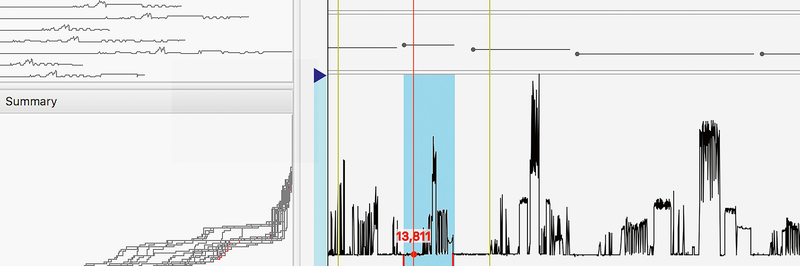
In addition to electricity consumption, the scientists also collect operation data from the cooling system, activity records for each machine, as well as clinical data on the type of examinations. GreenRad can correlate and present these data quickly and interactively, allowing users to monitor energy consumption patterns and to determine their frequency and characteristics.

IT engineer Degen sees this approach as fundamentally different compared to conventional handling of large amounts of data: “Data mining is usually used with correlation algorithms to find patterns automatically. We use humans as a recognition algorithm; people not computers recognize recurring processes and patterns. Our thesis is that there are many questions where only people can make sound decisions. We present the data on a plate and provide the software tools.”

In order for the data to end up on that plate, a considerable effort is required, says Degen: “The data isn’t consistent at all at first, either in time or in content: it must be aligned.” Once this has been done, the data must be visualized in such a way that the relevant information can be extracted. Brodbeck describes the requirements of the program: “It must be interactive and visually clear so that you can find information quickly if you have an idea.”

The system test in Basel already revealed energy consumption trends: in standby mode, a machine consumes constant current, just like a TV. During an examination, power consumption rises to peak level from less than a second up to a few minutes. Here, Degen sees improvement potential: “A high-level control system could synchronize all machine operations of less than one second so that high current consumption occurs in series and not in parallel.” This could significantly reduce the maximum power capacity needed.

GreenRad’s key ability to make patterns visible comes to the fore when reducing total electricity consumption and thus the CO2 footprint. Degen cites an example: “We counted up to twenty calibration sequences during CT scans. This could probably be reduced.” He is sure that the program has even wider potential: the researchers used their software to test the log files of computer programs. Because they wrote the program, they can determine all variables and data types themselves. As a result, there are virtually no limits to the possible applications.

Methodology

  • Exploratory Data Analysis
  • Interactive Visualization
  • In-Memory Processing

Infrastructure

  • Software tools for data processing and correlation (in some cases developed in-house)
  • Modern software development environment with version management system, automated creation and tests on our own server systems

Collaboration

  • University Hospital of Basel, Radiology & Nuclear Medicine Clinic
Contact

Dominique Brodbeck

Prof. Dr. Dominique Brodbeck

Lecturer
Phone
+41 61 228 56 52
E-Mail
dominique.brodbeck@fhnw.ch
Markus Degen

Prof. Markus Degen

Lecturer in medical computer sciences
Phone
+41 61 228 56 53
E-Mail
markus.degen@fhnw.ch

School of
Life Sciences FHNW University of Applied Sciences and Arts Northwestern Switzerland

  • About the School
    • School
    • Degree Programmes
    • Continuing Education
    • Research
    • Events
  • Social Media
    • Facebook
    • Instagram
    • YouTube
    • LinkedIn
  • About FHNW
    • Organisation
    • Schools
    • Locations
    • FHNW Library
    • Media Relations
  • Support
    • IT Support
    • Inside FHNW
    • Webmail
Logo FHNW - 20 Years
Logo Swiss Universities
Logo European University Association
© University of Applied Sciences and Arts Northwestern Switzerland (FHNW)
  • Data Protection
  • Imprint
  • Accessibility
  • DE
  • EN