Skip to main contentSkip to search barSkip to navigationSkip to footer
Logo of the University of Applied Sciences and Arts Northwestern Switzerland
  • DE
  • EN
  • Home

Ten Schools One Goal

The FHNW comprises 10 schools with different specializations. Select a school to see its specific courses, study programmes and information.

Applied Psychology

Architecture, Construction and Geomatics

Art and Design

Music

Computer Science

Life Sciences

School of Education

Social Work

Engineering and Environment

Business

  • Study offerings

    • All degree programmes
    • Master in Life Sciences
    • Master in Medical Informatics
    • Joint Degree Master in Biomedical Engineering
    • Info events
  • About degree programmes

    • Tuition fees and scholarships
    • Digital Life Sciences
  • International

    • Outgoing Students
    • Incoming Students
    • Double Degree
    • Partner universities
    • Student stories
    • Buddy programme
    • News and stories
  • Continuing education offerings

    • All continuing educations
    • CAS - Certificate of Advanced Studies
    • Modules and Seminars
    • Info events
  • Organisation

    • Consulting services
    • Legal information and terms & conditions
  • Research

    • Research fields
    • Projects
  • Collaboration

    • Process Technology Centre
    • Services
    • Tech Transfer Office
    • Student projects
  • International

    • Study abroad
    • International research projects
  • Updates and insights

    • News and stories
    • Research highlights
  • Events

    • All events
    • Info events
  • Media corner

  • About the School of Life Sciences

    • Strategy and values
    • Management board
    • Staff
    • Advisory board
    • People directory
    • Diversity and equal opportunities
    • Media corner
    • Infrastructure and campus
  • Institutes and centres

    • Institute for Chemistry and Bioanalytics
    • Institute for Ecopreneurship
    • Institute for Medical Engineering and Medical Informatics
    • Institute for Pharma Technology and Biotechnology
    • Centre for Teaching and Learning
    • Process Technology Centre
Logo of the University of Applied Sciences and Arts Northwestern Switzerland
  • About the School
    • School
    • Degree Programmes
    • Continuing Education
    • Research
    • Events
  • Social Media
    • Facebook
    • Instagram
    • YouTube
    • LinkedIn
  • About FHNW
    • Organisation
    • Schools
    • Locations
    • FHNW Library
    • Media Relations
  • Support
    • IT Support
    • Inside FHNW
    • Webmail
  • Data Protection
  • Imprint
  • Accessibility
  • Study offerings

    • All degree programmes
    • Master in Life Sciences
    • Master in Medical Informatics
    • Joint Degree Master in Biomedical Engineering
    • Info events
  • About degree programmes

    • Tuition fees and scholarships
    • Digital Life Sciences
  • International

    • Outgoing Students
    • Incoming Students
    • Double Degree
    • Partner universities
    • Student stories
    • Buddy programme
    • News and stories
  • Continuing education offerings

    • All continuing educations
    • CAS - Certificate of Advanced Studies
    • Modules and Seminars
    • Info events
  • Organisation

    • Consulting services
    • Legal information and terms & conditions
  • Research

    • Research fields
    • Projects
  • Collaboration

    • Process Technology Centre
    • Services
    • Tech Transfer Office
    • Student projects
  • International

    • Study abroad
    • International research projects
  • Updates and insights

    • News and stories
    • Research highlights
  • Events

    • All events
    • Info events
  • Media corner

  • About the School of Life Sciences

    • Strategy and values
    • Management board
    • Staff
    • Advisory board
    • People directory
    • Diversity and equal opportunities
    • Media corner
    • Infrastructure and campus
  • Institutes and centres

    • Institute for Chemistry and Bioanalytics
    • Institute for Ecopreneurship
    • Institute for Medical Engineering and Medical Informatics
    • Institute for Pharma Technology and Biotechnology
    • Centre for Teaching and Learning
    • Process Technology Centre

Type a search term and search continuing education,degree programmes, events, documents and other content.

Treasures in production waste, FHNW School of Life Sciences

12.12.2019 – School of Life Sciences, Institute for Ecopreneurship


  • Life Sciences
  • News and events
  • News and Stories
  • All news and stories
All news and stories
Teaser_scandium.jpg

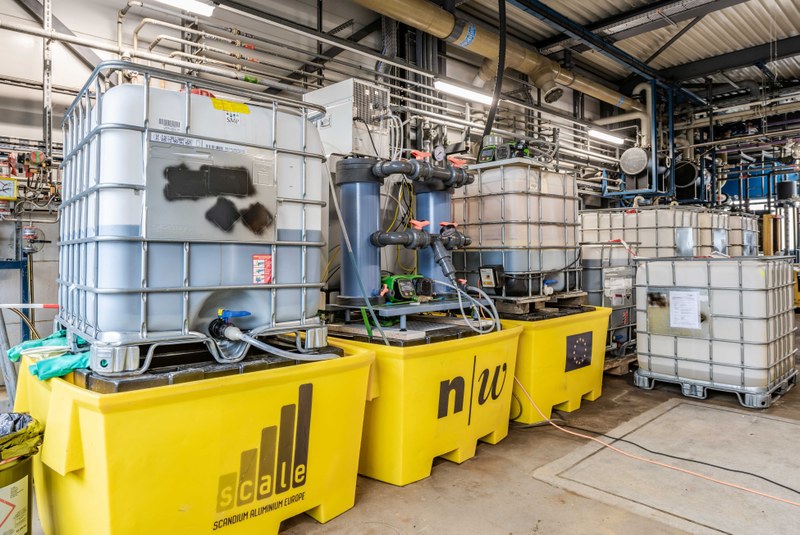
Filtration process for recovering the rare earth metal scandium from acidic industrial wastewater

  • Story

Scandium is a critical raw material, and yet it ends up on landfill sites - for example in form of industrial waste from white pigment and aluminium production. The pan-European research cooperation SCALE aims to recover valuable scandium from industrial waste and establish new European supply chains. SCALE stands for «Production of Scandium compounds and scandium aluminium alloys from European metallurgical by-products» and is funded by Horizon 2020.

The FHNW School of Life Sciences is participating in the project together with its partner GETEC PARK.SWISS AG. In a pilot test in the industrial halls of the chemical park, FHNW chemist Sebastian Hedwig is testing whether scandium can be extracted from strongly acidic process waste water by means of filtration. The promising laboratory experiments at HLS are intended to prove the practical applicability of the process at a larger scale and advance the technological maturity of scandium recovery, in line with the need for action across Europe.

More sustainable aircraft and fuel cells

Scandium is important to many industries, especially the aerospace industry, where it improves the strength and weldability of aluminium alloys, enabling the construction of lighter and more fuel efficient aircrafts. Through its use in solid oxide fuel cells, scandium is also important for alternative power generation. «This is an element with great potential, but there is not an adequate supply,» says environmental biotechnologist Markus Lenz of the FHNW.

Europe does not have yet exploitable natural scandium deposits, but it does have many millions of tonnes of waste from aluminium production and the manufacture of the white pigment titanium dioxide. «This waste also contain valuable scandium in small quantities», explains Lenz.

If European countries tap into these secondary scandium sources, we will have a double profit. Waste is processed in a useful way and we give the aviation and high-tech industry in Europe a certain independence.
Markus Lenz, Group Leader, Applied Circular Economy

A successful cooperation


«For our tests, we received process wastewater from white pigment production in the Netherlands. We removed interfering substances from this wastewater and then concentrated the liquid so that it contains a particularly large amount of scandium,» explains Hedwig. The tests are performed at GETEC PARK.SWISS's chemical park using numerous cubic metre plastic tanks. The brown acidic wastewater broth in one of the tanks is environmentally unfriendly: it is corrosive and contains a cocktail of metals. For GETEC PARK.SWISS the handling of such substances is part of everyday business. With its infrastructure, high safety and environmental standards and the know-how of its employees, the chemical park is an important development partner that bridges the gap between laboratory and industry. HLS's scandium research is also in line with GETEC PARK.SWISS AG's «Waste to Value» corporate philosophy, i.e. recognising waste as a possible resource: You eliminate it and gain something.

Several filtration steps retain scandium

Sebastian Hedwig has designed his experimental plant in such a way that a clear, scandium-rich liquid is produced from the acidic wastewater broth. He achieves this with a multi-stage filtration system. First, the acidic process wastewater is pre-treated, followed by microfiltration using special filter bags. These filter bags filter out particles larger than one micrometre. Subsequently, those particles smaller than one micrometre are removed by ultrafiltration. The last and most important stage is nanofiltration.

«The special thing about nanofiltration is that it does not screen out particles but charged particles,» explains Hedwig. «We know that scandium in a solution is always triple positively charged. However, a nanofiltration membrane only allows single-charged ions to pass through, so scandium is retained.» The larger and more strongly charged a molecule is, the less passes through the membrane and is lost. With the multi-stage filtration process, the researchers were able to reduce the volume of the original process wastewater by 60-70 percent under laboratory conditions and obtained a concentrate with more than twice as much scandium as at the beginning of the filtration.

The design of the test plant and the selection of suitable materials were decisive for the success of the project. «Since we work with a pressure of 35 bar, we could not use plastic parts,» explains Hedwig. «These would not withstand the pressure. In addition, the materials must be acid-resistant over a long period of time and must not corrode».

The pilot test provides important data to identify possible bottlenecks in the process that would not be visible on a laboratory scale. For example, it has already been shown that microfiltration works less well in the pilot test and the filters have to be changed more often. Nevertheless, the first wastewater was successfully treated on a cubic meter scale. This concentrate is now being refined into a pure scandium product by other project partners. Thanks to the close cooperation of European teams of experts, scandium is thus being produced for the first time in tangible quantities from European waste.


Contact
Markus Lenz

Dr. Markus Lenz

Team leader and lecturer, Applied Circular Economy
Phone
+41 61 228 56 86
E-Mail
markus.lenz@fhnw.ch
Sebastian Hedwig

Dr. Sebastian Hedwig

Research Associate
Phone
+41 61 228 53 85
E-Mail
sebastian.hedwig@fhnw.ch

School of
Life Sciences FHNW University of Applied Sciences and Arts Northwestern Switzerland

  • About the School
    • School
    • Degree Programmes
    • Continuing Education
    • Research
    • Events
  • Social Media
    • Facebook
    • Instagram
    • YouTube
    • LinkedIn
  • About FHNW
    • Organisation
    • Schools
    • Locations
    • FHNW Library
    • Media Relations
  • Support
    • IT Support
    • Inside FHNW
    • Webmail
Logo FHNW - 20 Years
Logo Swiss Universities
Logo European University Association
© University of Applied Sciences and Arts Northwestern Switzerland (FHNW)
  • Data Protection
  • Imprint
  • Accessibility
  • DE
  • EN