Gas chromatography-mass spectrometry for substance analysis
Gas chromatography-mass spectrometry (GC-MS) is a specialised analytical technique used to separate complex mixtures, quantify analytes, identify peaks and determine traces of contaminants. It is used in a range of applications, including food analysis, residue analysis, environmental analysis, toxicology and others.
We offer GC-MS services for large companies, start-ups, universities and other partners. Collaborative projects are always tailored to the specific problem at hand. Our work covers the entire spectrum, from sample preparation and development to method validation (if requested by the customer), analysis and evaluation.
Substance classes
We analyse volatile and gaseous substances, as well as less volatile substances after derivatisation.
- Flavourings
- Solvents
- Pesticides
- Fats and oils
- Residues (e.g. in drinking water)
- Metabolites
- Hormones
A look inside the facility
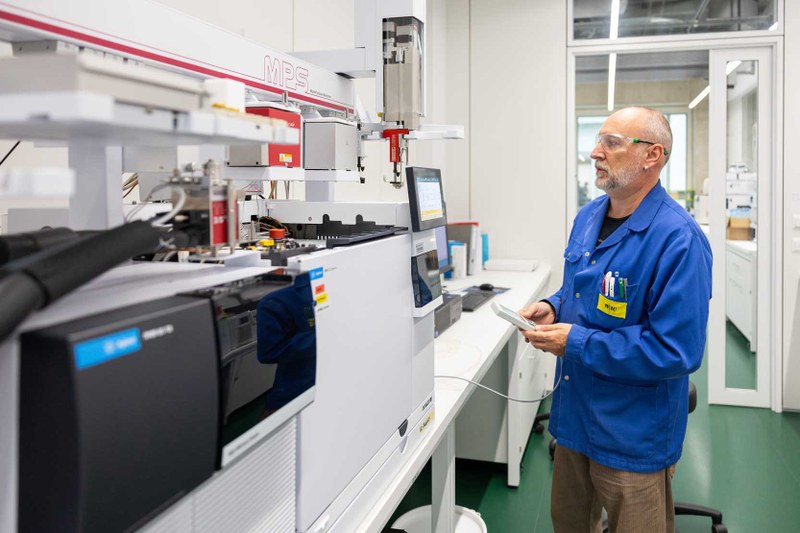
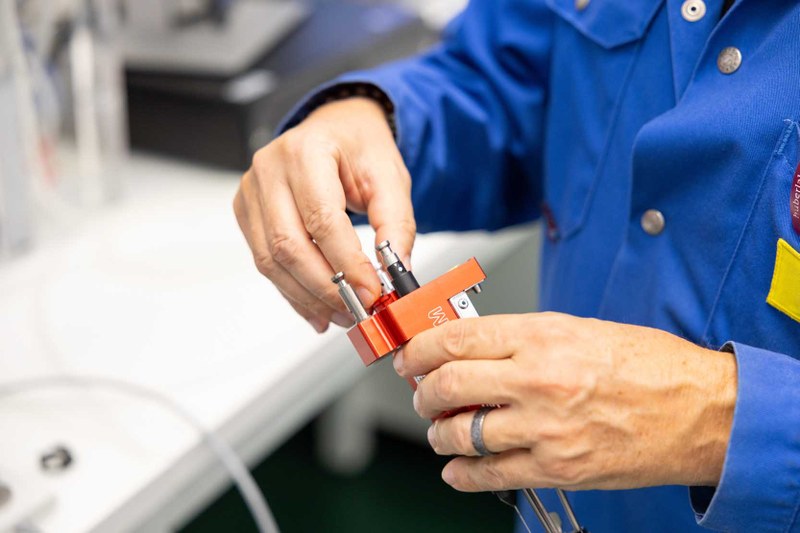
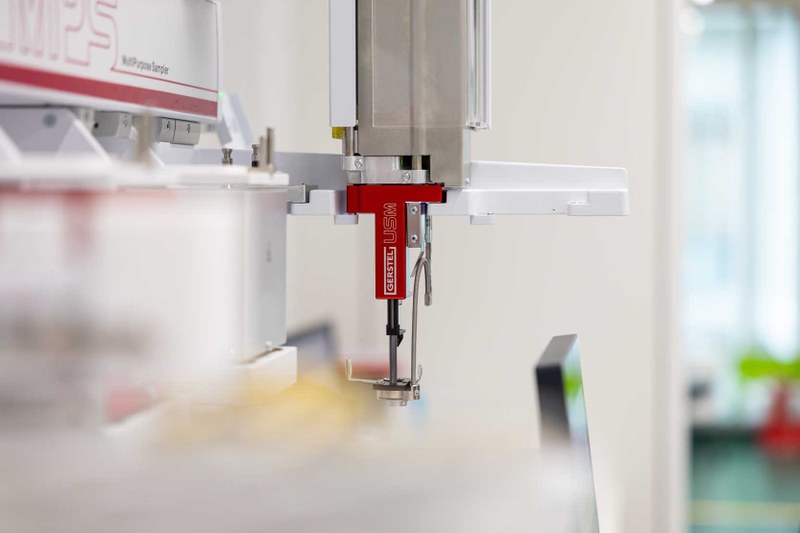
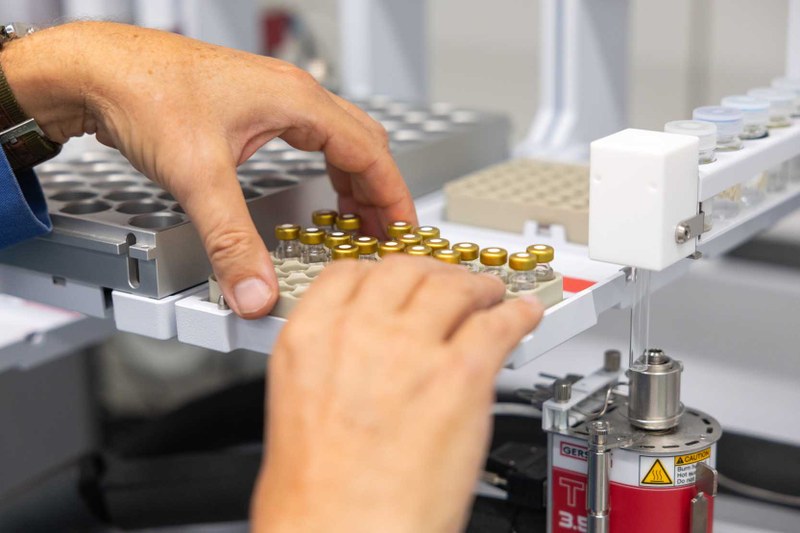
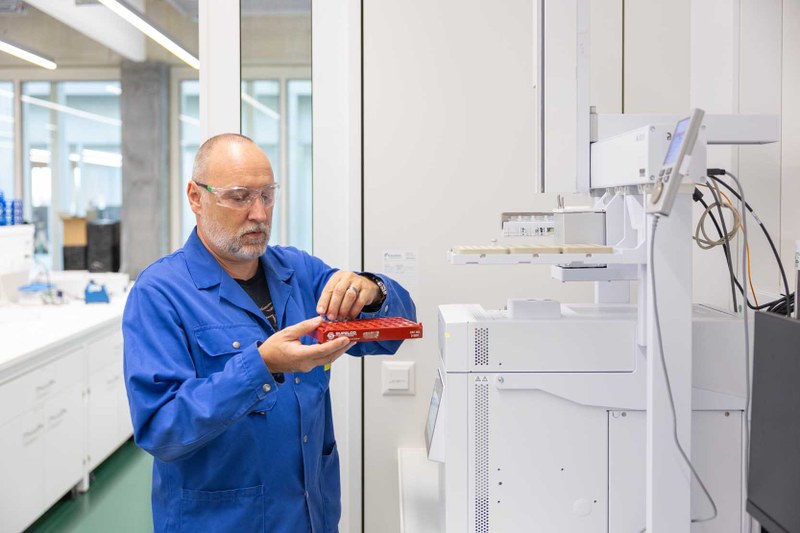
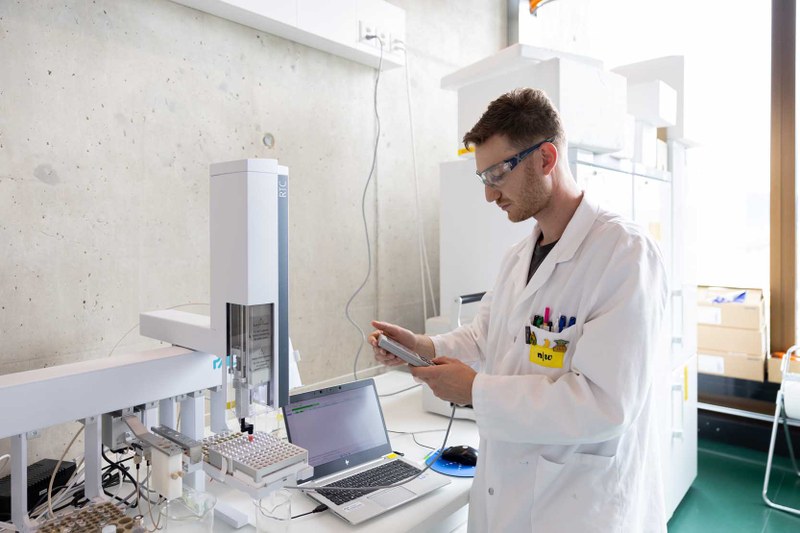
Automated sample preparation with the PAL system 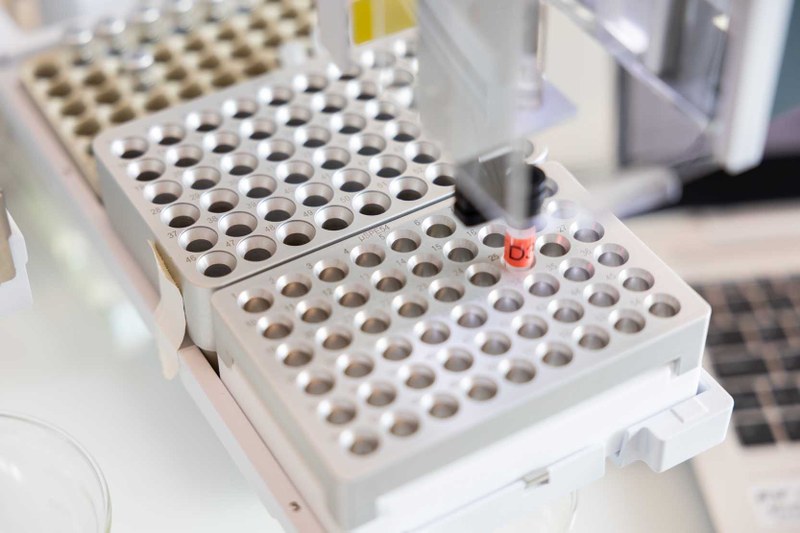
Automated sample preparation with the PAL system
Equipment
GC Agilent 8850 PAL 3
- Fatty Acid Methyl Ester (FAME analysis) capabilities
- Fast wash station
- Hydrogen carrier gas
GC Agilent 7890B, Leco Pegasus BT ToF, Gerstel PAL
- Laboratory Equipment Corporation Pegasus Benchtop Time-of-Flight (Leco Pegasus BT ToF) ready for Hydrogen carrier gas
- Gerstel Prep and Load (Gerstel PAL) system
- Automated Liner Exchange (ALEX)
- Maestro and ChromaTOF control software
GC Agilent 7890A, MS Agilent 5975C, CTC Kombi PAL
- Dual-pathway gas chromatography system capable of running two distinct analytical methods or sample introduction techniques simultaneously or independently
- Multimode inlet (MMI) and split/splitless inlet (SSLI)
- Solid-phase microextraction (SPME)
- Headspace (HS)
- MS channel for complex identification and trace-level analysis with Helium carrier
- Flame ionization detector (FID) channel for general organic compound quantification with Hydrogen carrier
GC Agilent 8890, MS Agilent 5977B, Gerstel PAL RTC
- Programmable temperature vaporiser (PTV) and multimode inlet (MMI)
- Thermal desorption unit (TDU) 2 attachment
- Robotic tool changer (RTC)
- Solid-phase microextraction (SPME)
- Headspace (HS)
- In-tube extraction (ITEX)
- Pyrolysis GC-MS with Helium carrier
GC Agilent 8890, MS Agilent 7010D TQ, Gerstel MPS Sampler
- Programmable temperature vaporisor (PTV)
- Split/Splitless Inlet (SSLI)
- Thermal desorption unit (TDU) 3.5
- Robotic tool changer (RTC)
- Solid-phase microextraction (SPME) arrow
- In-tube extraction (ITEX)
- Thermal desorption unit (TDU) and multi-position evaporation station (mVap) for automated sample preparation
- Helium carrier gas
GC Agilent 8850, MS Agilent 5977B, PAL RSI 50
- High efficiency ion source (HES)
- Headspace (HS)
- Solid phase microextraction (SPME) arrow
- In-tube extraction (ITEX)
- Helium carrier
GC Agilent 7890A, MS Agilent 5977A, CTC PAL
- Solid phase microextraction (SPME)
- Headspace (HS)
- 2 programmable temperature vaporiser (PTV) inlets
- Olfactory detection port (ODP)
- Hydrogen carrier
GC Agilent 7820A
- Split/splitless inlet (SSLI)
- Flame ionization detector (FID) channel
- Hydrogen carrier
GC Agilent 7890A CTC CombiPAL
- 2 channel system
- Headspace (HS) channel in the middle
- Fluid injection at the front
- Hydrogen carrier
GC Agilent 7890B CTC RTC PAL3
- Flame ionization detector (FID)
- Thermal conductivity detector (TCD)
- Robotic tool changer (RTC) Headspace (HS) tool
- Liquid injection
- Gas flow cell tool
- Breath gas analysis with Exetainer
- Argon carrier
GC Agilent Intuvo X2
- Split/splitless inlet (SSLI)
- Flame ionization detector (FID) channel
- Hydrogen carrier
GC Agilent 7890B
- Split/splitless inlet (SSLI)
- Flame ionization detector (FID) channel
- Hydrogen carrier
GC-Agilent 7890A
- Split/splitless inlet (SSLI)
- Flame ionization detector (FID) channel
- Hydrogen carrier
Contact

FHNW School of Life Sciences
FHNW University of Applied Sciences and Arts Northwestern Switzerland
School of Life Sciences
Hofackerstrasse 30
CH - 4132 Muttenz