Detecting and measuring substances in water and soil by LC-MS and ion chromatography
Households, industry and agriculture release a wide variety of substances into the environment. To safeguard the health of people and animals, and to protect our water and soils, these substances must be monitored and their degradation assessed.
We support national, cantonal and local governments with measuring substances in wastewater and the environment. We also develop and test new methods for trace analysis, in collaboration with wastewater treatment facilities and environmental management organisations.
Expertise and services
Substance classes
Working with water or soil samples, we can detect and measure substances arising from a wide range of sources:
- Medicines
- Pesticides
- Industrial chemicals
- PFAS
- Household chemicals
- Cosmetic products and sunscreens
Indicator substances
Wastewater treatment plants use indicator substances, which are organic micropollutants (OMPs), to assess their treatment efficiency. These substances include:
- Amisulpride
- Carbamazepine
- Citalopram
- Clarithromycin
- Diclofenac
- Hydrochlorothiazide
- Metoprolol
- Venlafaxine
- Benzotriazole
- Candesartan
- Irbesartan
- 4- and 5-methylbenzotriazole
We can analyse these substances in aqueous samples before and after the treatment stages of the wastewater treatment process. Using direct injection, we can quantify concentrations of at least 20 ng/L and detect concentrations as low as 5 ng/L.
PFAS measurement
We can detect and quantify a broad range of PFAS compounds, including several substances on the European PFAS-20 list, such as:
- Perfluorobutanoic acid (PFBA)
- Perfluorohexanoic acid (PFHxA)
- Perfluorooctanoic acid (PFOA)
- Perfluorobutanesulfonic acid (PFBS)
- Perfluorohexanesulfonic acid (PFHxS)
- Perfluorooctanesulfonic acid (PFOS)
- And more
With direct injection, we can quantify concentrations of approximately 10 ng/L. If samples are concentrated, we can quantify to approximately 0.5 ng/L.
Infrastructure
We use both LC-MS and ion chromatography to detect and measure substances in water and soil.
LC-MS allows contaminants to be quantified at very low levels, such as nanograms per litre (ng/L). This method combines the separation capabilities of high-performance liquid chromatography (HPLC) with the highly sensitive detection of a mass spectrometer (MS).
Ion chromatography is best used to analyse inorganic ions like chloride, sulphate, nitrate, sodium, or ammonium. It’s ideal for matrices like wastewater and soil that contain high salt levels, which can contaminate LC-MS systems. It also offers costs advantages over LC-MS and in some cases, is the method required by regulatory norms.
Samples can be processed by direct injection (using the sample as it is) or by concentrating them before analysis. To measure at the picograms per litre (pg/L) scale, we concentrate samples first using solid-phase extraction (SPE).
We provide advice to our partners on the best analysis method and sample processing technique based on their needs.
Equipment
- LC-MS 1: Agilent 1290 Infinity III Ultra High-Performance Liquid Chromatography (UHPLC) with Mass Spectrometer Agilent 6475 Triple Quadrupole (QQQ)
- LC-MS 2: Agilent 1290 Infinity II Ultra High-Performance Liquid Chromatography (UHPLC) with Mass Spectrometer Agilent 6495 Triple Quadrupole (QQQ)
- LC-MS 3: Agilent 1260 Infinity High-Performance Liquid Chromatography (HPLC) with Mass Spectrometer Agilent 6460 Triple Quadrupole (QQQ)
- LC-MS 4: Agilent 1290 Infinity II Ultra High-Performance Liquid Chromatography (UHPLC) with Mass Spectrometer Thermo QExactive (Orbitrap)
- Ion chromatography: Dionex ICS-6000 DP
Validating pilot treatment processes
We collaborate with the FHNW’s Environmental technology plant, which is specialised in the treatment of wastewater. When a new process is developed there, we test samples before and after treatment to determine its effectiveness at pilot-scale. This integrated workflow makes us a valuable partner for wastewater treatment facilities for both the development and validation of new treatment processes.
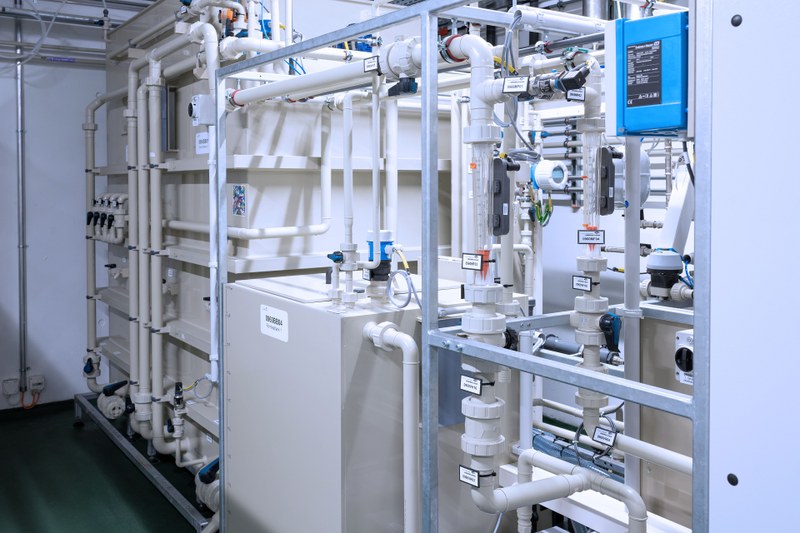
Environmental technology plant
- Institute
- Institute for Ecopreneurship
Contact
Dr. Boris Kolvenbach
- Phone
- +41 61 228 56 76
- boris.kolvenbach@fhnw.ch
FHNW School of Life Sciences
FHNW University of Applied Sciences and Arts Northwestern Switzerland
School of Life Sciences
Hofackerstrasse 30
CH - 4132 Muttenz