New biocompatible materials for tissue engineering of bone and cartilage replacements
Workers, athletes, children, pensioners – every segment of the European population is affected by musculoskeletal disorders such as bone fractures and cartilage damage. The development and marketing of more effective tissue engineering products would enable hospitals and their doctors practising regenerative medicine to provide better care for their patients affected by these problems.
Four renowned laboratories in the Upper Rhine region specialising in biomaterials and bioengineering have joined forces to develop an innovative therapeutic strategy. The aim is to produce new materials for tissue engineering to treat incurable bone or cartilage damage and where the damaged area must be replaced with new tissue.
The project team, coordinated by Philippe Lavalle and his cross-border partners, is developing an implantable biomaterial that offers optimal compatibility with the organism, with the aim of improving the condition of patients with tissue damage. The new biomaterial will be developed from two natural proteins known for their excellent biocompatibility. It will serve as implantable replacement tissue to enable the healing of injured areas.
First, the protein-based structures must be designed and manufactured, and their qualities (strength, hardness, elasticity, shape, etc.) must be ensured. The next step will be to select the best materials from a biological point of view, analysing in particular their biocompatibility and immunological effects. Finally, the technology transfer phase from the laboratory to the hospital bed will be initiated with the help of our industrial partners in the Upper Rhine region. This will enable this therapeutic innovation to enter clinical trials within three years of the project's completion.
Gallery
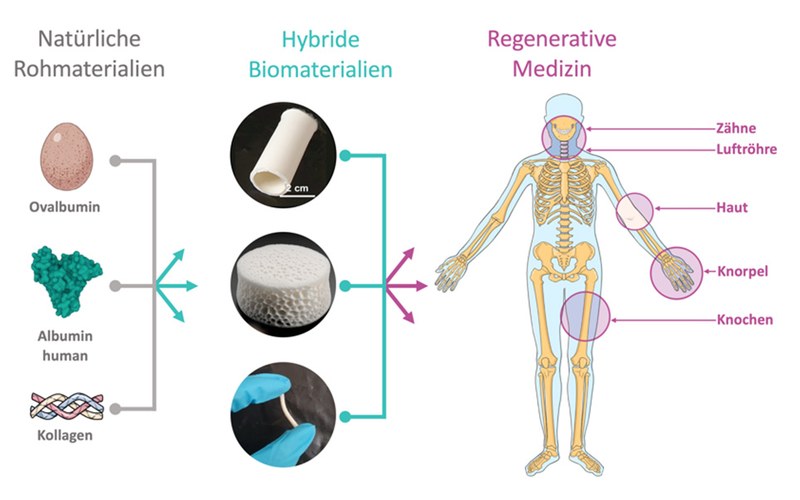
Innovative tissue engineering strategy for obtaining new biomaterials to treat bone or cartilage damage in humans. Copyright: Arnaud Scherberich, Jordan Beurton, Eya Aloui, Philippe Lavalle & Benoît Frisch. The illustration was created in part with the help of Servier Medical Art. 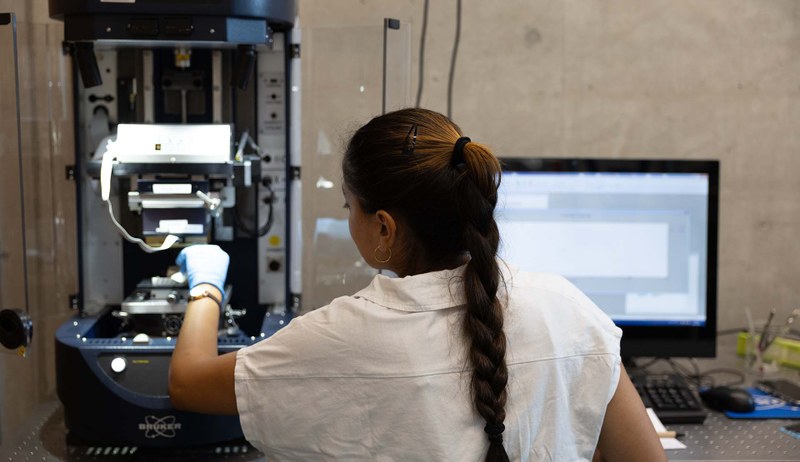
Açelya Ikisivri performs micromechanical analyses of porous foams using the Universal Tribolab. We achieve precise characterisation of innovative foam structures through high-resolution micromechanical testing methods. Source: Joël Karlin. 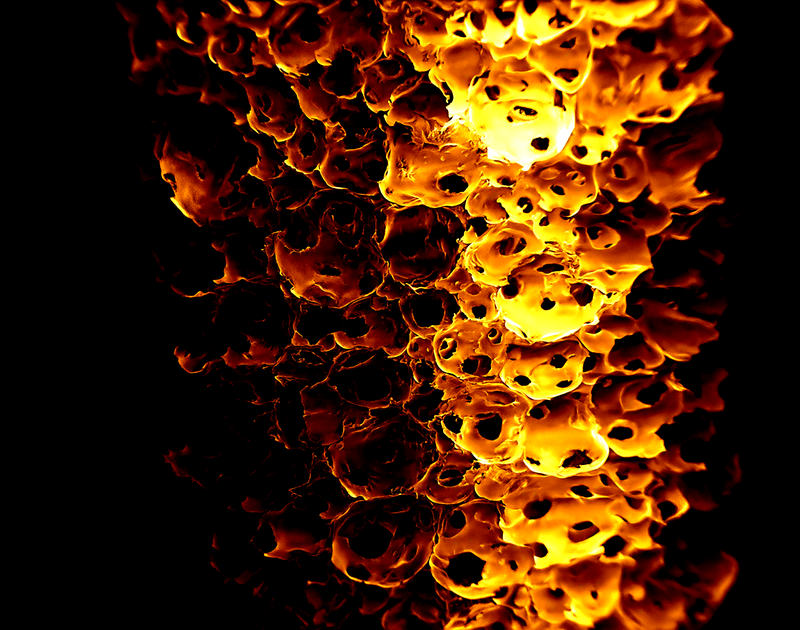
Protein foam. Source: Sonja Beer.
Publications
Bertsch, C., Colin, F., Aloui, E., Graff, J., Antal, M. C., Kuchler‐Bopp, S., Moya, A., Marek, R., Zaugg, S., Mathieu, É., Thibault, C., Debry, C., Beurton, J., Senger, B., Frisch, B., de Wild, M., Scherberich, A., Lavalle, P., & Fath, L. (2026). A proof-of-concept study of an albumin-based bilayered scaffold for cartilage regeneration. Materials Today Bio,38, 103193.
Pfister, P., Lhospice, E., García‐García, A., Paillaud, R., Jung, S., Schaller, R., Kappos, E. A., Jaquiéry, C., Ismail, T., Schaefer, D. J., de Wild, M., Martin, I., Kaempfen, A., Scherberich, A., & Moya, A. (2026). Start, stop, rewind, repeat - cyclic exposure of adipose stromal cells‐derived cartilage organoids to chondrogenic and proliferative cues to achieve scaled‐up and customizable bone formation by endochondral ossification. Advanced Healthcare Materials, e04880–e04880.
S. Jung, A. Moya, P. Pfister, R. Paillaud, R. Marek, I. Martin, A. Scherberich, M. de Wild. Biomechanical testing of engineered digit phalanges. Bridge Engineering Institute (BEI) Conference 2024.
A. Moya, P.Pfister, S. Jung, R. Paillaud, I. Martin, M. de Wild, A. Scherberich. O10: A customizable autologous tissue engineering strategy for bone (re)construction. Swiss Society for Biomaterials and Regenerative Medicine Conference 2024.
Project details
- Type
- Research project
- Research field
- Functional materials and surfaces
- School
- FHNW School of Life Sciences / Institute for Medical Engineering and Medical Informatics
- Partners
- Albupad Matériaux Biologiques
Cellec Biotek AG
Cutiss Personalized Skin
Gelita
Meidrix
NovoNexile
Spartha
Straumann
Silony - Funding
- Région Grand Est
State of Baden-Württemberg
State of Rhineland-Palatinate
Cantons Basel-Stadt and Basel-Landschaft
Swiss Confederation
INTERREG Upper Rhine programme of the European Regional Development Fund - Duration
- 2024-2027

Contact
Prof. Dr. Michael de Wild
- Phone
- +41 61 228 56 49
- michael.dewild@fhnw.ch