Developing multi-channel neurofeedback systems for treatment of ADHD
Neurofeedback is a promising technique to treat Attention Deficit and Hyperactivity Disorder (ADHD), whose symptoms can include a lack of concentration, discipline and learning difficulties and motor hyperactivity. Unlike drugs, which have side effects, neurofeedback represents an alternative where no side effects occur when using widely accepted training protocols.
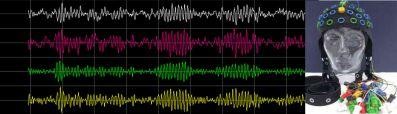
Electroencephalography (EEG) controlled brain-computer interface (BCI) is a non-invasive imaging technique that measures brain waves via electrodes placed on the scalp. Neurofeedback uses this imaging technique during training sessions aimed at controlling brain waves by well directed concentration. Success or failure are directly indicated by visual and auditory feedback and serve as motivation. Lasting neurological improvement can be achieved: children with ADHD often succeed in decreasing their abnormally high theta waves (daydreaming and fantasizing) and in increasing their alpha (relaxation) and beta (concentration) waves.
Most commercially available neurofeedback systems have only 1 or 2 registration channels. Our aim is to design a neurofeedback system using a g.tec amplifier and MatLab / Simulink software in close collaboration with therapists.
Objectives
The following technical improvements are our priorities:
- Continuous and prompt feedback.
- Well-defined repositioning system for comparison between different sessions.
- Performing quantitative EEG (QEEG) at the beginning of the sessions to choose the most suitable electrode position.
- Increasing the number of channels for controlling more complex processes, i.e. to include further brain areas in the analysis.
In addition to neurofeedback as a therapy for concentration difficulties, feedback could be used in other domains (cursor, robot, wheelchair) via controlling more complex operations and finally the combination of cognitive signals of several persons as game (mental rope pulling).
Gallery
Project details
- Type
- Research project
- Research field
- Methods and systems for neuronal stimulation
- School
- FHNW School of Life Sciences / Institute for Medical Engineering and Medical Informatics
Contact

Prof. Dr. Simone Hemm-Ode
- Phone
- +41 61 228 56 89
- simone.hemm@fhnw.ch