Photo-electro integrated next-generation energy technologies
Rising CO₂ emissions and the global accumulation of PET plastic waste represent two of the most pressing environmental challenges of our time. The EU, aligned with the Paris Agreement, targets a 40% reduction in greenhouse gas emissions and a 32% renewable energy share by 2030, while urgently seeking innovative solutions for plastic waste valorisation.
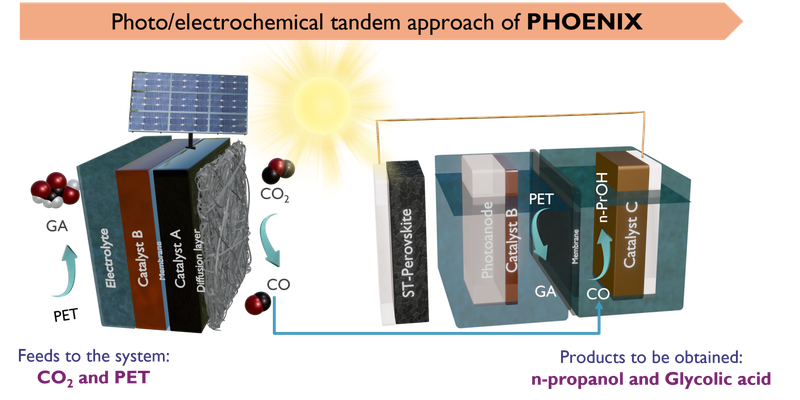
To address these issues, the PHOENIX project is developing a solar-driven electrochemical platform that couples carbon dioxide utilisation with polyethyleneterephthalate (PET) plastic upcycling. A photovoltaic-electrolyzer (PV-EC) will be combined with photoelectrochemical (PEC) technologies. The system will convert carbon monoxide into n-propanol, which is used in printing inks, industrial coatings, and pharmaceuticals; while transforming PET waste into glycolic acid, which is used in skin care products. The outcome is a cleaner and more energy-efficient alternative to conventional industrial processes, which upcycles waste into valuable products.
The FHNW School of Life Sciences is leading the work package on sustainability and circularity. We are conducting life cycle assessments to quantify the environmental impact of the integrated solar-driven platform, developing recycling schemes for the end-of-life recovery of critical materials from the prototypes and from thin film photovoltaics (CIGS, perovskites), and evaluating the techno-economic viability of the PHOENIX technology.
Funded by Horizon Europe, PHOENIX is a multidisciplinary consortium of 9 partners from 7 European countries, combining leading research institutions and industry across the full value chain from materials development to system demonstration.
Video
Infographic
Project details
- Type
- Research project
- Research field
- Applied circular economy, Sustainable resource management
- Topics
- Biology and chemistry, Circular economy, Electrical engineering and measurement technology, Energy, Environment and sustainability, Environmental technology and recycling, Materials, process engineering, Pharmaceutical, medical and biotechnology, Product and process design, Technologies and engineering
- School
- FHNW School of Life Sciences / Institute for Ecopreneurship
- Partners
- University of Innsbruck, Silesean University of Technology, Zentrum für Sonnenenergie- und Wasserstoff-Forschung Baden-Württemberg (ZSW), Leitat, Interuniversity Microelectronics Centre (IMEC), Helmholz Zentrum Berlin, CNRS, JBF Resin, K1-MET.
- Funding
- EU Horizon Europe GA no. 101172764, SBFI. Nr. 24.00434.
- Duration
- 2024 - 2027
Strategic action field
This project contributes to the FHNW strategic action field “Zero Emission”.
Team

Dr. Markus Lenz
- Phone
- +41 61 228 56 86
- markus.lenz@fhnw.ch

Prof. Dr. Christoph Hugi
- Phone
- +41 61 228 55 84
- christoph.hugi@fhnw.ch