Smart printed interactive robots for interventional therapy and surgery
The SPIRITS Interreg project (Smart Printed Interactive Robots for Interventional Therapy and Surgery) aims at developing innovative robotics by 3D printing for interventional radiology and image guided surgery.
SPIRITS combines existing expertise and creates synergies that lead to innovations. The new research consortium in the Upper Rhine region involves French, German and Swiss scientists. The SPIRITS project was launched as part of the Offensive Sciences program.
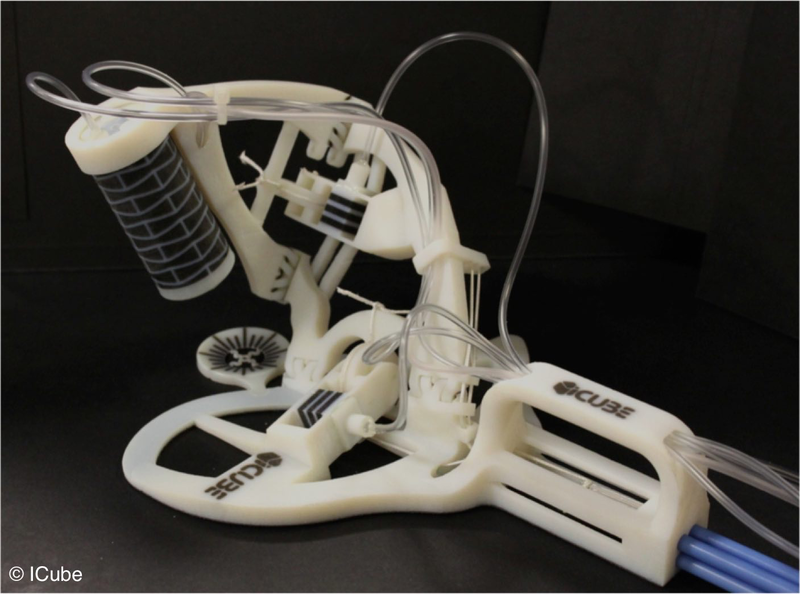
3D Printing of multimaterial polymer structures for the design of highly-integrated robotic structures. Picture represents a proof-of-concept developed at INSA Strasbourg - ICube lab (©ICUBE). Source: SPIRITS project webpage. 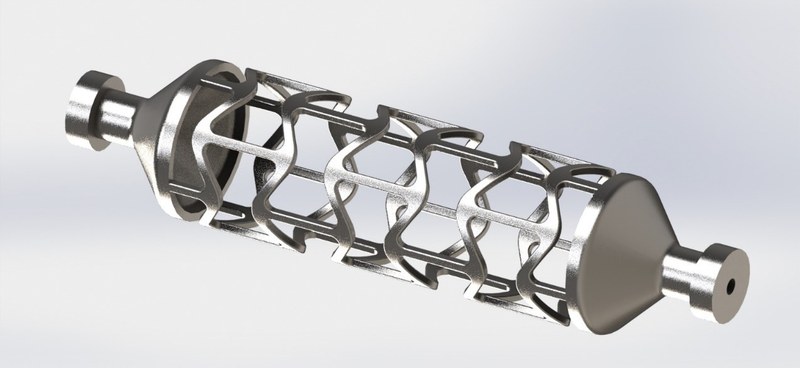
Design of auxetic needle drive. 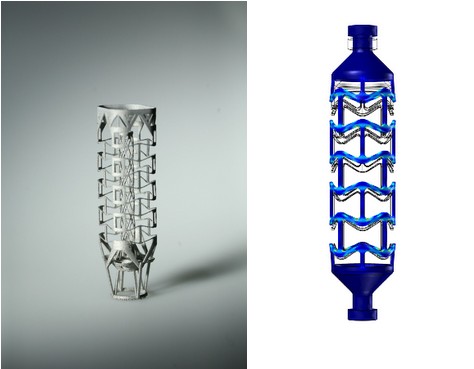
3D-printed auxetic needle drive. 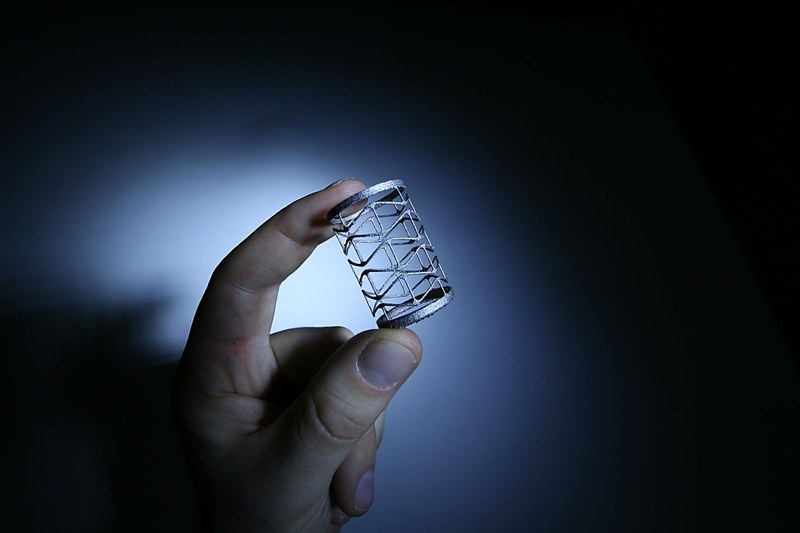
3D-printed auxetic needle drive. 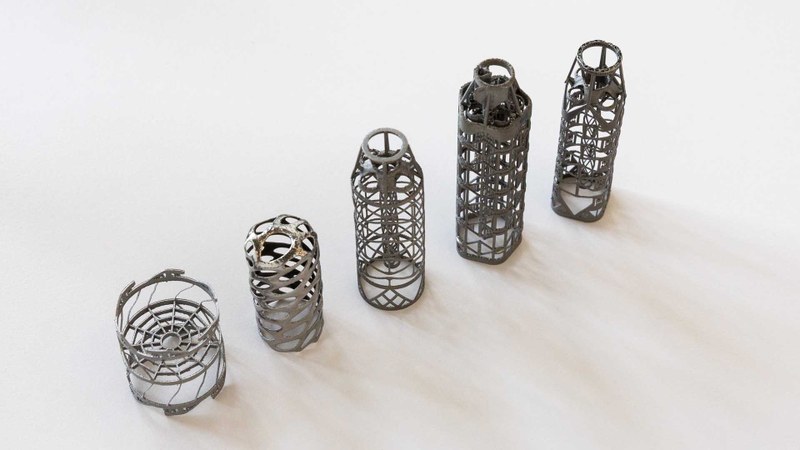
3D-printed auxetic needle drives. These cylindrical grid structures drive and guide biopsy needles. Source: Joël Karlin.
Stories

Radiation protection with robotics
A multinational research team is developing smart printed interactive robots for interventional therapy and surgery
Publications
- icube spirits
- Performance of metallic auxetic needle drives
- Pre-process calculation to optimize laser parameter in selective laser melting
- Evaluation of gamma irradiation impact on 3D-printed multimaterial polymer
- 3D-printed auxetic structures for bio-medical application
- Schlüsselprojekte Wissenschaft & Forschung, Regioinform 01/18
- SPIRITS: Smart Printed Interactive Robots for Interventional Therapy and Surgery 2017-2020 Final Executive Summary
- Link to the SPIRITS: Ein neues Roboter-Unterstützungssystem für die interventionelle Radiologie, Grenzüberschreitende Zusammenarbeit, Regio Basiliensis (PDF).
Project details
- Type
- Research project
- Research field
- Functional materials and surfaces, Design and additive manufacturing of medical devices, Computer aided surgery, Minimally invasive systems
- School
- FHNW School of Life Sciences / Institute for Medical Engineering and Medical Informatics
- Partners
- INSA Strasbourg, Hochschule Furtwangen, University Hospital Mannheim (UMM), Ecole Polytechnique Fédérale de Lausanne, Universität Mainz, Kantonsspital Baselland, Alsace Biovalley, Axilum Robotics, SAES Getters S.p.A., Help Tech GmbH, Sensoptic SA, iSYS Medizintechnik GmbH
- Funding
- Region Grand Est, Land Baden-Württemberg, Land Rheinland-Pfalz, Cantons Baselstadt, Basellandschaft, Aargau, Swiss Confederation, Baur SA, INTERREG Upper Rhine European Regional Development Fund
Contact

Prof. Dr. Michael de Wild
Arbeitsgruppenleiter Funktionale Materialien und Oberflächen
- Phone
- +41 61 228 56 49
- michael.dewild@fhnw.ch
Further projects
NanoPED
Nano-structured absorbable implants for paediatric neurosurgery
- Institute
- Institute for Medical Engineering and Medical Informatics
- Research field
- Functional materials and surfaces
Palatal patch for laser tissue gum surgery
Suture-free approach for immediate wound stability, reduced scarring and pain, and improved clinical efficiency
- Institute
- Institute of Product and Production Engineering, Institute for Pharma Technology and Biotechnology, Institute for Medical Engineering and Medical Informatics, Institute for Chemistry and Bioanalytics
- Research field
- Functional materials and surfaces, nanoLab
Real-time control of micro selective laser melting
Micro selective laser melting for miniature metallic devices
- Institute
- Institute for Medical Engineering and Medical Informatics
- Research field
- Functional materials and surfaces, Design and additive manufacturing of medical devices