Skip to main contentSkip to search barSkip to navigationSkip to footer
Logo of the University of Applied Sciences and Arts Northwestern Switzerland
  • DE
  • EN
  • Home

Ten Schools One Goal

The FHNW comprises 10 schools with different specializations. Select a school to see its specific courses, study programmes and information.

Applied Psychology

Architecture, Construction and Geomatics

Art and Design

Music

Computer Science

Life Sciences

School of Education

Social Work

Engineering and Environment

Business

  • Study offerings

    • All degree programmes
    • Master in Life Sciences
    • Master in Medical Informatics
    • Joint Degree Master in Biomedical Engineering
    • Info events
  • About degree programmes

    • Tuition fees and scholarships
    • Digital Life Sciences
  • International

    • Outgoing Students
    • Incoming Students
    • Double Degree
    • Partner universities
    • Student stories
    • Buddy programme
    • News and stories
  • Continuing education offerings

    • All continuing educations
    • CAS - Certificate of Advanced Studies
    • Modules and Seminars
    • Info events
  • Organisation

    • Consulting services
    • Legal information and terms & conditions
  • Research

    • Research fields
    • Projects
  • Collaboration

    • Process Technology Centre
    • Services
    • Tech Transfer Office
    • Student projects
  • International

    • Study abroad
    • International research projects
  • Updates and insights

    • News and stories
    • Research highlights
  • Events

    • All events
    • Info events
  • Media corner

  • About the School of Life Sciences

    • Strategy and values
    • Management board
    • Staff
    • Advisory board
    • People directory
    • Diversity and equal opportunities
    • Media corner
    • Infrastructure and campus
  • Institutes and centres

    • Institute for Chemistry and Bioanalytics
    • Institute for Ecopreneurship
    • Institute for Medical Engineering and Medical Informatics
    • Institute for Pharma Technology and Biotechnology
    • Centre for Teaching and Learning
    • Process Technology Centre
Logo of the University of Applied Sciences and Arts Northwestern Switzerland
  • About the School
    • School
    • Degree Programmes
    • Continuing Education
    • Research
    • Events
  • Social Media
    • Facebook
    • Instagram
    • YouTube
    • LinkedIn
  • About FHNW
    • Organisation
    • Schools
    • Locations
    • FHNW Library
    • Media Relations
  • Support
    • IT Support
    • Inside FHNW
    • Webmail
  • Data Protection
  • Imprint
  • Accessibility
  • Study offerings

    • All degree programmes
    • Master in Life Sciences
    • Master in Medical Informatics
    • Joint Degree Master in Biomedical Engineering
    • Info events
  • About degree programmes

    • Tuition fees and scholarships
    • Digital Life Sciences
  • International

    • Outgoing Students
    • Incoming Students
    • Double Degree
    • Partner universities
    • Student stories
    • Buddy programme
    • News and stories
  • Continuing education offerings

    • All continuing educations
    • CAS - Certificate of Advanced Studies
    • Modules and Seminars
    • Info events
  • Organisation

    • Consulting services
    • Legal information and terms & conditions
  • Research

    • Research fields
    • Projects
  • Collaboration

    • Process Technology Centre
    • Services
    • Tech Transfer Office
    • Student projects
  • International

    • Study abroad
    • International research projects
  • Updates and insights

    • News and stories
    • Research highlights
  • Events

    • All events
    • Info events
  • Media corner

  • About the School of Life Sciences

    • Strategy and values
    • Management board
    • Staff
    • Advisory board
    • People directory
    • Diversity and equal opportunities
    • Media corner
    • Infrastructure and campus
  • Institutes and centres

    • Institute for Chemistry and Bioanalytics
    • Institute for Ecopreneurship
    • Institute for Medical Engineering and Medical Informatics
    • Institute for Pharma Technology and Biotechnology
    • Centre for Teaching and Learning
    • Process Technology Centre

Type a search term and search continuing education,degree programmes, events, documents and other content.

  • Life Sciences
  • Research and services
  • Research in life sciences
  • Projects
Projects

Titanium bone scaffolds, FHNW School of Life Sciences

School of Life Sciences


Filling bony defect sites with an open-porous lattice structures

The treatment of large bone defects still poses a major challenge in orthopaedic and craniomaxillofacial surgery. One possible solution is the development of personalized porous titanium based implants, designed to meet all mechanical needs with a minimum amount of titanium and maximum of osteopromotive properties.

In this project, we developed specific designs of unit cells to fill out bony defect site with an open-porous lattice structure. The mechanic response of the scaffold depends on the chosen lattice architecture. This is of great importance for mimic human bone by titanium scaffolds in order to reduce stress shielding.

The designed titanium scaffolds were 3D-printed by selective laser melting and then implanted into calvarial defects in rabbits to examine bone formation and osseointegration. Significant differences are noted between defects filled with implants and untreated defects.

The studies further aimed to apply SLM that allows a high degree of microarchitectural freedom to generate lattice structures and to determine the optimal distance between rods and the optimal diameter of rods for osteoconduction (bone ingrowth into scaffolds) and bone regeneration. For the biological readout, diverse SLM-fabricated titanium implants were placed in the calvarium of rabbits and new bone formation and defect bridging were determined after 4 weeks of healing. To link 3D scaffold architecture to biological readouts, bone ingrowth, bone to implant contact, and defect bridging of noncritical-sized defects in the calvarial bone of rabbits were determined. We further elucidated the optimal microarchitecture for osteoconduction and determine compression strength and Young’s Modulus of the selected architectures.

Media

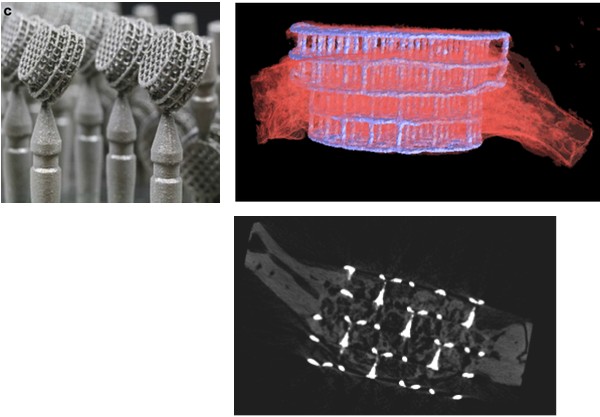
3D-printed titanium scaffolds for preclinical study. From: M. de Wild et al., Bone regeneration by the osteoconductivity of porous titanium implants manufactured by selective laser melting: A histological and µCT study in the rabbit, Tissue Engineering Part A, 19 (23-24):2645-54 (2013).
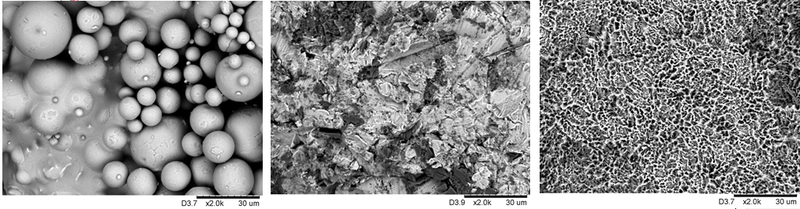
Modified surface of the 3D-printed implants. From: M. de Wild et al., Bone regeneration by the osteoconductivity of porous titanium implants manufactured by selective laser melting: A histological and µCT study in the rabbit, Tissue Engineering Part A, 19 (23-24):2645-54 (2013).
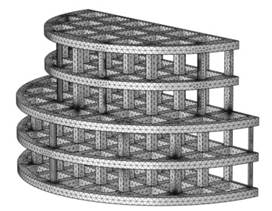
FEM simulation of open-porous scaffold. From: W. Hoffmann, S. Fabbri, R. Schumacher, S. Zimmermann, M. de Wild, FEM analysis of porous titanium bone scaffolds. European Cells and Materials, 26, Suppl. 4, 28 (2013). And winner of the Student Awards 2013 for the best poster presentation.
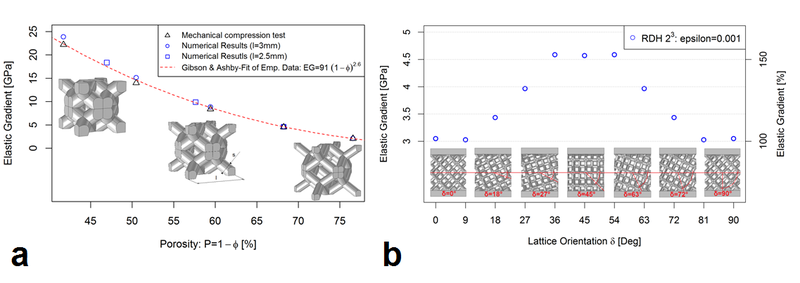
Influence of porosity and lattice angle on mechanic properties of the scaffold. From: S. Zimmermann, M. de Wild, Density- and Angle-Dependent Stiffness of Titanium 3D Lattice Structures, BioNanoMat 15 (S1), S35, (2014).

Publications

  • Osteoconductive Lattice Microarchitecture for Optimized Bone Regeneration
  • Mechanical anisotropy of titanium scaffolds
  • Stiffness-anisotropy of porous implant geometries
  • Influence of Microarchitecture on Osteoconduction and Mechanics of Porous Titanium Scaffolds Generated by Selective Laser Melting
  • Lattice Microarchitecture for Bone Tissue Engineering from Calcium Phosphate Compared to Titanium

Project details

Type
Research project
Research areas
Functional materials and surfaces and Implant design and production with additive manufacturing
University
FHNW School of Life Sciences / Institute for Medical Engineering and Medical Informatics
Partner
Universitätsspital Zürich
Funding
AOCMF, SNSF

Contact

Michael de Wild

Prof. Dr. Michael de Wild

Team leader, Functional Materials and Surfaces
Phone
+41 61 228 56 49
E-Mail
michael.dewild@fhnw.ch

School of
Life Sciences FHNW University of Applied Sciences and Arts Northwestern Switzerland

  • About the School
    • School
    • Degree Programmes
    • Continuing Education
    • Research
    • Events
  • Social Media
    • Facebook
    • Instagram
    • YouTube
    • LinkedIn
  • About FHNW
    • Organisation
    • Schools
    • Locations
    • FHNW Library
    • Media Relations
  • Support
    • IT Support
    • Inside FHNW
    • Webmail
Logo FHNW - 20 Years
Logo Swiss Universities
Logo European University Association
© University of Applied Sciences and Arts Northwestern Switzerland (FHNW)
  • Data Protection
  • Imprint
  • Accessibility
  • DE
  • EN