At the School of Business FHNW, we shape teaching and learning together.
The FHNW School of Business stands for continuous improvement in teaching, research, and services – with a strong practical and scientific impact. Ensuring the quality of our degree programmes and continuing education offerings is especially important to us.
Accredited quality
The FHNW is accredited by the Swiss Accreditation Council. In addition, the School of Business received the prestigious AACSB accreditation in 2021 – a seal of quality held by only around 6% of business schools worldwide.
Our concept of teaching and learning
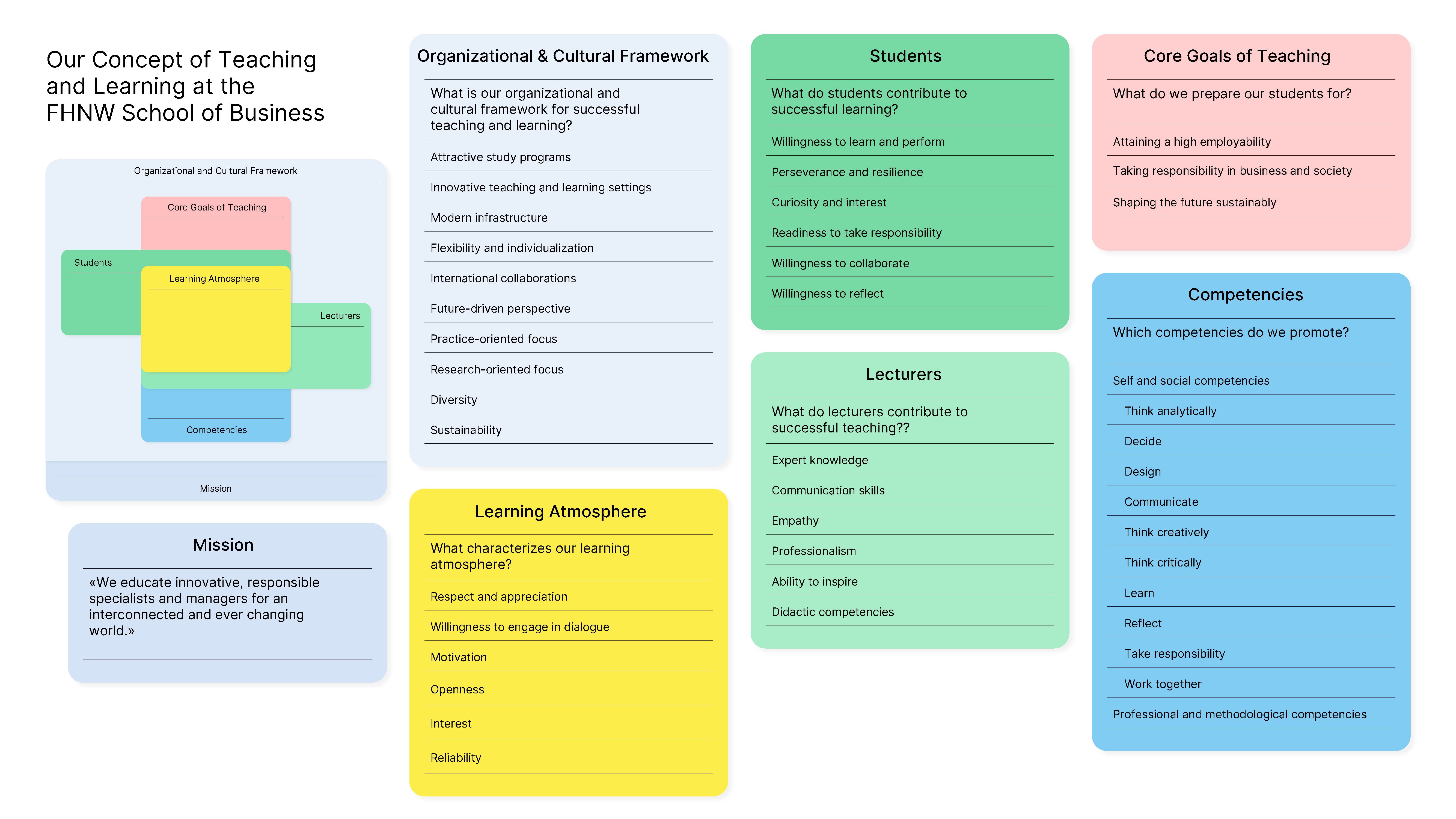
Our concept of teaching and learning reflects what matters most to us: creating a respectful and inspiring learning atmosphere for everyone. It provides guidance for students and faculty while also offering external stakeholders insight into our values and principles.
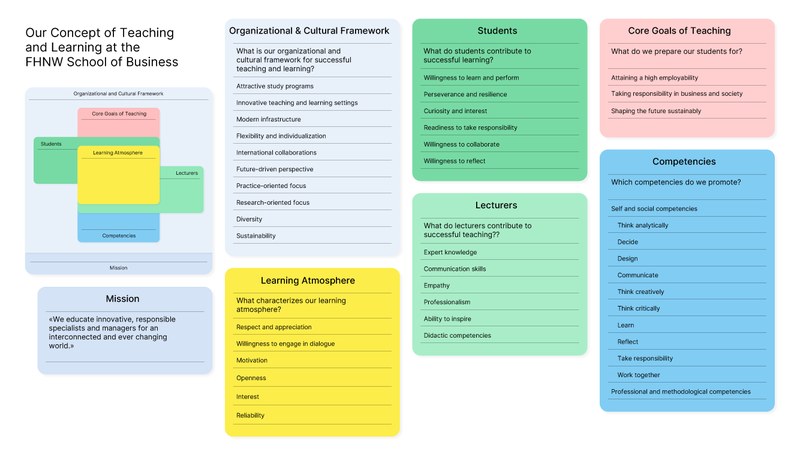
We foster competencies that are essential for the future and continuously develop our teaching practices - always in alignment with our institutional culture and mission. Together, we create a future-oriented learning environment that adapts flexibly to change. In doing so, we prepare our students to take on responsibility in business and society, empowering them to actively shape our interconnected, dynamic world.
Our competency model
The FHNW School of Business designs its teaching to be competency-orientated. Consequently, it is not only the imparting of content that is important, but also, and in particular, the ability to act – to apply and implement knowledge in practice.
The competency model of the School of Business was developed and implemented in a participatory process involving lecturers, representatives from business and society, and students. It provides the foundation for designing curricula, learning objectives and teaching methods.
The competency model is designed to bridge the gap between academic studies and the requirements of professional practice in university teaching. The aim is to equip students with the knowledge and skills to make conscientious and responsible decisions, considering the needs of the present while also thinking about the future.
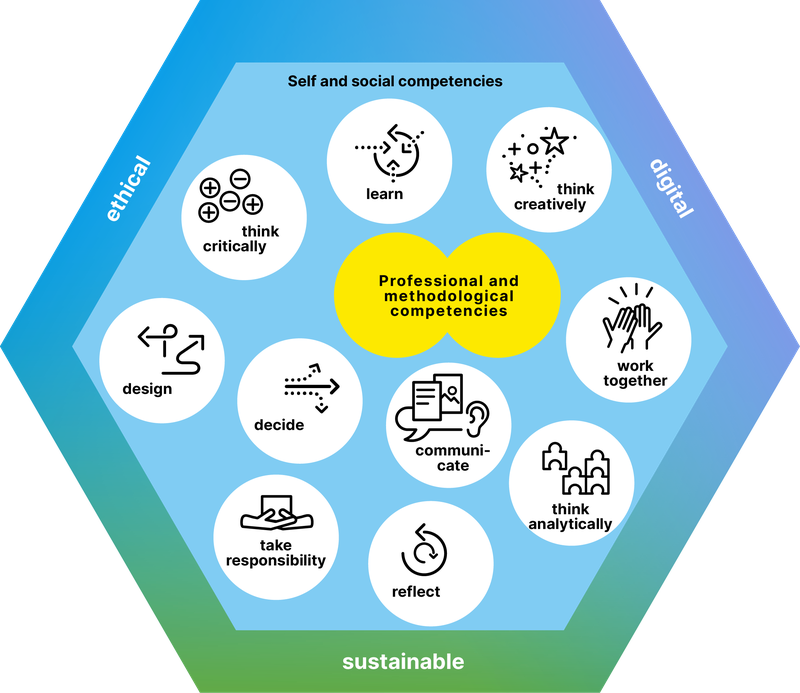
The model distinguishes between three competency areas, each of which incorporates the cross-cutting themes of ethics, sustainability and digitalisation.
- Professional competencies: Sound knowledge of the economy and its related disciplines.
- Methodological competencies: analytical, digital and scientific working methods.
- Personal and social competencies: Future-oriented skills such as thinking critically, reflecting, working together, taking responsibility and communicating effectively.
Professional competencies
Professional competencies refer to the in-depth knowledge, skills and abilities required in a particular field or discipline to successfully manage tasks and problems in that field.
Methodological competencies
Methodological competencies describe the ability to apply techniques, approaches and procedures in a specific context to systematically solve problems and achieve objectives.
Self and social competencies
Communicate
Behavioural anchors, or observation elements, may include …
- Communicates in analogue and/or digital form, in words and/or pictures, in a way that is appropriate to the purpose, situation and audience
- Can take the other party's point of view and respond to it
- Communicates clearly, concisely and precisely
- Listens actively and ensures mutual understanding by asking questions
- Argues coherently and persuasively
- Can inspire and motivate others
Decide
Behavioural anchors, or observation elements, may include …
- Recognises the need to take a decision
- Identifies, recognises and weighs risks and alternatives; can prioritise in the process
- Considers different factors and interests when making decisions, e.g. business factors, sustainability issues
- Can make a sound decision even in ambiguous, uncertain contexts
- Makes decisions and does not procrastinate
Design
Behavioural anchors, or observation elements, may include …
- Curious, open and receptive to change
- Does not rest on its laurels, challenges the status quo and acts proactively and with foresight
- Utilises the available scope for action and is proactive
- Provides impetus for continuous improvement and innovation and makes suggestions for optimising processes and improving the quality of results
- Brings projects to a focused conclusion
Learn
Behavioural anchors, or observation elements, may include …
- Is motivated to learn new things and applies what has been learnt
- Can initiate, continue, organise and successfully complete a learning process
- Recognises the need for and benefits of continuous, lifelong learning
- Has learning techniques and strategies
- Identifies his/her own learning needs and is aware of his/her own learning process
- Recognises when he/she needs help, seeks and accepts support
Reflect
Behavioural anchors, or observation elements, may include …
- Regularly assesses one's own performance, identifying both strengths and weaknesses, as well as patterns of behaviour, motives, values and goals.
- Is prepared to assess the performance of others and the systems in place.
- Learns from both successes and failures.
- Can analyse challenging situations and how they are dealt with, deriving action strategies for future challenges from this.
Take responsibility
Behavioural anchors, or observation elements, may include …
- Takes responsibility for him/herself, the tasks assigned, and the decisions made
- Is not discouraged by delays, resistance or setbacks, but stays on the ball and actively shapes/influences the situation
- Is reliable, willing to perform and able to concentrate on the tasks and objectives set
- Owns mistakes and failures and accepts the consequences
Think analytically
Behavioural anchors, or observation elements, may include …
- Approaches unknown topics in their complexity in a systematic and structured way
- Identifies content and relationships
- Can distinguish the essential from the irrelevant
- Can recognise the complexity of issues and reduce it appropriately for oneself and others
- Systematically obtains missing information, filters out relevant information, analyses it and maintains an overview
Think creatively
Behavioural anchors, or observation elements, may include …
- Thinks networked in terms of opportunities, solutions and scenarios
- Breaks out of common patterns
- Leverages existing thinking patterns
- Places existing ideas in a new context
- Can generate new, unconventional, creative ideas
Think critically
Behavioural anchors, or observation elements, may include …
- Investigates the existing (information, matter, objects) from different perspectives
- Is not satisfied with the first best explanation/solution
- Thinks in variants/scenarios and weighs them against aspects/criteria such as risk, cost-effectiveness, ethics, sustainability
- Prepares a sound basis for decision making
Work together
Behavioural anchors, or observation elements, may include …
- Contributes to collaboration, supports and accepts support
- Appreciates the skills of others, builds trust and makes good use of diversity
- Builds relationships, works with others in an interdisciplinary way, puts synergies to use and ensures the targeted exchange of information and knowledge
- Addresses resistance, problems and conflicts at an early stage, recognises the concerns and interests of others, and seeks solutions that are supported by all.
Employers expect our graduates to demonstrate sound technical and methodological skills, as well as competencies such as the ability to think critically, reflect on themselves, work in teams, communicate effectively and act responsibly. These skills will enable graduates to solve problems in today's and tomorrow's dynamic, digital and globally networked business world, as well as fostering resilience.
Voices from the business community

Further informationen
Find out more about the development process here: Mücke, A.; Röhm, R. 2025. Promoting competency-based education through the development of a competency model: lessons learned from a change perspective. In: 11th International Conference on Higher Education Advances (HEAd’25). Valencia, 17-20 June 2025. https://doi.org/10.4995/HEAd25.2025.19745
Contact

Dr. Sebastian Linxen
- Phone
- +41 61 279 17 44
- sebastian.linxen@fhnw.ch