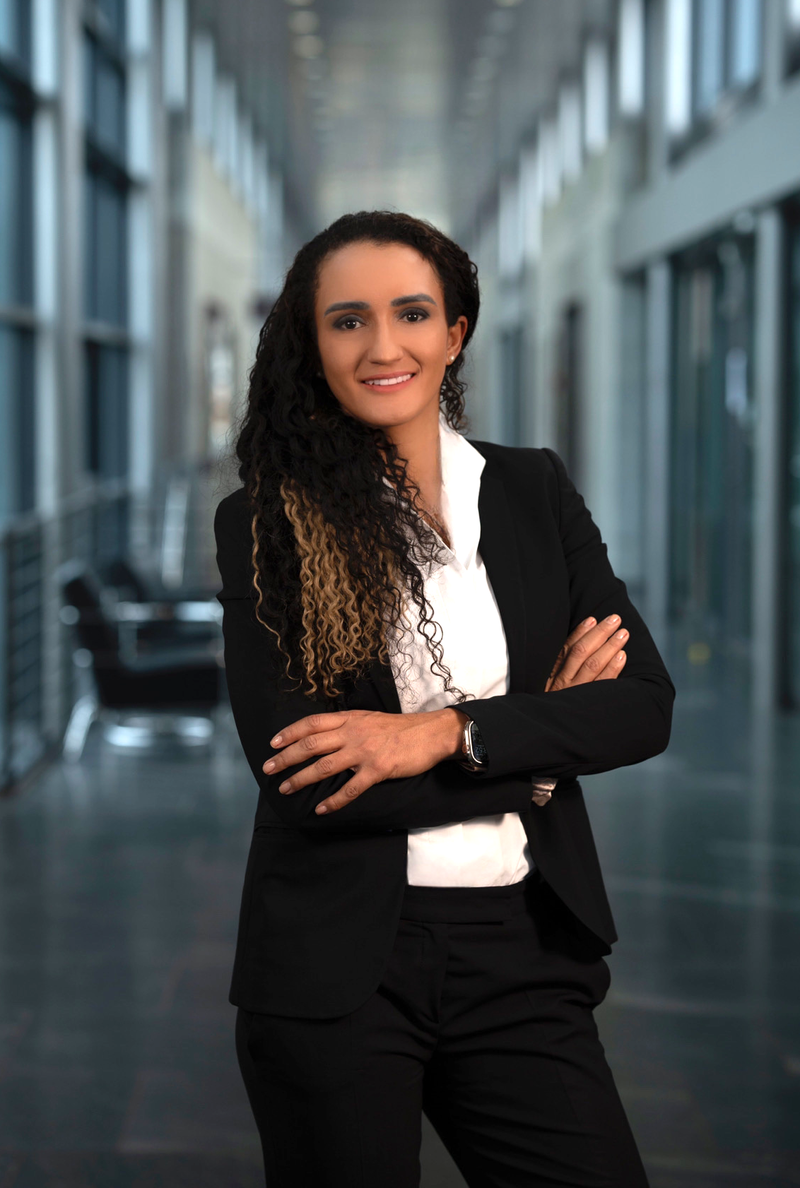
Priscila Köster’s career began in IT and led via data engineering and her first leadership role at a bank to Swisscom. Today she leads a consulting team of 13 there in the field of data, AI and cloud. She completed her Dual Degree MBA alongside a full-time position, a formative experience that has had a lasting impact on her leadership style.
Author - Alice Lydia Frey
Priscila Köster, known to many as Prissy, began her career in technology: an IT apprenticeship, a degree in business information systems, and several years in data engineering as a consultant for business intelligence solutions before she moved into leadership. She took on her first leadership responsibility at Coutts Bank, then part of the RBS Group, where she built a team for data-driven solutions. Her path then led her to Swisscom, into an environment that felt like a start-up within a large company, where the team worked in an agile, innovative and entrepreneurial way and actively shaped new topics. What began as a group of five has since grown into a unit of more than 65 professionals focused on data, AI and cloud. Today she leads a consulting team of 13 within it that supports companies with data-driven topics and their digital transformation. She works with a wide range of clients and stakeholders and is responsible for collaboration across different levels, from developers and technical experts to executive management. Alongside a full-time position, she completed the Dual Degree MBA (MBA FHNW Cross-Cultural Leadership / Edinburgh Business School). In this interview she explains why she chose the programme, how the pandemic changed her studies, and how the MBA shaped her approach to leadership. What she takes away from the experience speaks to more than just her own career.
“”
From technology to leadership
Priscila had already been leading a team for some time. But, as she puts it, she “really comes from the technical side”. Around 2019/2020 her unit grew rapidly, and her role grew with it. The step from consultant to manager was one of her biggest challenges: letting go of operational and technical work and making the transition to a more methodical, strategic and leadership-oriented role. She no longer had to solve everything herself; instead, she had to hand over responsibility, trust her team and redefine her own added value: away from hands-on delivery and towards leadership, direction and strategic design. Technically, she felt confident, and she also had a solid foundation in business. But for the level at which she was operating, she felt she needed more.
The person who encouraged her to take the next step was her manager, who had built the unit. He had completed the Dual Degree MBA himself and was convinced that the programme could give her the right input for the next stage of her career. His own experience strengthened her decision.
When everything suddenly went online
What she had been looking forward to most was the people: meeting new contacts, exchanging ideas and learning together. Then the pandemic hit, and almost overnight everything moved online. “That was a setback”, she says. She soon realised, however, that everyone was in the same situation and that she was not alone.
In the end, the change also had its advantage. As a consultant, she had been travelling almost five days a week; now the commuting fell away, giving her more time. She was also impressed by the online learning platform: clearly structured, with progress tracking and videos, as well as courses that could be booked specifically to prepare for exams. Those who preferred to study independently could do so; those who needed more guidance could find it too.
Models that make a difference
What has stayed with her most is the practical focus. Instead of dry theory, the programme centred on case studies, with participants expected to justify their solutions by applying theoretical models. “There was no right or wrong, as long as you could connect it to the theory.” For Priscila, who describes herself as very logical, that made all the difference. Knowing a model by heart is one thing; knowing how to apply it in everyday situations is another. She still draws on the models when she gets stuck: she knows that the literature offers different approaches and can then look for the one that fits. “You take what helps you”, she says.
Learning from others, encouraging others
When the group finally came together in person toward the end of the programme, it was a pivotal moment for her. The participants were diverse in terms of backgrounds, nationalities and professions, yet they were all sitting in the same room with the same goal. That meant a great deal to her. Two friendships from that time have lasted, one of them particularly close.
At Swisscom, Priscila supports women in the tech industry who want to advance their careers, encouraging them to believe more in themselves. She uses her own MBA experience as an example. At the beginning, she was unsure herself, particularly because the programme was taught in English. “I first had to learn the terminology”, she recalls; at times she wondered whether her English was good enough. She took the risk anyway, saw it through, and is proud of what she achieved.
Her message is aimed at women first, but ultimately at anyone who does not have enough confidence in themselves: “Dare to do more.” Things can go wrong, she says, but you are doing it for yourself, and either way you gain something from the experience.
Leading with empathy
Why leadership in the first place, and why Cross-Cultural Leadership? The reason goes back a long way. Around 20 years ago, she had a manager whose way of dealing with people has stayed with her ever since, as an example of how she did not want to lead. She is convinced that kindness and empathy achieve more than pressure. “Everything you do, you do with people and for people.”
In the age of AI, she believes the human and empathetic side of leadership is becoming even more important. However good AI and the technology behind it become, for her, people remain at the centre. And people want to work with leaders who are empathetic, approachable and respectful. She is convinced that this also brings out far more in individuals and their personal strengths.
A principle that guides her every day is “hard on the issue, soft on the person”, inspired by the Harvard Concept. For her, this means being clear and consistent on the issue and on expectations while remaining respectful, empathetic and humane in how she treats people: in conflict situations, in leading her staff and in dealing with people in general. That is why she values not only the quality of results but equally the quality of experience: not just what is achieved together, but how people experience the collaboration and the path to get there.
Because she works with very different cultures and personalities, Cross-Cultural Leadership was a natural fit for what she felt was still missing. The international and intercultural focus of the Dual Degree MBA gave her an additional perspective on leadership: she is now more conscious of individual differences and accepts that not everyone has to be the same, but that each person brings their own strengths and weaknesses.
The master’s thesis: AI in insurance
Her master’s thesis grew out of a strategic initiative in her unit focusing on AI in the insurance industry. Her central question: how can insurers successfully introduce artificial intelligence, not just technically but strategically? What do they need to consider beforehand, and what opportunities and risks do they face? The result was a multilingual practical guide for clients on the strategic introduction of AI in insurance, available in German, French and English.
For the project, Priscila conducted numerous interviews with experts and managers at eight Swiss insurers, from health to life insurance and across a wide range of business areas, from claims management to IT leadership. In addition, she surveyed almost 200 policyholders to understand their expectations and reservations about AI. Do they trust it? Would they rather pay more for personal contact or less for an avatar? By combining the insurers’ perspective with that of the policyholders, she created a well-founded basis for a practical guide.
What remains
What helped her through this intensive period was a clear structure. Alongside the full-time job, she learned to set priorities and to distinguish between what was important and what was urgent. When she caught Covid herself, the flexibility of the programme helped: exams could be postponed and modules completed at her own pace. This allowed her to balance family, work and study.
What has stayed with her above all is a broader understanding of the bigger picture, from project management and strategy to finance and leadership. The MBA did not just give her confidence; above all, it broadened her perspective. With her technical background, she was used to looking at issues mainly from a specialist and technological angle. She is now much better able to connect technical, strategic, financial and entrepreneurial aspects, which allows her to approach discussions and decisions at management level more holistically.
Today she speaks to top management as an equal. In the past, she sometimes deliberately held back in such situations or wondered whether her perspective was relevant enough. Now she contributes her opinion, asks questions, argues her case and stands her ground, even with very experienced leaders. “Not because I have to have an answer to everything, but because I have learned to trust my experience and my knowledge.”
Who is the MBA right for?
Priscila would recommend the MBA without reservation, with one condition: you need a clear personal goal. “Then it’s enjoyable, and you can see the value in it.” Those who simply want to collect another qualification can easily lose their way; those who come with a genuine purpose get the most out of the programme. That was true for her too. For her, the MBA was never just an extra line on her CV: she knew which direction she wanted to develop in and could connect a great deal of what she learned directly to her day-to-day work and apply it.
For her, the MBA is therefore much more than an additional qualification: it has helped her complement her technical expertise with strategic and entrepreneurial thinking, and step into her leadership role with greater confidence.
Her conclusion in one sentence: “A broad body of knowledge and an incredible confidence: that I have my place at the table, that my perspective has value, and that I can take on responsibility and help shape things at a strategic and entrepreneurial level.”
MBA FHNW Cross-Cultural Leadership / Edinburgh Business School
Contact
Dr. Laila Kabous
- Phone
- +41 61 279 17 36 (Direct)
- laila.kabous@fhnw.ch