Skip to main contentSkip to search barSkip to navigationSkip to footer
Logo of the University of Applied Sciences and Arts Northwestern Switzerland
Degree Programmes
Continuing Education
Research and Services
International
About FHNW
En
Locations and ContactFHNW LibraryMedia Relations
Logo of the University of Applied Sciences and Arts Northwestern Switzerland
  • Degree Programmes
  • Continuing Education
  • Research and Services
  • International
  • About FHNW
En
Locations and ContactFHNW LibraryMedia Relations
Life Scie...
Seminar Continuous Chromatography for Biotherapeutics

Seminar Continuous Chromatography for Biotherapeutics

A profound introduction to continuous chromatography for mAbs, Oligonucleotides, Peptides and Viral Vectors.
Key data

Next start
8.9.2026
Duration
3 Days (8.-10.9.2026)
Teaching language
English
Place
FHNW Campus Muttenz
Fee
CHF 3’000
Register now

Mobile navi goes here!

The aim of this seminar is to provide an introduction to continuous chromatography with hands-on practice with capture and polishing processes for biomolecules. These processes lead to improvements in productivity and manufacturing costs while reducing environmental footprint. Attendees will acquire the basic tools to design, run and evaluate multicolumn processes and to quantify these improvements, serving as basis for an economic evaluation. As the least complex of all multicolumn processes, the workshop is focused on twin column chromatography.

  • Introduction to continuous chromatography for biomolecules
  • Theory of multi-column chromatography
  • Design of multi-column chromatography processes
  • Hands-on training on twin column equipment for capture and polishing applications
  • Process performance evaluation and scale-up
  • Introduction to process modelling

This workshop does not cover 4-zone SMB, chiral and small molecule separations.

Content

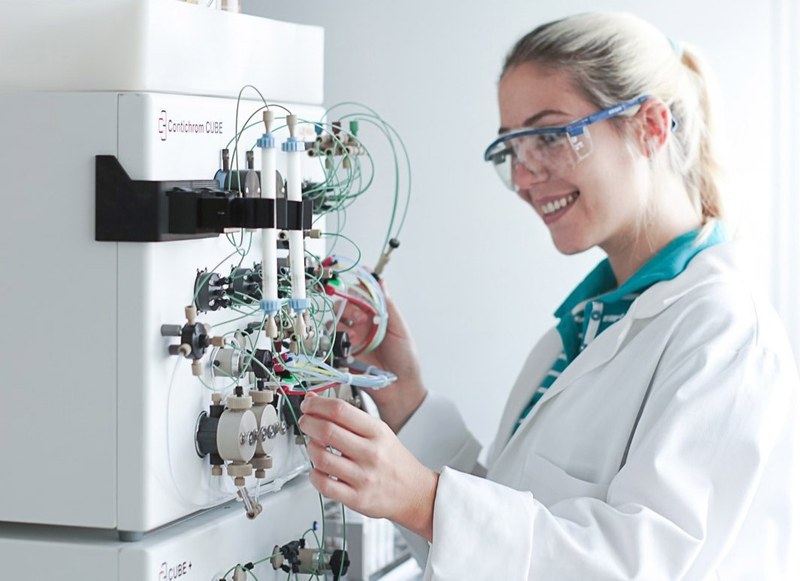
The seminar comprises presentations and interactive workshops using laboratory-scale Contichrom CUBE twin column separation & purification systems. Subject matter experts and graduate assistants will support the participants during the interactive workshops and data analysis sessions.

Day 1
  • Production of Biotherapeutics
  • Fundamentals of Large-molecule chromatography
  • Intro to Continuous Chromatography (CaptureSMB)
  • Lab workshop: CaptureSMB
  • Modelling and Simulation
  • Digitalization
  • Evening program / Dinner

Programme Day 1
09.00-09.10: Welcome and Housekeeping
09.10-09.45: Lecture 1 Production of Bio-Therapeutics
09.45-10.45: Lecture 2 Fundamentals of Large-Molecule Chromatography
10.45-11.00: Coffee break
11.00-12.30: Lab Workshop 1 Contichrom CUBE and Batch Capture
12.30-13.30: Lunch
13.30-14.15: Lecture 3 Continuous Countercurrent Chromatography
14.15-15.00: Lecture 4: Affinity (Capture) Chromatography
15.00-15.15: Coffee break
15.15-17.00: Lab Workshop 2 CaptureSMB
17.00-18.00: Lecture 5: Performance Evaluation of Continuous Chromatography
18.00: Reception

Day 2
  • Flowthrough and Frontal Chromatography
  • Integrated Chromatography
  • Continuous Chromatography: MCSGP
  • Lab workshop: MCSGP
  • Performance Evaluation
  • Lab workshop: CaptureSMB Evaluation
  • N-Rich
  • Evening program / Dinner

Programme Day 2
09.00-10.30: Lecture 6 Bind and Elute (Polishing) Chromatography
10.30-10.54: Coffee break
10.45-12.00: Lab Workshop 3 Linear Gradient Chromatography
12.00-13.00: Lunch
13.00-13.30: Lab Workshop 4 Evaluation Center
13.30-14.30: Lab Workshop 5 Evaluation of Batch and CaptureSMB
14.30-15.00: Presentation of Capture Results by Groups
15.00-15.15: Coffee break
15.15-17.30: Lab Workshop 6 MCSGP
17.30: Social programme + Dinner

Day 3
  • Modelling Workshop
  • Lab workshop: MCSGP Evaluation
  • Scale-up (MCSGP)
  • Wrap-up

Programme Day 3
09.00-10.30: Lecture 7 Integrated Continuous Manufacturing & Process Digitalization
10.30-10.45: Coffee break
10.45-12.00: Lecture 8 Modeling and Simulations
12.00-13.00: Lunch
13.00-14.00: Lab Workshop 7 Evaluation of MCSGP
14.00-14.30: Presentation of Polishing Results by Groups
14.30-15.15: Lecture 9-I Scale-up of continuous chromatography (part I)
15.15-15.30: Coffee break
15.30-16.15: Lecture 9-II Scale-up of continuous chromatography (part II), Guest Speaker: Ralf Eisenhuth, Bachem, Switzerland
16.15-16.45: Lecture 10 N-Rich Process for Isolation of Impurities
16.45-17.00: Course Wrap-up
17.00-17.30:Guided lab tour (optional)

Overview

Target Audience

This seminar is aimed at industry and academic separation scientists and process development engineers who already have some familiarity with single column chromatography and who want to broaden their understanding of chromatographic processes and look at new and more efficient ways to separate and polish biomolecules.

Format

The seminar comprises presentations and interactive workshops using laboratory-scale Contichrom CUBE twin column separation & purification systems. Subject matter experts and graduate assistants will support the participants during the interactive workshops and data analysis sessions.

Seminar fee

The seminar fee is CHF 3’000.
This includes lecture summaries in paper and electronic formats, materials used during the workshop, internet access (Wifi), lunch and coffee breaks as well as participation in the evening pro-gram/dinner. It does not include accommodation, travel costs or catering other than indicated above.

Seminar leaders

Massimo Morbidelli Ph.D., Professor of Chemical Reaction and Separation Technologies in the Department of Chemistry, Politecnico di Milano. A pioneer in preparative continuous chromatography and in particular in the application of multicolumn technologies for protein purification in the pharma industry, Prof. Morbidelli has co-authored over 500 research articles and four books. He serves as associate editor for the Industrial & Engineering Chemical Research journal of the ACS and is the recipient of the 2005
RH Wilhelm award from the AIChE and of the 2014 Gerhard Damkoehler medal of DECHEMA. He is a co-founder of ChromaCon AG in Zurich.

Thomas Müller-Späth, Ph.D., Director of RnD at ChromaCon AG in Zurich. After an assignment at Bayer Health-care, Thomas completed his doctoral work on continuous chromatography of biomolecules in the group of Prof. Morbidelli, and co-founded ChromaCon AG to bring the technology to the market. He has been working on research projects with industrial partners, development of chromatography processes and equipment, and IP management. He has presented on numerous workshops and conferences on continuous chromatography and has co-authored over 20 publications and patents.

Supervisors and tutors: Sebastian Vogg, Richard Weldon, Lars Aumann

Accommodation

Hotel Baslertor Muttenz

Hotel b_smart_motel Basel

Moevenpick Basel

Testimonials

PhD. Theresa Ahern, Eli Lilly (IE)

“The continuous chromatography seminar had an excellent balance of theoretical content and laboratory based exercises. It was great to explore the significant gains observed in productivity, buffer consumption and resin utilization over batch chromatography.”

PhD. Mercedes Ferreras, Novo Nordisk (DK)

“Great to learn all the potential and application of the different ways of using continuous chromatography and learn that this is not just a smart way of working in research, but that it can be implemented in large scale production.”

Event Partner:

Downloads

  • Conditions of Participation Continuing Education Courses HLS

Continuing Education

Life Sciences
Overview Continuing Education
Thomas Villiger

Dr. Thomas Villiger

Lecturer in Bioprocess Technology Team leader Bioprocess Technology

Telephone

+41 61 228 52 46

E-mail

thomas.villiger@fhnw.ch

Address

School of Life Sciences FHNW Institute for Pharma Technology and Biotechnology Hofackerstrasse 30 4132 Muttenz

Weiterbildung Englischint_wb_seminaroverview_kurs_seminar

What we offer

  • Degree Programmes
  • Continuing Education
  • Research and Services

About FHNW

  • Schools
  • Organisation
  • Management
  • Facts and Figures

Information

  • Data Protection
  • Accessibility
  • Imprint

Support & Intranet

  • IT Support
  • Login Inside-FHNW

Member of: