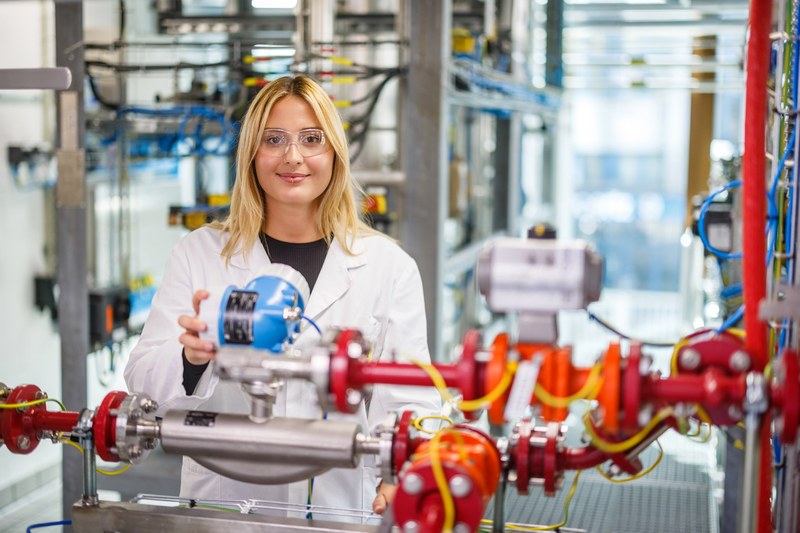
As a chemical engineer, would you like to design sustainable, safe and efficient processes for the future? This Master’s programme at the FHNW School of Life Sciences expands your expertise in a practical way and enables you to develop solutions to climate, health and environmental challenges across a range of disciplines.
Factsheet
- Degree
- Master of Science in Life Sciences
- Study mode
- Full-time, Part-time/work-study
- Learning mode
- Online, Onsite
- ECTS credits
- 90 / 120 (Double Degree)
- Next start
- 22.2.2027
- Duration
- 3 semesters (full-time) / 6 semesters (part-time)
- Teaching language
- Englisch
- Place
- FHNW Campus Muttenz, Hofackerstrasse 30, 4132 Muttenz
- Stay abroad
- Possible
- Application fee
- CHF 200
- Semester fee
- CHF 750 / CHF 1 000 / CHF 5 000
At a glance
- Interdisciplinary and practical: Combine elements of (bio‐)chemistry, pharmaceutical science and environmental technology with state-of-the-art process engineering, safety technology and sustainability.
- Individual study portfolio: Select modules according to your interests – from reaction technology and pharmaceutical production to data analysis and economics.
- Practical thesis: Put your knowledge into practice with an eight-month thesis at an industry partner or in our Process Technology Centre.
- International option: You can complete your master thesis abroad or take advantage of the opportunity to earn a double degree at one of our partner universities.
Why study this?
What career opportunities are open to you?
Graduates combine a broad scientific foundation with engineering expertise. You will be able not only to design innovative processes but also implement and operate them. This prepares you for key roles in forward‑thinking industries where demand for sustainable, robust and rapidly implementable processes continues to grow.
Typical areas of employment for graduates are:
- Pharmaceutical and biopharmaceutical companies: Development and quality control of medicines.
- Chemical and process engineering: Planning, optimising and operating sustainable production processes.
- Raw materials and the circular economy: Use of biomass and recycled materials to produce platform chemicals.
- Energy and environmental technology: Development of low-emission and energy-efficient technologies.
- Technology start-ups and innovation centres: Translating scientific findings into marketable products and processes.
- Consulting and engineering offices: Technical and scientific advice on implementing sustainable and future-proof processes.
Structure and programme contents
The programme offers a tailor-made, practical education tailored to the requirements of the chemical, pharmaceutical and process engineering industries.
You will acquire in-depth knowledge in:
- (Bio-)chemistry, pharmaceuticals and environmental technology: Specialisation in scientific and technical principles for the development and evaluation of chemical processes.
- Safety technology and sustainability: Dealing with modern concepts for the safe and sustainable design of industrial processes.
- Process development and optimisation: Methods for modelling, scaling and increasing the efficiency of chemical processes.
- Technological reflection and practical relevance: Dealing with real issues in the area of conflict between feasibility, efficiency and social responsibility – e.g. in project work and special courses.
- Digital tools and real-time data: Use of state-of-the-art simulation and calculation tools as well as the use of innovative measurement technology for data-supported process control.
Elective modules from related fields allow for individual specialisation. These include:
- Biotechnology
- Analytical Chemistry
- Organic and Supramolecular Chemistry
- Environmental Technologies
This range of options allows you to tailor your studies to your interests and professional goals.
Details of the degree programme
Programme structure
Full-time course
Part-time study
Module groups for the Chemical Engineering specialisation
A total of 50 ECTS credits (i.e. 17 modules each worth 3 ECTS credits) must be earned. Other modules can be selected: Module overview (English)
You can also plan your studies in advance with our MSc Life Sciences planning tool.
Chemical Engineering
Compulsory electives
Cluster-specific
Core skills
Thesis
International
Our master's programme opens up global horizons: whether aiming for a double degree, planning your master's thesis overseas or coming to us from abroad, we will support you every step of the way!
Outgoing Students: Doing your Master's thesis abroad: Information
Incoming Students: Studying with us as an international student: Information
Information about studying abroad: International Student Guide (PDF).
Requirements and admission
Direct admission requires:
- a Bachelor’s degree in a related field from a university of applied sciences or university with a good grade (Switzerland: A, B or ≥ 5; Germany/Austria: at least “good”),
- sufficient English proficiency.
If you do not fully meet the requirements, you may be invited to a personal interview.
Proof of sufficient English skills must be provided with one of the following certificates:
Type of certificate | Required level |
|---|---|
CE (Cambridge English) | B2/FCE |
IELTS (English Language Testing System) | 5.5 |
TOEFL (Test of English as a Foreign Language) | IBT 72 |
Spoken or Written Academic English (module in the bachelor’s degree programme at the School of Life Sciences) | 4.5 |
If you are unable to provide evidence of the required command of English, you are obliged to improve it during the course of your master’s degree programme. You can either attend the advanced English course offered by the FHNW School of Life Sciences or other suitable language courses. At the end of the programme, proof must be provided that the required level of English has been achieved (see table above).
Organisational matters
The international Master of Science in Life Sciences is conducted in collaboration with other Swiss Universities of Applied Sciences: Berner Fachhochschule BFH, Haute Ecole Spécialisée de la Suisse Occidentale HES-SO and Zürcher Hochschule für angewandte Wissenschaften ZHAW.
Course start
Tuition fees
Downloads/Links
Advising and Info Events
Contact
Prof. Dr. Georg Lipps
- Phone
- +41 61 228 54 52
- georg.lipps@fhnw.ch
Info Events
Loading...
Registration
Master in Life Sciences - Chemical EngineeringSpring semester 2027
- Date
- 22.2.2027
- Duration
- 3 semesters (full‑time)/6 semesters (part‑time)
- Place
- FHNW Campus Muttenz, Hofackerstrasse 30, 4132 Muttenz
- Notes
- Final application date: 30.11.2026
Master in Life Sciences - Chemical EngineeringAutumn semester 2027
- Date
- 20.9.2027
- Duration
- 3 semesters (full‑time)/6 semesters (part‑time)
- Place
- FHNW Campus Muttenz, Hofackerstrasse 30, 4132 Muttenz
- Notes
- Final application date: 30.4.2027