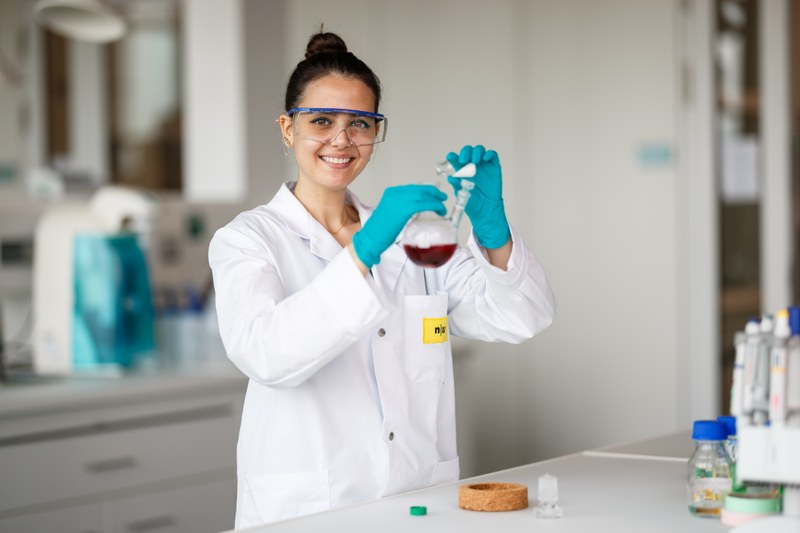
Would you like to take molecular chemistry further and develop innovative systems in practice? This Master’s programme qualifies you for leading roles in research, industry and technology.
Factsheet
- Degree
- Master of Science in Life Sciences
- Study mode
- Full-time, Part-time/work-study
- Learning mode
- Onsite, Online
- ECTS credits
- 90 / 120 (Double Degree)
- Next start
- 22.2.2027
- Duration
- 3 semesters (full-time) / 6 semesters (part-time)
- Teaching language
- Englisch
- Place
- FHNW Campus Muttenz, Hofackerstrasse 30, 4132 Muttenz
- Stay abroad
- Possible
- Application fee
- CHF 200
- Semester fee
- CHF 750 / CHF 1 000 / CHF 5 000
At a glance
- State‑of‑the‑art synthesis technologies: Deepen your expertise in photochemistry, electrosynthesis, flow chemistry and (bio)catalysis with a practical, industry‑oriented focus.
- Functional nanosystems: Design and synthesise biomolecular conjugates, bioactive surfaces and functional (nano)systems for applications in pharmaceuticals, agriculture and materials science.
- Customised study plan: Combine the core modules Organic Chemistry and Supramolecular Chemistry with electives from fields such as Analytical Chemistry, Biotechnology, Pharma Technology and Chemical Engineering to tailor the course to your interests and career goals
- Practice‑oriented master’s thesis: Undertake your eight‑month thesis at an industry partner or partner university - an ideal opportunity to build a professional network and gain research insights.
- International opportunities: Earn a double degree at a partner university or complete your thesis abroad.
Why study this?
What career opportunities are open to you?
This specialisation links physical chemistry with the Life Sciences, preparing you for a career in research and development. Your broad education, supported by electives from related disciplines, allows you to target careers in industry, academia or specialist institutions. In‑depth expertise in organic and supramolecular chemistry is in demand across sectors, qualifying you for varied roles nationally and internationally.
Typical areas of employment for graduates are:
- Pharmaceutical and biopharmaceutical companies: development and quality control of medicines.
- Agrochemical industry: research and application in crop protection and yield enhancement.
- Materials science: development of new and functional materials.
- Environmental technology: design of environmentally friendly processes and substances.
- High‑end manufacturing: application of supramolecular systems in precision production.
- Universities and research institutions: basic and applied research.
- Technology‑oriented companies: innovation management and product development at the interface of chemistry and technology.
Structure and programme contents
The programme provides a sound, practice‑oriented education, combining organic and supramolecular chemistry with current challenges in research and industry.
You will gain advanced knowledge in the following areas:
- Modern organic chemistry: Concepts and applications such as multi‑component reactions, photochemistry, electrochemistry, flow chemistry and (bio)catalysis.
- Molecule and synthesis design: Planning and synthesis of complex molecules including drugs, agrochemicals, polymers and biomolecules.
- Functional systems and surfaces: Development of bioconjugates, bioactive surfaces and functional materials for therapeutic or diagnostic applications.
- Electives from related fields: Specialisation options in Analytical Chemistry, Biotechnology, Chemical Engineering or Pharma Technology to promote interdisciplinary skills.
In addition to a wide range of subject-specific content, further modules strengthen skills in:
- Scientific working and communication: Planning, implementation and presentation of research projects in an international environment.
- Interdisciplinary thinking: Work at the interfaces between chemistry, biology, technology and industry.
- Personal design of the course: Individual focus setting according to your interests and career goals – also through an optional semester abroad with the option of obtaining a second master’s degree.
Details of the degree programme
Programme structure
Full-time course
Part-time study
Module Groups for the Organic and Supramolecular Chemistry specialisation
A total of 50 ECTS credits (i.e. 17 modules each worth 3 ECTS credits) must be earned. Other modules can be selected: Module overview (English)
You can also plan your studies in advance with our MSc Life Sciences planning tool.
Organic & Supramolecular Chemistry
Compulsory electives
Cluster-specific
Core skills
Thesis
International
Our master's programme opens up global horizons: whether aiming for a double degree, planning your master's thesis overseas or coming to us from abroad, we will support you every step of the way!
Outgoing Students: Doing your Master's thesis abroad: Information
Incoming Students: Studying with us as an international student: Information
Information about studying abroad: International Student Guide (PDF).
Requirements and admission
Direct admission requires:
- a Bachelor’s degree in a related field from a university of applied sciences or university with a good grade (Switzerland: A, B or ≥ 5; Germany/Austria: at least “good”),
- sufficient English proficiency.
If you do not fully meet the requirements, you may be invited to a personal interview.
Proof of sufficient English skills must be provided with one of the following certificates:
Type of certificate | Required level |
|---|---|
CE (Cambridge English) | B2/FCE |
IELTS (English Language Testing System) | 5.5 |
TOEFL (Test of English as a Foreign Language) | IBT 72 |
Spoken or Written Academic English (module in the bachelor’s degree programme at the School of Life Sciences) | 4.5 |
If you are unable to provide evidence of the required command of English, you are obliged to improve it during the course of your master’s degree programme. You can either attend the advanced English course offered by the FHNW School of Life Sciences or other suitable language courses. At the end of the programme, proof must be provided that the required level of English has been achieved (see table above).
Organisational matters
The international Master of Science in Life Sciences is conducted in collaboration with other Swiss Universities of Applied Sciences: Berner Fachhochschule BFH, Haute Ecole Spécialisée de la Suisse Occidentale HES-SO and Zürcher Hochschule für angewandte Wissenschaften ZHAW.
Course start
Tuition fees
Downloads/Links
Advising and Info Events
Contact
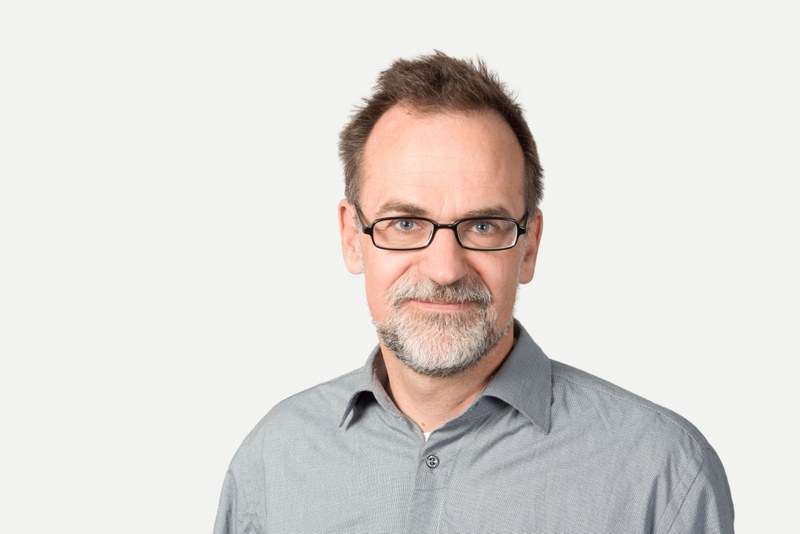
Prof. Dr. Georg Lipps
- Phone
- +41 61 228 54 52
- georg.lipps@fhnw.ch
Info Events
Loading...
Registration
Master in Life Sciences - Organic and Supramolecular ChemistrySpring semester 2027
- Date
- 22.2.2027
- Duration
- 3 semesters (full‑time)/6 semesters (part‑time)
- Place
- FHNW Campus Muttenz, Hofackerstrasse 30, 4132 Muttenz
- Notes
- Final application date: 30.11.2026
Master in Life Sciences - Organic and Supramolecular ChemistryAutumn semester 2027
- Date
- 20.9.2027
- Duration
- 3 semesters (full‑time)/6 semesters (part‑time)
- Place
- FHNW Campus Muttenz, Hofackerstrasse 30, 4132 Muttenz
- Notes
- Final application date: 30.4.2027