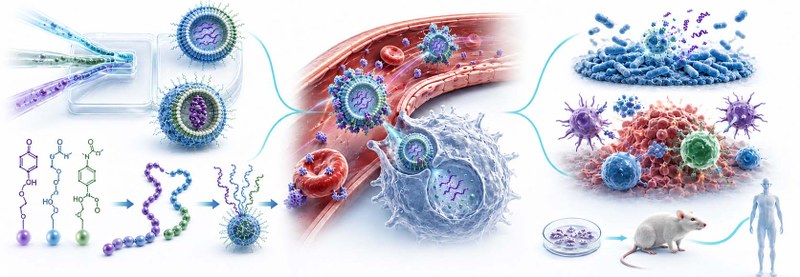
Engineering nanocarriers from material design to biological performance
We engineer nanoparticles to overcome biological barriers, enable the delivery of challenging biotherapeutics, and address hard-to-treat diseasess.
Our team is skilled at working with lipid, polymeric, and hybrid materials to produce nanocarriers. Inside, we can package cargo such as mRNA, peptides, proteins, and small molecules.
Our nanoparticles can be used to target cancer and antimicrobial-resistant infections, or be designed as sensing and diagnostic agents.
Research focus areas
Our research spans nanocarrier construction, nano–bio interactions, drug delivery, and translation to the clinic.
Nanocarrier engineering
We build lipid, polymeric, inorganic and hybrid nanocarriers through controlled synthesis and self-assembly, matching the carrier's architecture to its cargo and therapeutic purpose.
- Top-down and bottom-up synthesis
- Self-assembly and cargo encapsulation
- Proteins, peptides, nucleic acids and small molecules
Nano–biointerface engineering
We tune the size, composition, morphology, stiffness and surface chemistry of nanocarriers, then investigate how biological environments transform the nanocarrier's identity and performance.
- Surface engineering and bioconjugation
- Protein corona under biomimetic flow
- Barrier, cellular and immune interactions
Drug delivery and translation toward the clinic
We develop nanocarriers for small molecules and biologics, connecting in vitro mechanisms with preclinical validation. We also consider clinically relevant manufacturing constraints and predict how production of nanocarriers at larger scale will affect their size.
- Designing nanotherapeutics for cancer and resistant infections
- Producing nanoparticles using microfluidics, ensuring quality by design (QbD), and scaling up their production
- Understanding how in vitro results will translate to preclinical and clinical contexts
Projects
Lipid-polymer hybrid nanoparticles (LPNPs)
Lipid-polymer hybrid nanoparticles (LPNPs) combine the cargo compatibility of lipid systems with the mechanical stability and processing opportunities of polymeric carriers.
We are developing an integrated platform for reproducible formulation, dry-state storage and scalable two-step manufacture of LPNPs. Our aim is to develop LPNPs that deliver mRNA through the lungs (inhalation).
- Design: combining the cargo, lipid, and polymer
- Interrogate: considering the structure, interface, and function
- Manufacture: ensuring stability and quality at scale
- Validate: measuring performance against infectious diseases and cancer