Production of recombinant proteins and cell products with automated and linked processes
Recombinant proteins such as antibodies are up to 1,000 times larger and more complicated molecules than classical drugs such as aspirin. Novel therapies whose administered products rely on viral vectors, exosomes or modified cells are even more complex. The production of these large molecules and cell products is correspondingly difficult, expensive and time-consuming.
The bioprocess technology group teaches, develops and optimizes such biopharmaceutical production processes to produce sufficient material and, above all, with the desired product quality. New technologies and process approaches as well as traditional cell cultures and purification steps are used to map the entire process chain from the initial cell line to the finished product. Particular attention is paid to innovative measurement and control technology in order to be able to develop production-oriented solutions with automated and interconnected processes.
Research focus areas
Protein production
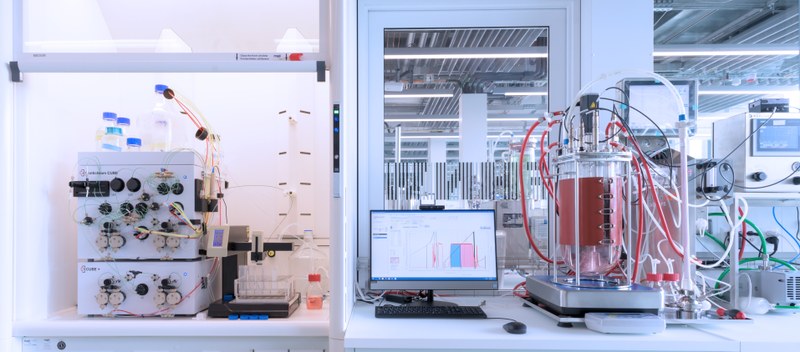
We have extensive knowledge in upstream and downstream processing for protein production. Our «plug-and-play» expression systems allow straighforward production of diverse proteins in both bacterial and mammalian host cells. The BPT infrastructure provides versatile production scales, with capabilities spanning from microtiter plate-level for screening applications to larger operations of up to 100L in pilot-scale production. We have access to diverse analytical and purification techniques for subsequent purification and analysis of high-quality products.
Viral vector manufacturing
Adeno-associated viruses (AAVs) have great potential as delivery vehicles for gene therapy. The production of therapeutic AAVs is complex and requires many steps to get to the final product: Plasmid production and purification, cell expansion, plasmid transfection and finally AAV production and purification.
We cover all steps from plasmid to product for high-quality AAV production. We produce and purify plasmids with our in-house developed plasmid platform. We evaluate different conditions for plasmid transfection of mammalian cells to increase AAV yield in suspension, optimise production conditions in bioreactors and set up robust and reliable purification methods to later characterize the produced AAV particles.
Continuous biomanufacturing
Mammalian steady-state perfusion processes represent a promising alternative to current fed-batch processes for biopharmaceutical production. Due to continuous feeding of nutrients and removal of waste products, a steady-state at a high VCD can be achieved, leading to higher productivities. However, the efficiency of recombinant therapeutic molecules is largely affected by quality attributes of which glycosylation being one of the most critical factors. Controlling the quality profile of biopharmaceuticals during long-term perfusion processes can be challenging. Together with an increase of biosimilars going to market due to patent expiry, matching quality attributes of biosimilars to the reference medical product is a of great interest in biopharmaceutical industries.
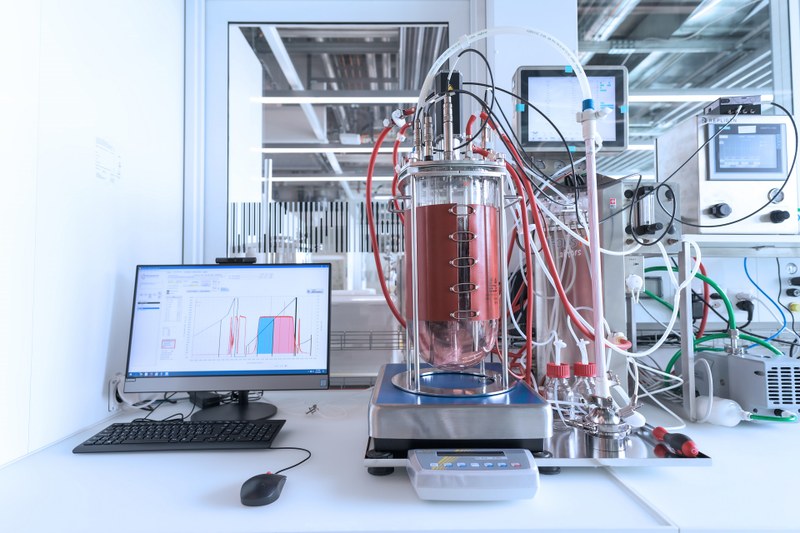
We evaluate multiple process intensification strategies to increase productivity with a strong focus on their impact on product quality. The bioprocess technology laboratory is equipped with several perfusion upgraded bioreactor systems containing TFF or ATF cell retention devices. State-of-the-art inline sensor technology, but also at-line analyzers including an autosampler system are available for close process monitoring. Furthermore, latest PAT technology such as Raman spectroscopy is in use to get real-time information about bioprocesses.
Process analytical technology
Since their initiation by the FDA in 2004, Process Analytical Technology (PAT) has been at the heart of the biopharmaceutical industry processes, allowing enhanced control and understanding of production operations. Through timely measurements of critical quality attributes (CQA) on-line, at-line and off-line, without disturbing the process, PAT enables real-time quality assurance. It encompasses a wide variety of techniques such as spectroscopy, chromatography as well as chemometrics. The ultimate goal of PAT is to reach a level of process control high enough to ensure the final product conformation and eventually real-time release testing (RTRT).
PAT techniques include classical analytical instruments, online sensors, and data analysis algorithms, and make use of Infrared as well as Raman spectroscopy. Used on-line in fermentations such as perfusion cell culture, it predicts various media components which have an impact on product quality.
Process modelling and machine learning
We pioneer advanced techniques for managing and interpreting biotechnological data. Our mission is to create state-of-the-art methodologies for:
- Data Manipulation: Enhancing the extraction, transformation, and handling of complex biotechnological data.
- Process Modeling: Developing detailed and accurate models that represent intricate biological processes.
- Simulation and Prediction: Using models to simulate processes, forecast outcomes, and understand potential scenarios.
- Optimization: Improving the efficiency and effectiveness of processes through sophisticated optimization techniques.
Currently, our primary focus is on upstream processes, which include the initial stages of biotechnological production, such as the production of mono clonal antibodies (mABs) and Adeno-associated viruses (AAV) capsids using perfusion processes. By leveraging our expertise in machine learning and computational modeling, we aim to drive innovation and provide cutting-edge solutions that address the unique challenges of upstream bioprocessing.
Facilities
News and stories
Publications
Contact

Prof. Dr. Thomas Villiger
- Phone
- +41 61 228 52 46
- thomas.villiger@fhnw.ch