With over 10,000 grape varieties, monitoring authenticity, adulteration and fraud poses a serious challenge for the wine industry.
The authenticity of our food and drink is an ever-present issue, with more and more fraudulent products entering the supply chain every day. In February 2016 Italian authorities seized bottles, labels and boxes relating to counterfeit samples of a well-known luxury brand of champagne which had an estimated market value of €1.8m. Analytical chemistry may help testing for authenticity and geographic origin of wine.
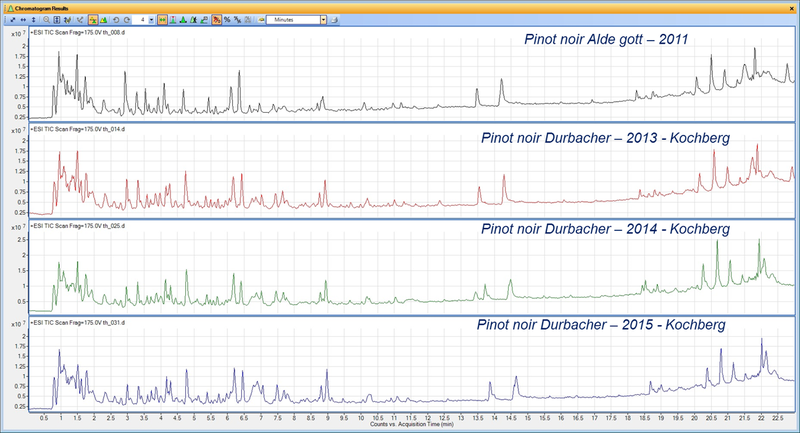
Example LC-MS chromatograms
The analysis of wine with robust high resolution LC-MS/MS has shown that it is possible to separate different vintages from the same vineyard.
3D Principal component analysis
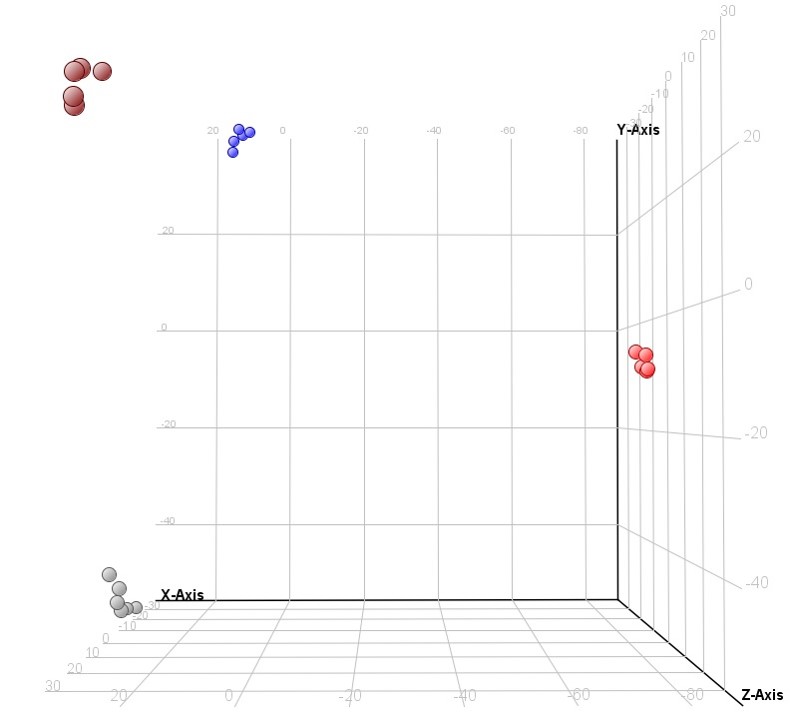
Red: Pinot noir Alde gott, 2011
Blue: Pinot noir Durbacher, 2013
Brown: Pinot noir Durbacher, 2014
Grey: Pinot noir Durbacher, 2015
The differentiation of wine varieties is possible by high resolution LC-MS/MS data and statistical data analysis. Profiling of various vintages from the same vineyard was successful but analysis time and processing time need to be improved.
Project details
- Type
- Research project
- Research areas
- Instrumental analytics
- University
- FHNW School of Life Sciences / Institute for Chemistry and Bioanalytics
- Collaboration
- Timm Hettich, Götz Schlotterbeck
Contact

Prof. Dr. Stefan Gaugler
- Phone
- +41 61 228 50 98
- stefan.gaugler@fhnw.ch