Skip to main contentSkip to search barSkip to navigationSkip to footer
Logo of the University of Applied Sciences and Arts Northwestern Switzerland
  • DE
  • EN
  • Home

Ten Schools One Goal

The FHNW comprises 10 schools with different specializations. Select a school to see its specific courses, study programmes and information.

Applied Psychology

Architecture, Construction and Geomatics

Art and Design

Music

Computer Science

Life Sciences

School of Education

Social Work

Engineering and Environment

Business

  • Study offerings

    • All degree programmes
    • Master in Life Sciences
    • Master in Medical Informatics
    • Joint Degree Master in Biomedical Engineering
    • Info events
  • About degree programmes

    • Tuition fees and scholarships
    • Digital Life Sciences
  • International

    • Outgoing Students
    • Incoming Students
    • Double Degree
    • Partner universities
    • Student stories
    • Buddy programme
    • News and stories
  • Continuing education offerings

    • All continuing educations
    • CAS - Certificate of Advanced Studies
    • Modules and Seminars
    • Info events
  • Organisation

    • Consulting services
    • Legal information and terms & conditions
  • Research

    • Research fields
    • Projects
  • Collaboration

    • Process Technology Centre
    • Services
    • Tech Transfer Office
    • Student projects
  • International

    • Study abroad
    • International research projects
  • Updates and insights

    • News and stories
    • Research highlights
  • Events

    • All events
    • Info events
  • Media corner

  • About the School of Life Sciences

    • Strategy and values
    • Management board
    • Staff
    • Advisory board
    • People directory
    • Diversity and equal opportunities
    • Media corner
    • Infrastructure and campus
  • Institutes and centres

    • Institute for Chemistry and Bioanalytics
    • Institute for Ecopreneurship
    • Institute for Medical Engineering and Medical Informatics
    • Institute for Pharma Technology and Biotechnology
    • Centre for Teaching and Learning
    • Process Technology Centre
Logo of the University of Applied Sciences and Arts Northwestern Switzerland
  • About the School
    • School
    • Degree Programmes
    • Continuing Education
    • Research
    • Events
  • Social Media
    • Facebook
    • Instagram
    • YouTube
    • LinkedIn
  • About FHNW
    • Organisation
    • Schools
    • Locations
    • FHNW Library
    • Media Relations
  • Support
    • IT Support
    • Inside FHNW
    • Webmail
  • Data Protection
  • Imprint
  • Accessibility
  • Study offerings

    • All degree programmes
    • Master in Life Sciences
    • Master in Medical Informatics
    • Joint Degree Master in Biomedical Engineering
    • Info events
  • About degree programmes

    • Tuition fees and scholarships
    • Digital Life Sciences
  • International

    • Outgoing Students
    • Incoming Students
    • Double Degree
    • Partner universities
    • Student stories
    • Buddy programme
    • News and stories
  • Continuing education offerings

    • All continuing educations
    • CAS - Certificate of Advanced Studies
    • Modules and Seminars
    • Info events
  • Organisation

    • Consulting services
    • Legal information and terms & conditions
  • Research

    • Research fields
    • Projects
  • Collaboration

    • Process Technology Centre
    • Services
    • Tech Transfer Office
    • Student projects
  • International

    • Study abroad
    • International research projects
  • Updates and insights

    • News and stories
    • Research highlights
  • Events

    • All events
    • Info events
  • Media corner

  • About the School of Life Sciences

    • Strategy and values
    • Management board
    • Staff
    • Advisory board
    • People directory
    • Diversity and equal opportunities
    • Media corner
    • Infrastructure and campus
  • Institutes and centres

    • Institute for Chemistry and Bioanalytics
    • Institute for Ecopreneurship
    • Institute for Medical Engineering and Medical Informatics
    • Institute for Pharma Technology and Biotechnology
    • Centre for Teaching and Learning
    • Process Technology Centre

Type a search term and search continuing education,degree programmes, events, documents and other content.

  • Life Sciences
  • Research and services
  • Research in life sciences
  • Projects
Projects

Evaluating organically cultivated bamboo species for their antioxdiant capacities, FHNW School of Life Sciences

School of Life Sciences


LC-MS/MS profiling of flavonoid composition and assessment of antioxidant capacity of 24 different bamboo species
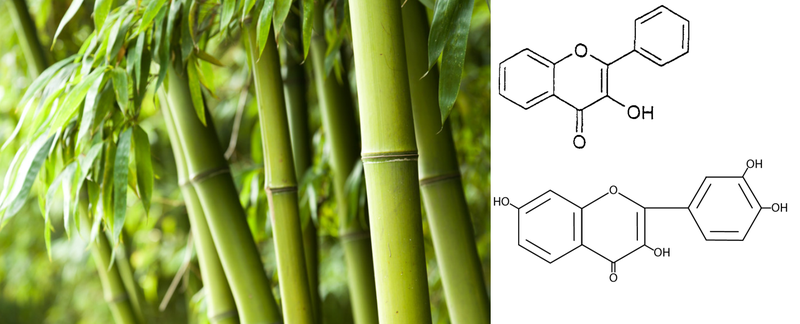
Flavonoide in Bambus.PNG

Bamboo is a rich source of flavonoids. These secondary plant metabolites exhibit many beneficial physiological effects such as anti-inflammatory, anti-oxidant, anti-viral and anti-aging properties or prevention against cardiovascular diseases, which were exploited in traditional Chinese medicine TCM also [1]. Today, bamboo is widespread used in cosmetics and in the textile and food industry.

We investigated 24 bamboo species of the genera Phyllostachys, Fargesia murielae and Sasa that were organically cultivated and harvested in Switzerland. Dried leaves were milled and extracted by accelerated solvent extraction (ASE). Clean-up of samples before LC-MS/MS analysis was achieved by solid phase extraction (SPE).

Results

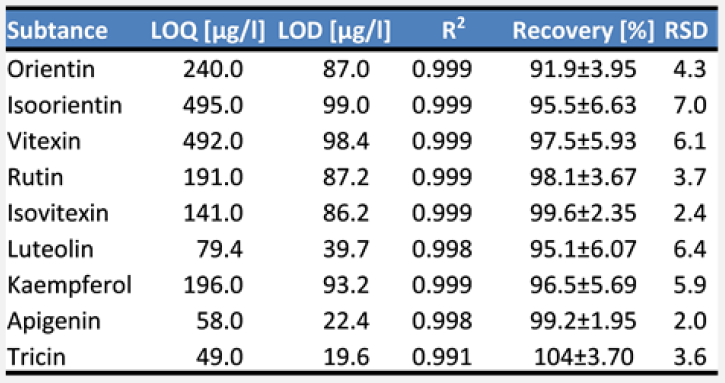
The LC-MS/MS method for quantification of the major bamboo flavonoids was robust and valid.
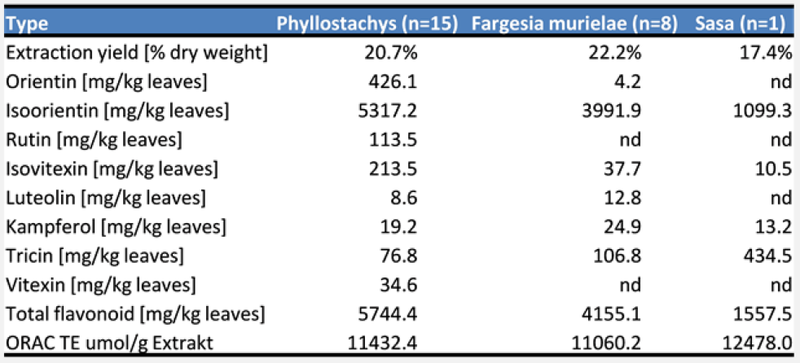
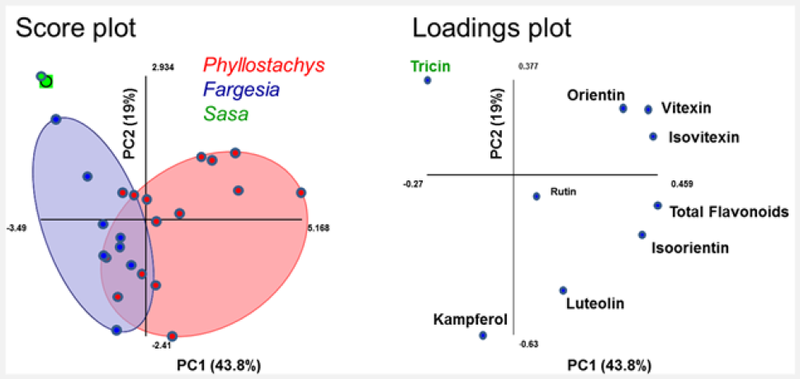
Different bamboo species can be clearly distinguished by an altered flavonoid profile. In addition different bamboo genera show characteristic patterns of individual flavonoids. Phyllostachys bamboo generally exhibits both higher total and higher individual flavonoid levels compared to Fargesia murielae and Sasa. Tricin is most prominently found in Sasa bamboo. Anti-oxidative capacity was found to be similar for all bamboo genera. Principal component analysis, based on flavonoid levels for the 24 different bamboo species, clearly reveals similarities within a genus and differences in between the genera.
Conclusion

A robust LC-MS/MS method was developed for quantification of flavonoids in bamboo leaf extracts. All bamboo genera reveal high radical scavenging properties. Principal component analysis allows for straightforward differentiation between bamboo species.  Further studies on other beneficial physiological effects of bamboo are currently under investigation in our labs.

[1] Lu B., Wu, X., Tie X., Zhang Y. Toxicology and safety of anti-oxidant of bamboo leaves. Food and Chemical Toxicology, 43 (2005), 783-792.

Project details

Type
Research project
Research areas
Instrumental analytics
University
FHNW School of Life Sciences / Institute for Chemistry and Bioanalytics
Partner
Organic Bamboo Industries AG
Collaboration
Timm Hettich, Jenny Dold, Christian Gerig, Götz Schlotterbeck

Contact

Stefan Gaugler

Prof. Dr. Stefan Gaugler

Team Leader, Instrumental Analytics
Phone
+41 61 228 50 98
E-Mail
stefan.gaugler@fhnw.ch

School of
Life Sciences FHNW University of Applied Sciences and Arts Northwestern Switzerland

  • About the School
    • School
    • Degree Programmes
    • Continuing Education
    • Research
    • Events
  • Social Media
    • Facebook
    • Instagram
    • YouTube
    • LinkedIn
  • About FHNW
    • Organisation
    • Schools
    • Locations
    • FHNW Library
    • Media Relations
  • Support
    • IT Support
    • Inside FHNW
    • Webmail
Logo FHNW - 20 Years
Logo Swiss Universities
Logo European University Association
© University of Applied Sciences and Arts Northwestern Switzerland (FHNW)
  • Data Protection
  • Imprint
  • Accessibility
  • DE
  • EN