Holographic identification of titanium implants
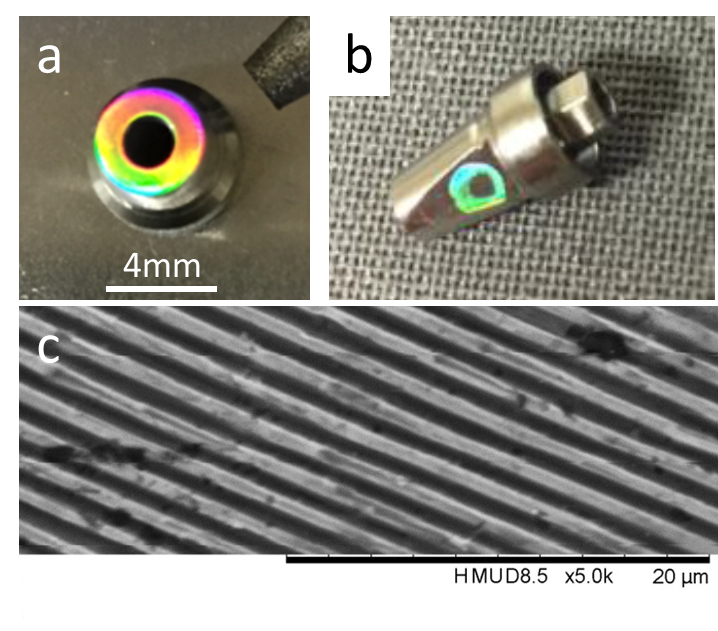
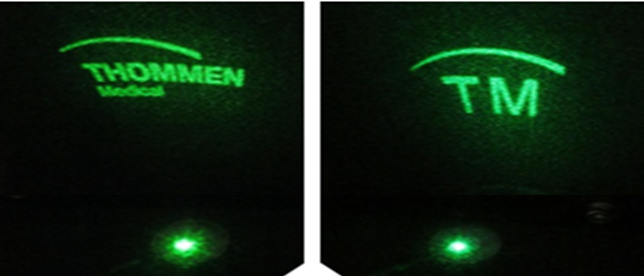
The holographic labelling of implants is necessary to ensure their authenticity and traceability. In this project, we developed holographic security features and highly complex Diffractive Optical Elements (DOE) revealing images like QR codes, logos, article or lot numbers when illuminated by a laser that can be integrated directly into the titanium implant material. These innovative design attributes can be used for unique device identification (UDI) in medical devices.
Our nanostructured surface-labelling is fully tissue-compatible because the embossing process is based on a physical structuring of the implant surface without additives or coating. The underlying holographic nanostructures are resistant to all conventional sterilization methods. Security 1st and 2nd levels features provide (hidden) unique identifying structures for trademark protection of titanium implants.
Gallery

References
- M. de Wild, R. Krähenbühl, D. Kallweit, R. Marek, M. Estermann, M. Schnieper, Holographic identification of titanium implants, European Cells and Materials, Online Periodical, Collection 1; Meet the Expert Conference Abstracts, p10 (2019).
- M. Estermann, J. Waser, Ch. Schneider, A. Luu-Dinh, M. Schnieper, D. Kallweit, R. Krähenbühl, M. de Wild, R. Marek, Medical prostheses, medical osteosynthetic devices or hearing aids with security and/or identification elements, patent application, EP18164627.4 and EP18164630.8, 28.03.2018.
Project details
- Type
- Research project
- Research field
- Functional materials and surfaces
- School
- FHNW School of Life Sciences / Institute for Medical Engineering and Medical Informatics
- Partners
- Thommen Medical, CSEM
- Funding
- KTI / CTI
Contact

Prof. Dr. Michael de Wild
- Phone
- +41 61 228 56 49
- michael.dewild@fhnw.ch