Key data
Activities
- Schola Cantorum Basiliensis: Lecturer for Natural Trumpet
- Schola Cantorum Basiliensis: Lecturer for Didactics Natural Trumpet
Short biography
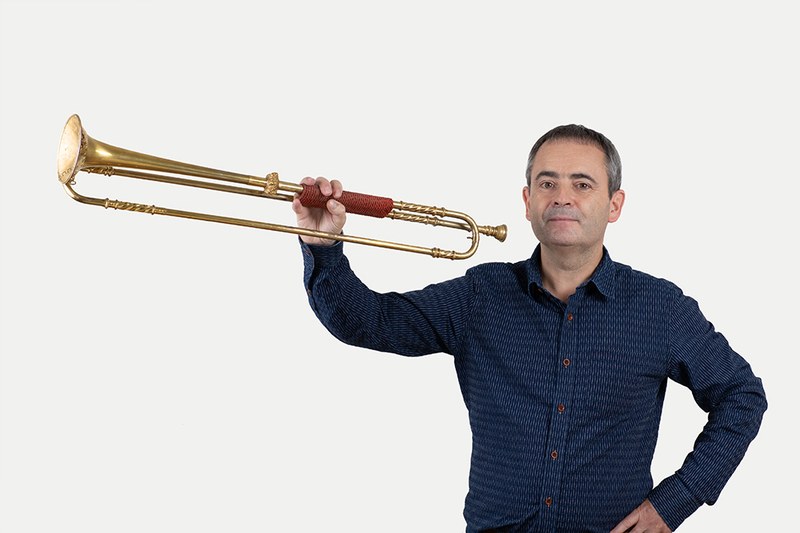
After completing his studies at the Conservatoire National Supérieur de Musique in Lyon – where Jean-François Madeuf has been teaching historical trumpets since 1992 – he spent several years as an orchestral musician and as a trumpet teacher (modern valve trumpet) at French conservatoires. In 2001, he was appointed professor at the Schola Cantorum Basiliensis as the successor to Edward H. Tarr, the pioneer of the natural trumpet, and also teaches subject-specific pedagogy / didactics. In 2011, he was also appointed as lecturer at the Conservatoire National Supérieur de Musique in Paris.
For many years, Madeuf has performed with numerous French, European and non-European Baroque ensembles, such as Les Arts Florissants, Le Concert Spirituel, Les Talents Lyriques, La Petite Bande and the Bach Collegium Japan. He can be heard in concert and on CD recordings and remains one of the few musicians who play the natural trumpet and the natural horn in an historically informed, authentic manner, without the correction holes that were only invented fifty years ago for modern instruments and are now most commonly used.
In 2009, Jean-François Madeuf was awarded the Christopher Monk Award by the Historic Brass Society for “his significant contribution as a performer and teacher to historically informed performance”. He is currently conducting further research as part of a doctoral thesis at the Koninklijk Conservatorium Brussel and the Vrije Universiteit Brussel.
In 2021, he was a prize-winner of the Hibou Foundation (Thalwil, Switzerland).
Publications
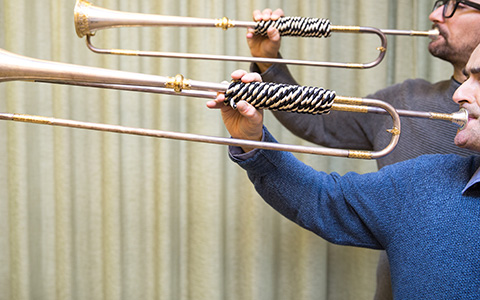
"… vnd machens nur aus dem Synn"
Philosophy
Jean-François Madeuf’s teaching is unique in that it is based on mastery of the natural instrument (whilst not ruling out the use of half-valved instruments) and enables students to develop a solid instrumental technique, which is so important in their professional lives. Students are also encouraged to apply their knowledge of historical sources in the most logical and convincing way possible, in order to foster a vibrant and rich ‘discours musical’.
The relevant repertoire spans from the late 16th century to the early 20th century, whether the instrument is played in its historical form, with modern modifications, or on instruments with slides or valves. In some cases, and for certain specific diplomas, it may also relate exclusively to the 19th-century repertoire, using instruments such as the valved flugelhorn or the cornet (piston).
Semi-improvised Sonata after Cesare Bendinelli’s Volume di Tutta l’arte della trombetta (1614). The Secret Behind Cesare Bendinelli’s (1542-1617) Volume di Tutta l’arte della trombetta (1614).