Culinary Return: gastro-political ecologies of indigenous cooking landscapes in Peru
Project details
- University
- Basel Academy of Art and Design / Institute of Experimental Design and Media Cultures
Fall Semester 2021
This Ph.D. will investigate Peruvian ancestral ways of cooking with the landscape, which are the ensembles of ancestral cooking and preserving methods based on Andean cosmovision and in accordance with diverse ecological non-human agencies (earth, water, air, etc.). Through a decolonial, post-dualistic, and feminist design practice, I position myself as a Peruvian mestiza and design researcher, to understand and rightfully mediate these indigenous foodways as common ecological knowledge, reclaiming its sovereignty and defying its current commoditization by the national and international gastronomy industry.
Peru is a food system paradox. The harsh division of urban and rural landscapes is the same that detaches its modern food culture to the living systems and agricultural communities that support it. This context is interconnected and endured by the global extractivist and power structures fueling the unsustainable food systems. Therefore, during the three years of this program, I propose to explore rooted and regenerative ways of knowing through indigenous cooking practices, in tandem research between Peruvian and Swiss food and design communities.
During the first stage, I will follow the Qhapaq Ñan, the Inca Road System that connected the pre-colonial Latin America, specifically the section that linked Lima, Peru’s modern capital, and Cuzco, Tahuantinsuyo ancient Capital. In this route, I will identify and learn with main indigenous communities who preserve these nurturing relationships with the landscape. I will map these autochthone foodways, such as saliva-fermentation, endemic foraging, salt and freeze-drying, and earth-oven cooking, through collective and embodied experimentation methods.
On a second stage, I will mediate this situated knowledge inside urban contexts in Lima and Basel, to prototype hybrid infrastructures for cooking and eating together to 1. Recover and rend visibility to indigenous voices and their multidimensional approach to food materiality 2. open up spaces for inter-and transdisciplinary dialogue to challenge the notions of western design and culinary exoticization 3. collectively develop an intersectional culinary archive to radically interconnected our food consumption practices back to ‘thinking-feeling with the earth’.
Informed by emerging epistemologies from the global south, through this research I will navigate the gastro-political entanglements of indigenous food sovereignty strive. In the global context of climate change and the Coronavirus pandemic, food has become both actor and activist. Hence, taking on Gloria E. Anzaldúa’s ‘mestiza consciousness’, this research aims to dwell in the borderlands of cooking as an aesthetical, interspecies, and political design practice.
Supervisors
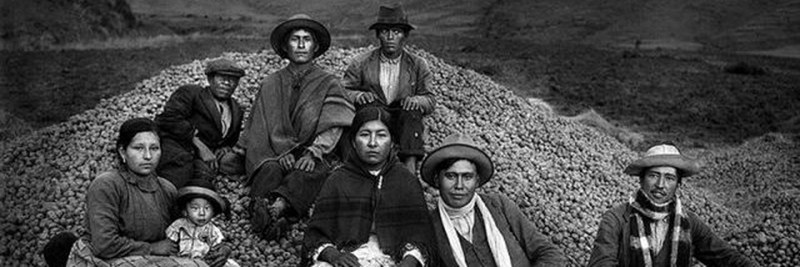
1934. “Ezequiel Arce (community) and his papas harvest”, Qatca, (Departamento de Cuzco, Perú) Martin Chambi Photography Archive