Seeing with Hands, Touching with Eyes. Providing new experiences with integration of Visual and Tactile Perception
Project details
- University
- Basel Academy of Art and Design / Institute of Experimental Design and Media Cultures
Fall Semester 2017
The development of digital media in the twentieth centuries onwards, has made people lose their connection with their sense of touch. The more we stare at screens and use touch interfaces, the more we stop training our haptic perception. Hence, people are losing the awareness with their sense of touch.
The technology today is influencing our vision in many ways. We are more dependent on our technological devices than ever. Because the society is aware that the industry is changing fast, they want to provide the users with more information through their screens. For example, the company Tanvas made touchscreen be more haptic, as they state: “haptic feedback system lets you feel texture on a touchscreen.” (See Figure 1) It is surreal to think that an already haptic material can represent another haptic material — meaning the screen which is already smooth and tactile, can through vibrations simulate an already know textile material to us. The only part is that these tactile monitors are still limiting our tactile experiences. People are not experiencing this tactile feedback through their whole body, but still with only tips of their fingers.
As mentioned, Visual Perception is one of our dominant senses due to Visual Cortex system. Although, if we loose our tactile sense our optic sense could not function the same way. Tactile perception is influenced by its surroundings. The topic is relevant, because people are not aware of this perceptual connection. Also, because of the industrial development we depend more on looking at the screens, and if these screens become a representation of tactile materials, I question can we then touch everything through the screens? These screens that already have a tactility within them. And although these screens can be tactile, the visual sense is still the dominant one. The screens show us what to expect.
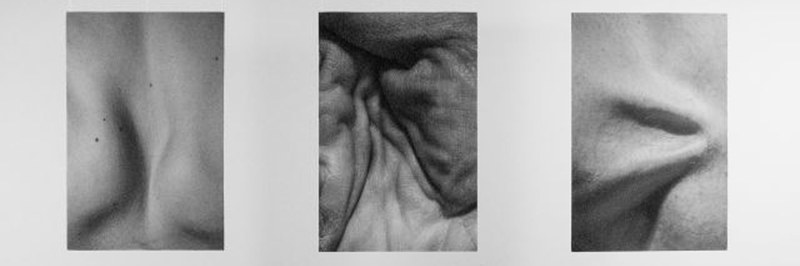
In my topic, I would like to integrate the two senses in a more analogical way. Also, with my work I do not want to simulate other tactile materials. I would examine what experiences can the beholder have with different tactile parameters.