Skip to main contentSkip to search barSkip to navigationSkip to footer
Logo of the University of Applied Sciences and Arts Northwestern Switzerland
  • DE
  • EN
  • Home

Ten Schools One Goal

The FHNW comprises 10 schools with different specializations. Select a school to see its specific courses, study programmes and information.

Applied Psychology

Architecture, Construction and Geomatics

Art and Design

Business

Computer Science

Engineering and Environment

Life Sciences

Music

School of Education

Social Work

  • Study offerings

    • All degree programmes
    • Master in Life Sciences
    • Master in Medical Informatics
    • Joint Degree Master in Biomedical Engineering
    • Info Events
  • About degree programmes

    • Tuition fees and scholarships
    • Digital Life Sciences
  • International

    • Outgoing Students
    • Incoming Students
    • Double Degree
    • Partner universities
    • Student stories
    • Buddy programme
    • News and stories
  • Continuing education offerings

    • All continuing educations
    • MAS - Master of Advanced Studies
    • DAS - Diploma of Advanced Studies
    • CAS - Certificate of Advanced Studies
    • SAS - Short Advanced Studies
    • Specialist seminars
    • Info Events
  • Organisation

    • Consulting services
    • Legal information and terms & conditions
  • Research

    • Research fields
    • Projects
    • Institutes and centres
  • Collaboration

    • Process Technology Centre
    • Facilities and services
    • Tech Transfer Office
    • Student projects
  • International

    • Study abroad
    • International research projects
  • Updates and insights

    • News and stories
    • Research highlights
  • Events

    • All events
    • Info Events
  • Media corner

  • About the School of Life Sciences

    • Strategy and values
    • Management board
    • Administration and service staff
    • Advisory board
    • People directory
    • Diversity and equal opportunities
    • Media corner
    • Infrastructure and campus
  • Institutes and centres

    • Institute for Chemistry and Bioanalytics
    • Institute for Ecopreneurship
    • Institute for Medical Engineering and Medical Informatics
    • Institute for Pharma Technology and Biotechnology
    • Centre for Teaching and Learning
    • Process Technology Centre
Logo of the University of Applied Sciences and Arts Northwestern Switzerland
  • About the School
    • School
    • Degree Programmes
    • Continuing Education
    • Research
    • Events
  • Social Media
    • Facebook
    • Instagram
    • YouTube
    • LinkedIn
  • About FHNW
    • Organisation
    • Schools
    • Locations
    • FHNW Library
    • Media Relations
  • Support
    • IT Support
    • Inside FHNW
    • Webmail
  • Data Protection
  • Imprint
  • Accessibility
  • Study offerings

    • All degree programmes
    • Master in Life Sciences
    • Master in Medical Informatics
    • Joint Degree Master in Biomedical Engineering
    • Info Events
  • About degree programmes

    • Tuition fees and scholarships
    • Digital Life Sciences
  • International

    • Outgoing Students
    • Incoming Students
    • Double Degree
    • Partner universities
    • Student stories
    • Buddy programme
    • News and stories
  • Continuing education offerings

    • All continuing educations
    • MAS - Master of Advanced Studies
    • DAS - Diploma of Advanced Studies
    • CAS - Certificate of Advanced Studies
    • SAS - Short Advanced Studies
    • Specialist seminars
    • Info Events
  • Organisation

    • Consulting services
    • Legal information and terms & conditions
  • Research

    • Research fields
    • Projects
    • Institutes and centres
  • Collaboration

    • Process Technology Centre
    • Facilities and services
    • Tech Transfer Office
    • Student projects
  • International

    • Study abroad
    • International research projects
  • Updates and insights

    • News and stories
    • Research highlights
  • Events

    • All events
    • Info Events
  • Media corner

  • About the School of Life Sciences

    • Strategy and values
    • Management board
    • Administration and service staff
    • Advisory board
    • People directory
    • Diversity and equal opportunities
    • Media corner
    • Infrastructure and campus
  • Institutes and centres

    • Institute for Chemistry and Bioanalytics
    • Institute for Ecopreneurship
    • Institute for Medical Engineering and Medical Informatics
    • Institute for Pharma Technology and Biotechnology
    • Centre for Teaching and Learning
    • Process Technology Centre

Type a search term and search continuing education,degree programmes, events, documents and other content.

Making water flows visible, FHNW School of Life Sciences

5.8.2026 – School of Life Sciences, Institute for Ecopreneurship


  • Life Sciences
  • News and events
  • News and Stories
  • All news and stories
All news and stories
Ta.jpeg

The FHNW School of Life Sciences is using a tool to help ensure a climate-resilient water supply in Peru.

  • Story

How can we identify where water is being lost in a city, and how can water suppliers better respond to the consequences of climate change? Answers to these questions are provided by the Water Flow Diagram (WFD1), an analytical approach for the transparent representation of urban water systems. Researchers at the FHNW School of Life Sciences (HLS) are currently using this tool in Peru in collaboration with the German Society for International Cooperation (GIZ). They have adapted it to local conditions to identify weaknesses in the water supply and lay the foundations for a secure long-term drinking water supply.

Patrik Eckert, a researcher in Dr Maryna Peter’s WASH working group at the HLS Institute for Ecopreneurship, collaborated with water supply companies, public authorities and universities in Lima, Tarapoto, Moyobamba and Cusco. The three-week technical mission focused on introducing and validating the water flow diagram. This visualisation tool clearly illustrates water flows in a city and highlights where it is used efficiently and where losses or vulnerabilities occur.
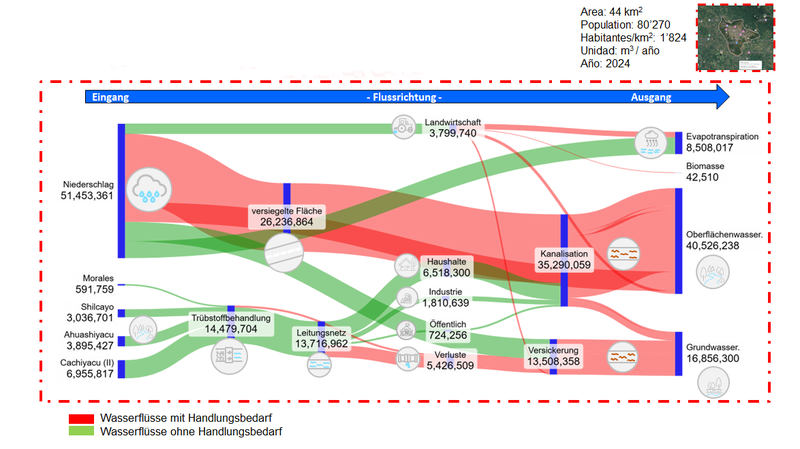
Water flow diagram for Tarapoto, Peru
UNSM Moyombamba

A tool for informed decision-making

Unlike traditional data tables, the water flow diagram makes complex interactions visible at a glance. It traces the water – from rainfall through rivers and lakes to its use in households, agriculture or industry – whilst also illustrating where it is lost or used unsustainably. This provides water suppliers with a sound basis for planning targeted investments and adapting their infrastructure to future challenges.

Tailor-made solutions for different regions

A particular focus of the project is on taking regional differences into account. In the Amazon region around Tarapoto the analysis centres primarily on heavy rainfall and its impact on the drinking water supply, whereas in the Andean region around Cusco the focus is on water sources and storage systems. The analyses are supplemented by scenarios for dry and wet seasons, as well as forecasts of population growth, tourism and increasing soil sealing. This enables realistic assessments of future developments.

“The water flow diagram helps to present complex water systems in an understandable way and to make informed decisions for a sustainable water supply” says Eckert.

Science and practice work hand in hand

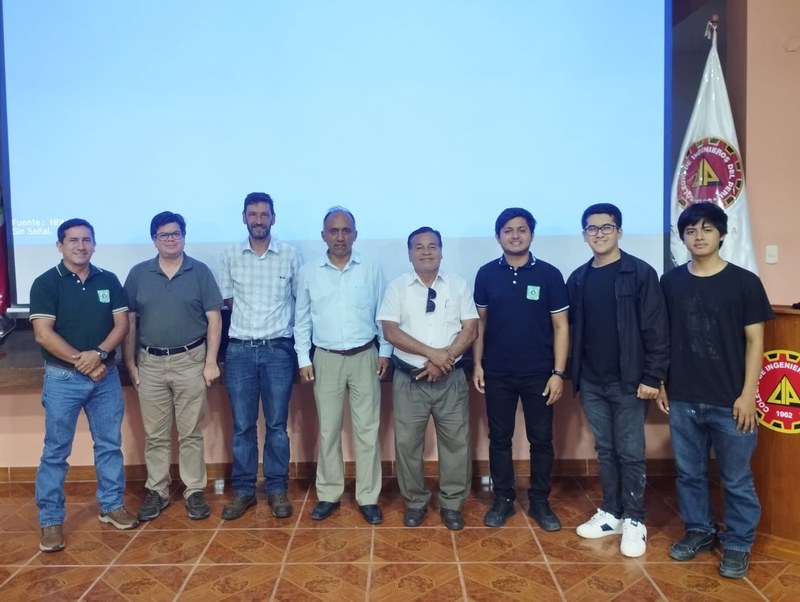
This collaboration is not limited to practical applications. With the signing of a framework agreement between the HLS and the Universidad Nacional de San Martín (UNSM), the partnership has also been strengthened in the academic sphere. As part of their final-year projects, students at the Peruvian university are further developing the water flow diagram and applying it directly with regional water suppliers.

“The close collaboration between academia and the field creates solutions that can be implemented immediately on the ground whilst also having a long-term impact.”

A contribution to climate-resilient water supply

Following successful trials with the water suppliers EMAPA San Martín, SEDA-CUSCO and EPS Moyobamba, the methodology is set to be incorporated into Peru’s national water management plan. The project is thus making an important contribution to making cities more resilient to the effects of climate change and to securing the long term supply of clean drinking water.

1 www.waterflowdiagram.ch

Project

Improving water security in Peru’s cities

Institute
Institute for Ecopreneurship
Research field
Water, sanitation, and hygiene

Contact

Patrik Eckert

Patrik Eckert

Research Associate
Phone
+41 61 228 60 07
E-Mail
patrik.eckert@fhnw.ch

School of
Life Sciences FHNW University of Applied Sciences and Arts Northwestern Switzerland

  • About the School
    • School
    • Degree Programmes
    • Continuing Education
    • Research
    • Events
  • Social Media
    • Facebook
    • Instagram
    • YouTube
    • LinkedIn
  • About FHNW
    • Organisation
    • Schools
    • Locations
    • FHNW Library
    • Media Relations
  • Support
    • IT Support
    • Inside FHNW
    • Webmail
Logo FHNW - 20 Years
Logo Swiss Universities
Logo European University Association
© University of Applied Sciences and Arts Northwestern Switzerland (FHNW)
  • Data Protection
  • Imprint
  • Accessibility
  • EN
  • DE