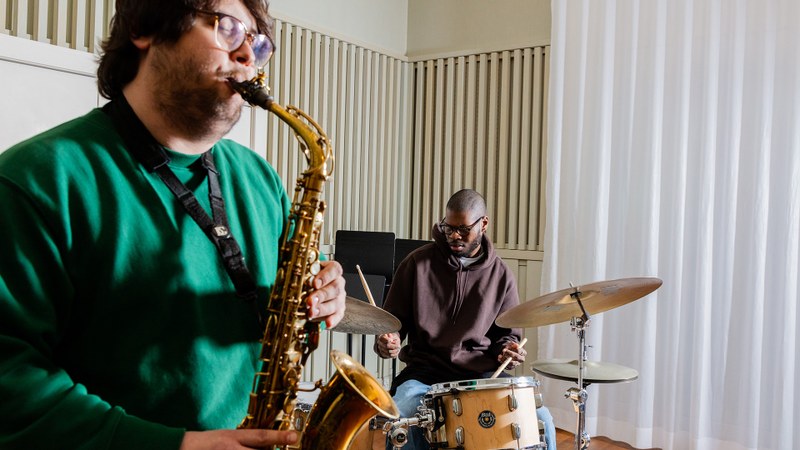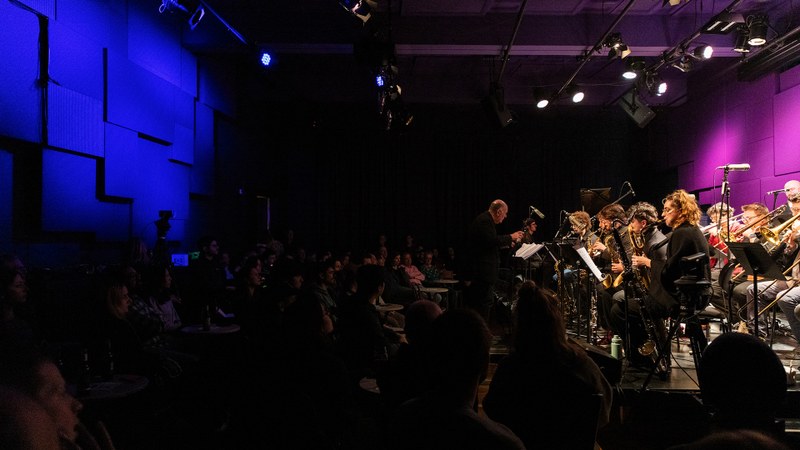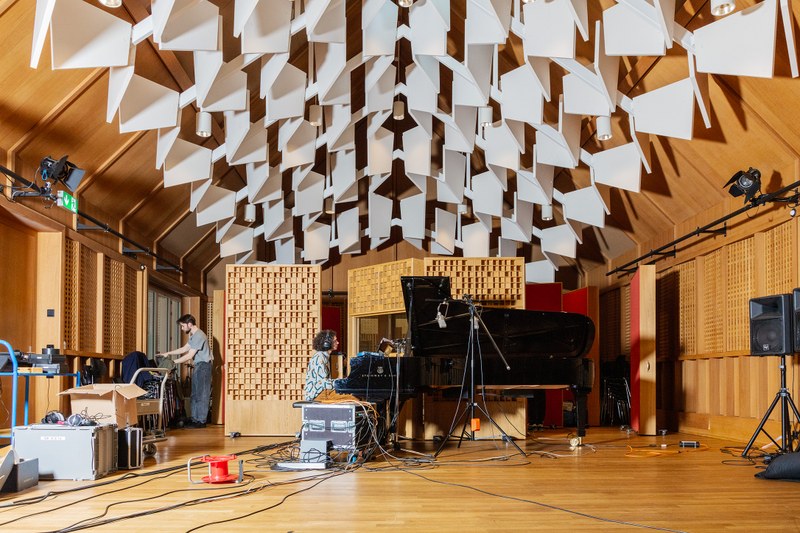
Find your own voice! The Bachelor Jazz gives you room to develop your personal musical expression while building a solid foundation in instrumental and theoretical skills. Our outstanding faculty guide you as artistic mentors. As part of an inspiring international community, you explore a wide range of musical approaches. Excellent facilities and Basel’s vibrant music scene provide an ideal environment for you to grow as an artist and expand your professional network.
Factsheet
- Degree
- Bachelor of Arts FHNW in Musik, Studienrichtung Jazz Instrumental/Vokal oder Komposition
- Study mode
- Full-time
- Learning environment
- Onsite
- ECTS points
- 180
- Next start
- 14.9.2026
- Duration
- 6 semesters
- Staying abroad
- Possible
- Application fee
- 200 CHF
- Semester fee
- 750 CHF (CH) | 1000 CHF (EU/EFTA) | 1250 CHF (Not-EU/Not-EFTA)
At a glance
- Practice-oriented curriculum: private lessons, ensembles, composition and theory, complemented by contextual reflection, music production, and industry knowledge
- Individual coaching from experienced, renowned faculty
- Regular inspiring masterclasses, projects, and collaborations
- Wide range of electives across all institutes of the Hochschule für Musik Basel
Why study this?
The Bachelor’s degree prepares you for further specialization and professional qualification in a consecutive Master’s program.
The program is designed for talented and dedicated musicians who want to turn their passion into a profession and prepare for careers in today’s diverse music world.
What is so special about studying jazz? What do you like about Jazzcampus Basel?
Neža Ožinger provides some insight
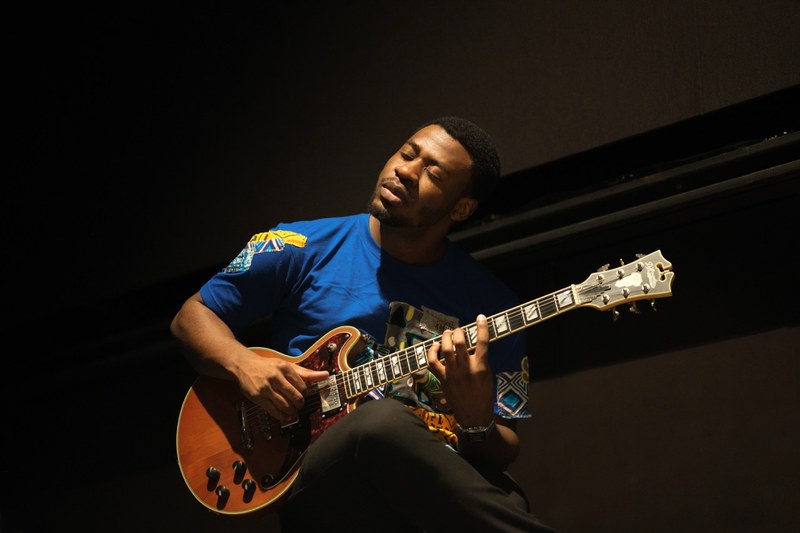
“I used to think, How could jazz musicians pick notes out of thin air? I had no idea of the knowledge it took. It was like magic to me at the time.” Calvin Hill in Paul F. Berliner’s outstanding book Thinking In Jazz – The Infinite Art of Improvisation
Structure and programme contents
The Bachelor programme focuses on the practical foundations on which the holistic development of an artistic personality is built. Central elements include the development of solid instrumental or vocal technique, a broad repertoire and a refined jazz language.
From the very beginning, strong emphasis is placed on the development of students’ own compositional work, alongside fundamental musical subjects such as theory, ear training and rhythm. These are complemented by a broad range of carefully coordinated core and elective courses. The programme supports students in developing their own musical voice and in contributing professionally to a wide variety of musical contexts.
Modules and regulations
The BA and MA degree programmes at the Basel Academy of Music are based on modules.
The legally binding structure provides an initial guide to the content and weighting of the subjects on the degree programme.
The detailed content and modalities of the individual subjects can be found in the module descriptions.
The study regulations come into force together with the study and examination regulations of the Basel Academy of Music FHNW and form the legal framework.
Structure
Module descriptions
Below please find the link with all the information on the module descriptions of several FHNW schools.
- Switch the language settings to English.
- Filter by semester, Hochschule für Musik Basel FHNW, the desired degree programme or other criteria to display the relevant module information.
- Use the PDF button to call up a document from each overview and save it for yourself.
- Course registrations are made via the intranet.
Study Regulations
Lecturers
Institut Jazz
Requirements, admission, entrance exam
A good basic knowledge of English is required at the start of the programme. This will be assessed during the admissions process.
Entrance exam
The entrance exam is individual for each study programme direction.
Main subject instrument or vocals
Guideline for the admission procedure
The admission procedure of the Academy of Music Basel for the Bachelor of Arts in Music Jazz with main subject instrument or vocals takes place in several phases:
Preselection: Video-Dossier
An audiovisual (video/sound) recording of three pieces accompanied by an ensemble must be submitted. As an option, personal compositions by the applicants can be included in the repertoire. The selection of the recorded music should highlight both the interpretative and improvisational skills and show familiarity and affinity with jazz as well as possibly with related musical genres.
Criteria for the creation of the videos
- All excerpts should be recorded in their entirety, in their original state and uncut.
- We recommend using a stereo microphone and placing it in the best possible position. If none is available, the microphone of a camera, computer or smartphone can also be used.
- The video should be shot from a static perspective, hands and face should be clearly visible.
- Public recordings can be used as long as they meet the above criteria and have not been edited.
- The recordings should be recent and in no case older than one year.
- The individual pieces can be recorded separately.
Upload and transmission
- To upload the video, please choose either the Vimeo (https://vimeo.com) or YouTube (https://youtube.com) platform.
- Access to the video must be provided until the end of June of the application year.
- The links to the videos (instrumental/vocal performances) are submitted at the same time as the application by 15 February at the latest.
Preselection
Based on the submitted portfolio, a committee decides on the admission to the second round. If the decision is positive, the date of the second round (=live audition) will be announced.
Audition
Ensemble and/or solo performance (duration: 30 minutes)
The audition consists of three parts:
- Performance of up to three prepared jazz-oriented pieces of different styles and rhythmic feels (the committee selects)
- Performance of free choice: A personal composition of the applicant / a composition of free choice / a technically demanding etude or transcription or similar. The performance can be unaccompanied or with the accompanying band organized by the university (see below).
- Sheet reading of a simple melody and improvisation over given harmonic sequences and (for guitar, piano or bass majors) accompaniment over a ciphered chord progression or (for percussion majors) interpretation of a submitted lead sheet.
Pieces that have already been submitted for the preselection (video dossier) may also be performed at the audition.
At the audition, the candidate must submit an extensive list of the (jazz) pieces he/she has performed so far and can preferably play by memory (without sheet music).
Ensemble performances can be completed with the candidate's own rhythm section (always the case for online auditions) or with a rhythm section organized by the university. If the performance is with a rhythm section (piano or guitar, bass, drums) organized by the university, the repertoire must be selected in such a way that it can be accompanied without prior rehearsal based on the sheet music provided by the candidate.
Audition mode
The second round (live performance=audition) takes place in presence on site. Upon request, the audition can take place in an online mode. The request has to be made upon the application. Once granted, the choice is binding. Without a specific request, the audition will be scheduled to take place on site.
Specific requirements for the online audition:
- If possible, the online audition should be completed with an independently organized ensemble (at least in duo).
- Care must be taken to ensure the best possible conditions for good transmission quality of the stream, for which we use the ZOOM platform. We recommend registering on http://zoom.us beforehand and familiarizing yourself with the platform.
Analytical examination (theory)
Candidates who are invited to the second round will also be invited to the theory examination before the audition. This part of the examination takes place exclusively in live-online mode.
Basics of Harmony:
- Recognizing intervals
- Recognizing major, minor, and so-called church modes
- Harmonizing a melody
- Analyzing of a chord progression
- Analyzing and ciphering three- and four-part chords
- Listening to and analyzing cadences and typical harmonic progressions
Ear Training:
- Listening to and identifying intervals
- Listening to and identifying tetrada (tonal and free)
- Singing a melody at sight
- Melodic dictation
- Singing and naming church scales (so-called modes of the major scale)
Rhythm:
- Singing / clapping binary and ternary exercises from the page, in 4/4 and 3/4 time up to 16th notes, 8th note triplets and quarter notes
- Rhythm dictation at the same level of difficulty
Main subject composition
Guideline for the admission procedure
The admission procedure of the Academy of Music Basel for the Bachelor of Arts in Music Jazz with main subject composition takes place in several phases:
Preselection: Video-Dossier
An audiovisual (video/sound) recording of three pieces accompanied by an ensemble must be submitted. One of the pieces should be a personal composition of the applicant. The selection of the recorded music should highlight both the interpretative and improvisational skills and show familiarity and affinity with jazz as well as possibly with related musical genres.
Additionally, at least two notated personal compositions of the applicants and a short written description of at least one of these notated compositions have to be submitted along with the audiovisual recording.
Criteria for the creation of the videos
- All excerpts should be recorded in their entirety, in their original state and uncut.
- We recommend using a stereo microphone and placing it in the best possible position. If none is available, the microphone of a camera, computer or smartphone can also be used.
- The video should be shot from a static perspective, hands and face should be clearly visible.
- Public recordings can be used as long as they meet the above criteria and have not been edited.
- The recordings should be recent and in no case older than one year.
- The individual pieces can be recorded separately.
Upload and transmission
- To upload the video, please choose either the Vimeo (https://vimeo.com) or YouTube (https://youtube.com) platform.
- Access to the video must be provided until the end of June of the application year.
- The links to the videos (instrumental/vocal performances) are submitted at the same time as the application by 15 February at the latest.
Preselection
Based on the submitted portfolio, a committee decides on the admission to the second round. If the decision is positive, the date of the second round (=live audition) will be announced.
Audition
Ensemble and/or solo performance (duration: 30 minutes)
The audition consists of three parts:
- Performance with an ensemble: Two pieces of free choice, one personal composition of the applicant, one composition by a different composer (the committee selects)
- Solo performance of a personal composition of the applicant or a piece of free choice
- Presentation of two notated personal compositions of the applicant with short prepared explanations (optional also including excerpts to listen to)
- Written assignment (60 minutes)
The written assignment will be communicated on the day of the audition.
Pieces that have already been submitted for the preselection (video dossier) may also be performed at the audition.
At the audition, the candidate must submit an extensive list of the (jazz) pieces he/she has performed so far and can preferably play by memory (without sheet music).
Ensemble performances can be completed with the candidate's own rhythm section (always the case for online auditions) or with a rhythm section organized by the university. If the performance is with a rhythm section (piano or guitar, bass, drums) organized by the university, the repertoire must be selected in such a way that it can be accompanied without prior rehearsal based on the sheet music provided by the candidate.
Audition mode
The second round (live performance=audition) takes place in presence on site. Upon request, the audition can take place in an online mode. The request has to be made upon the application. Once granted, the choice is binding. Without a specific request, the audition will be scheduled to take place on site.
Specific requirements for the online audition:
- If possible, the online audition should be completed with an independently organized ensemble (at least in duo).
- Care must be taken to ensure the best possible conditions for good transmission quality of the stream, for which we use the ZOOM platform. We recommend registering on http://zoom.us beforehand and familiarizing yourself with the platform.
Analytical examination (theory)
Candidates who are invited to the second round will also be invited to the theory examination before the audition. This part of the examination takes place exclusively in live-online mode.
Basics of Harmony:
- Recognizing intervals
- Recognizing major, minor, and so-called church modes
- Harmonizing a melody
- Analyzing of a chord progression
- Analyzing and ciphering three- and four-part chords
- Listening to and analyzing cadences and typical harmonic progressions
Ear Training:
- Listening to and identifying intervals
- Listening to and identifying tetrada (tonal and free)
- Singing a melody at sight
- Melodic dictation
- Singing and naming church scales (so-called modes of the major scale)
Rhythm:
- Singing / clapping binary and ternary exercises from the page, in 4/4 and 3/4 time up to 16th notes, 8th note triplets and quarter notes
- Rhythm dictation at the same level of difficulty
Organisational matters
Registration
BA Music | Jazz Instrument/Voice or Composition
- Date
- 14.9.2026
- Duration
- 6 Semester
- Place
- Jazzcampus Basel