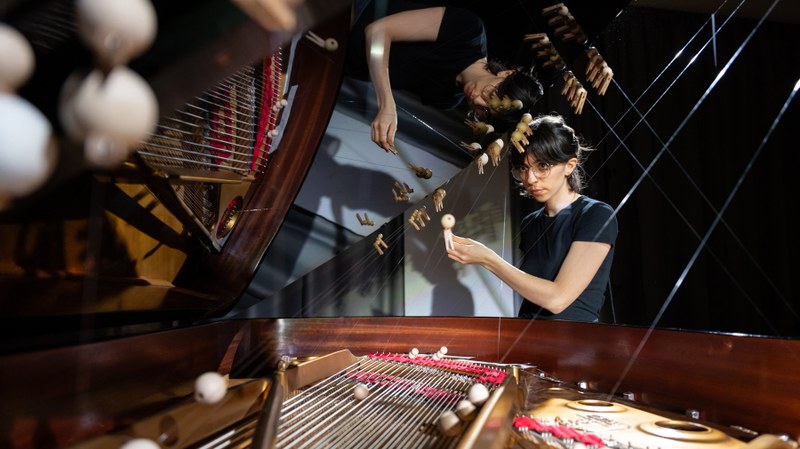
Institut Klassik | Creative compositional work in the context of a variety of instrumental, vocal, performance, electronic and multimedia aesthetics and forms of expression. sonic space basel students from all conceivable facets of contemporary music practice offer the ideal environment for collaborative realisation of proprietary creations. National and international collaborations with the beacons of the new music scene in the context of more than 50 public performances each year guarantee innovation, artistic excellence and networking opportunities. The work culture is modular, diverse and collaborative.
Factsheet
- Degree
- Master of Arts FHNW in Komposition/ Musiktheorie, Studienrichtung Komposition
- Study mode
- Full-time
- Learning mode
- Onsite
- ECTS credits
- 120
- Next start
- 19.9.2027
- Duration
- 4 semesters
- Teaching language
- German: B1 level required
- Stay abroad
- Possible
- Application fee
- 200 CHF
- Semester fee
- 750 CHF (CH) | 1000 CHF (EU/EFTA) | 1250 CHF (Not-EU/Not-EFTA)
At a glance
- highly modular curriculum, also in individual tuition
- interdisciplinary approaches and collaborative work in the environment of sonic space basel, strong focus on peer-to-peer learning
- aesthetically artistic openness generates undogmatic creativity
- ongoing and close collaboration with professional contemporary music ensembles, including regular commissioning of new works
Why study this?
The educational goals of the MA Composition/Music Theory programme in composition are – in addition to expanding one's own catalogue of works – a pronounced ability to reflect on one's own actions and creative work, confident handling of collaborative working methods, as well as a sound knowledge of the professional field and confident communication skills in dealing with ensembles, orchestras, concert organisers, management offices and other players in the free market.
The FHNW Master of Arts in Composition/Music Theory with a Composition Major produces graduates with the necessary qualifications to pursue a career as an independent professional Composer.
This study programme is aimed at holders of a Bachelor degree with a Composition Major or an equivalent qualification.
Michele Selvaggi (*2000): Quondam, Apparatus - for Amplified Ensemble, Transducers, and Tinguely Machine
What is the sound of new compositions? What is possible? The video shows a performance at Tinguely Museum Basel of Michele Selvaggi, a graduate of this study programme.
Structure and programme contents
The highly modularised curriculum gives composers plenty of scope for independent activity in projects both on and off campus, allowing them to tailor their studies to their individual needs. The open format of the sonic space basel teaching modules promotes interdisciplinary approaches and collaborative work.
Specials
- As part of sonic space basel, an environment of top performers who are capable of professionally executing the most demanding compositions.
- Eduard Brunner Composition Prize: Every year, one of our students is awarded a composition prize worth CHF 5'000 as part of an internal sonic space basel competition.
Modules and regulations
The BA and MA degree programmes at the Basel Academy of Music are based on modules.
The legally binding structure provides an initial guide to the content and weighting of the subjects on the degree programme.
The detailed content and modalities of the individual subjects can be found int he module descriptions.
The study regulations come into force together with the study and examination regulations of the Basel Academy of Music FHNW and form the legal framework.
Structure
Module descriptions
Study Regulations
Lecturers
Johannes Kreidler
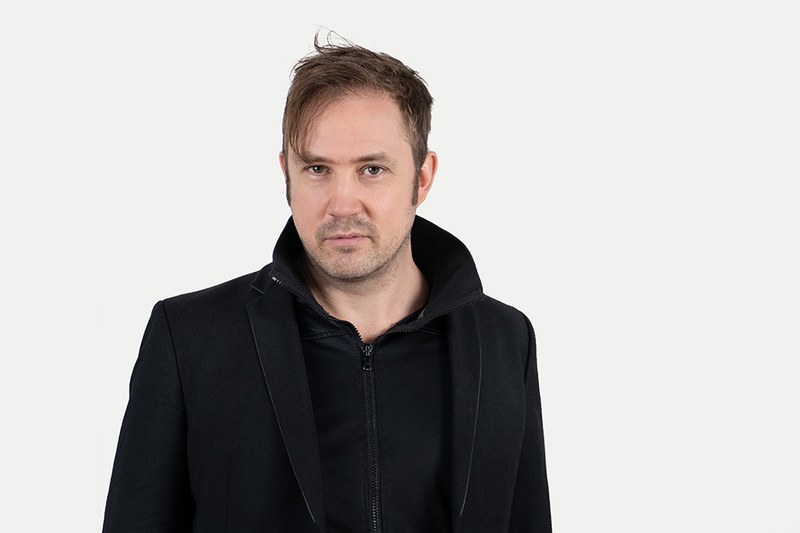
Michel Roth
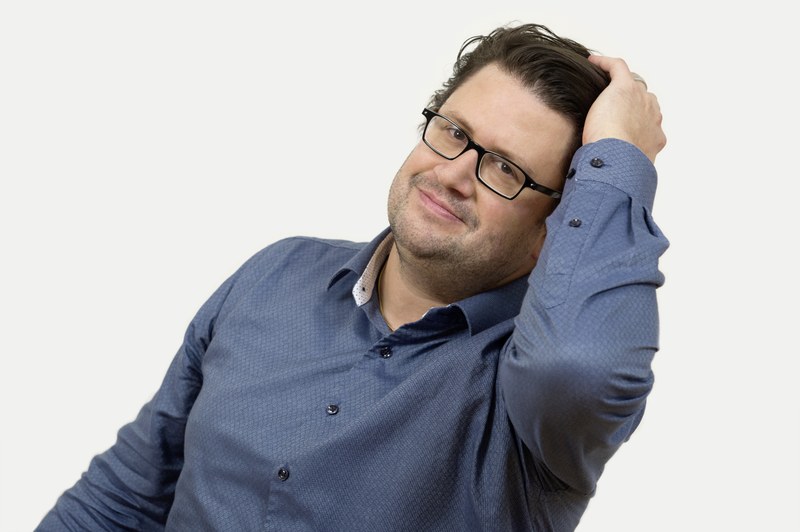
Caspar Johannes Walter
Institut Klassik
Requirements, admission, entrance exam
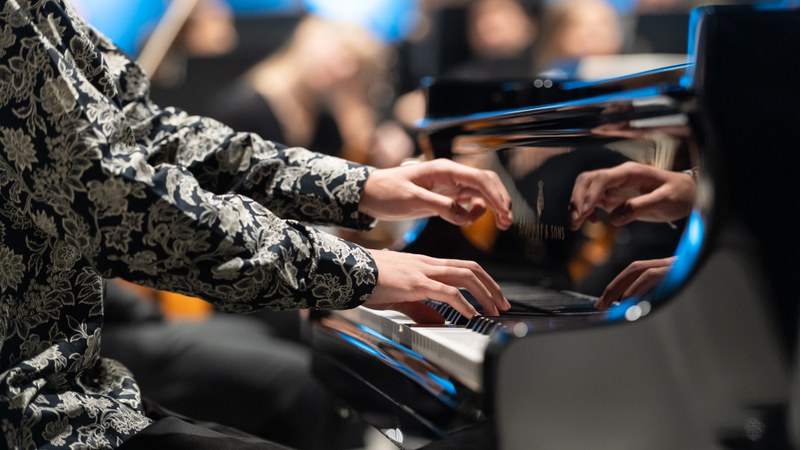
In order to enter the FHNW Master of Arts in Composition/Music Theory programme with a Composition Major, applicants must be awarded a Bachelor in Composition or equivalent as well as they must have passed the entrance exam and were offered a free place at the Academy (limited places). Applicants who have submitted all the necessary registration documents in time will be invited to the online entrance exam by mail and online meeting.
For further information on the admission criteria, please see the Study field regulations of the Master of Arts FHNW in Composition/Music Theory, Composition (in German).
We expect students to have very good German language skills at the beginning of the studies. Students who are not German native speakers must present a B1 German language certificate according to the Common European Framework of Reference for Languages (CEFR) at the beginning of the studies.
This certificate must be complete, i.e. all modules (reading, listening, writing, speaking) have been tested separately and passed at least at level B1 overall. Only certificates that have been certified with the ALTE-Q-Mark seal of approval (e.g. the B1 certificate of the Goethe-Institut or the telc certificate) are accepted. The required certificate B1 must be submitted with the confirmation of admission but not later than 31 Mai.
Exceptions will be decided upon by the head of degree programme.
Entrance exam
The entrance exam is individual for each study programme direction.
Dates
Procedure
Examples Written Exam
Organisational matters
sonic space basel
Projects / Ensembles
Quicklinks
Files and Regulations
Music library "Vera Oeri-Bibliothek"
Advising and information events
Contact
Student Administration Academy of Music, Klassik
- Phone
- +41 61 264 57 32 (Direct)
- klassik.hsm@fhnw.ch
Prof. Uli Fussenegger
- Phone
- +41 61 264 56 19 (Direct)
- uli.fussenegger@fhnw.ch
Information events
Loading...
Registration
MA Composition/Music Theory | Composition
- Date
- 19.9.2027
- Duration
- 4 Semester
- Place
- Campus Musik-Akademie Basel