More solar power from the same roof: why inverters matter
Switzerland has set itself a clear climate goal: by 2050, the country aims to reach net-zero greenhouse gas emissions [1]. To reach this goal, renewable energy and energy efficiency both play an important role [2]. Solar power is already growing quickly, but the energy transition is not only about installing more photovoltaic panels. It is also about making sure that each system works as efficiently as possible.
A solar installation is more than the panels we see on the roof. Behind the scenes, several technical components decide how much of the produced electricity can actually be used. One of the most important components is the inverter.
A small box with a big task
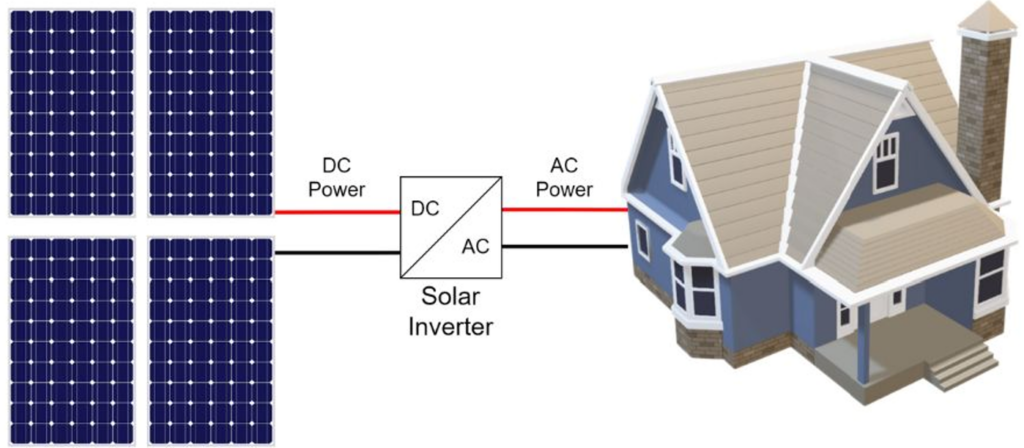
Photovoltaic panels produce direct current, also called DC electricity. However, homes, businesses and the electricity grid use alternating current, known as AC electricity. The inverter converts the electricity from DC to AC so that it can be used in everyday life [3].
This sounds like a simple technical step. But during this conversion, a small part of the energy is lost, mostly as heat. For one single rooftop system, this loss may seem small. Across thousands of solar installations in Switzerland, however, small losses can add up.
This is why inverter efficiency matters.
More solar power is not only about more panels
Solar power is expanding strongly worldwide. The International Energy Agency expects global renewable power capacity to increase by almost 4,600 GW between 2025 and 2030, with solar PV representing nearly 80% of this growth [5]. Switzerland follows this development. In 2024, Switzerland added 1,799 MW of new PV capacity and reached 8.17 GW of cumulative installed PV capacity. PV electricity covered around 10.36% of national electricity consumption in that year [6].
This growth is important. But it also raises a practical question: how can Switzerland get the most value from every installed solar system?
Installing more panels is one part of the answer. Using the electricity from these panels as efficiently as possible is another part. This is where inverter technology becomes relevant. Switzerland’s Energy Strategy 2050 also emphasises that energy efficiency must increase, the share of renewable energies must grow, and energy-related CO2 emissions must decrease [2].
What we investigated
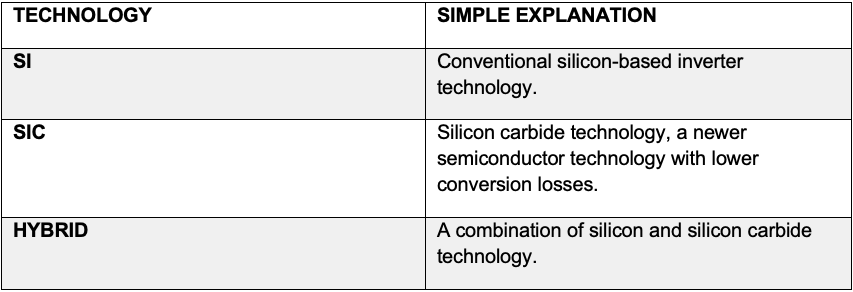
In our project, we compared three inverter technologies: conventional silicon-based technology, silicon carbide technology and a hybrid solution that combines silicon and silicon carbide. For readability, the technologies are described in simple terms below.
The aim was to find out how these technologies perform under Swiss conditions. Switzerland may be a small country, but solar installations do not operate everywhere in the same way. A PV system in Ticino is exposed to different sunlight and weather conditions than a system in Lucerne or in an alpine region.
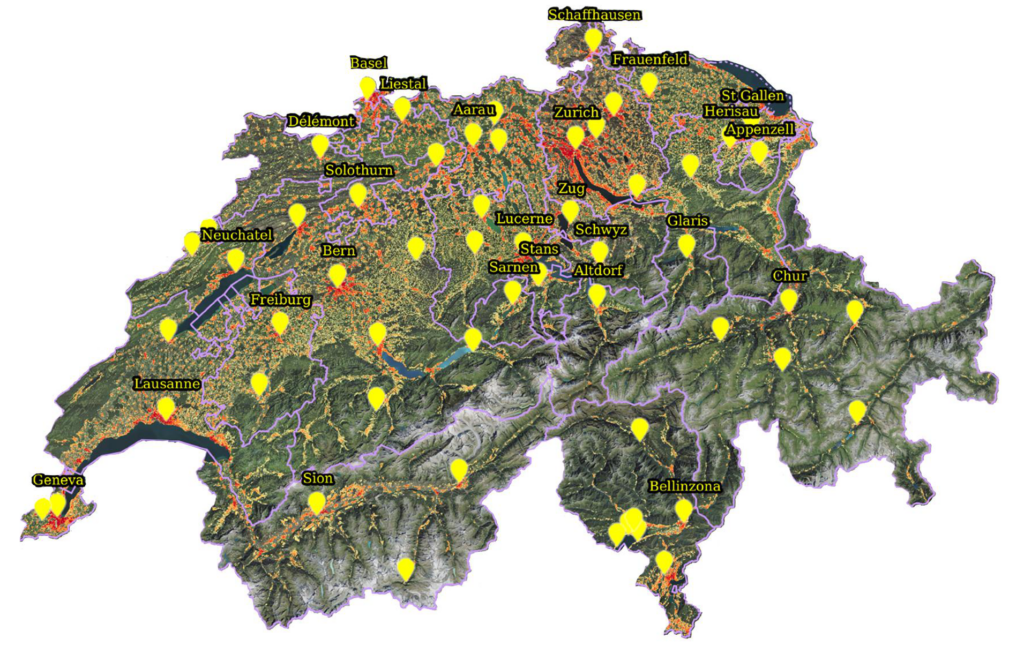
For this reason, we simulated photovoltaic systems at selected locations across Switzerland. The simulations included different climates, elevations and geographical conditions. We also compared two system sizes, 3 kWp and 10 kWp, and two roof orientations, south-facing and east-west [7].
How we compared the technologies
Instead of building many real systems across Switzerland, we used simulations. This allowed us to compare the same type of photovoltaic system under different conditions. The location, system size, roof orientation and inverter technology were changed, while the basic assumptions remained the same.
This made the results comparable. In simple terms, we asked one main question:
How much usable solar electricity can different inverter technologies deliver under Swiss conditions?
What we found
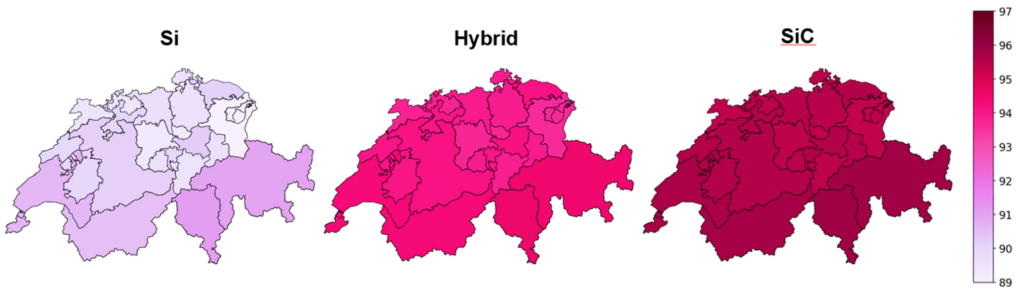
The results showed a clear trend. The SiC-based inverter achieved the highest efficiency and the lowest conversion losses across the investigated scenarios. The Hybrid inverter also performed better than the conventional silicon-based inverter, but it remained slightly below the pure SiC solution [7].
The difference was especially visible in smaller 3 kWp systems. These systems often operate below their maximum power. This happens in the morning, in the evening, during cloudy weather or when sunlight is weak. This operating condition is called partial-load operation.
Under these conditions, the inverter does not always work at its best point. Therefore, technologies with good partial-load efficiency become more important. In our simulations, SiC technology showed the strongest advantage in these situations [7].
The following figure shows one representative example: a 3 kWp PV system with east-west orientation. In this case, the SiC inverter achieved the highest efficiency, while the Hybrid inverter performed better than the conventional Si inverter.
Why small differences matter
At first, a few percentage points of efficiency difference may sound small. But photovoltaic systems operate for many years. Over this lifetime, lower conversion losses can lead to more usable electricity and lower costs.
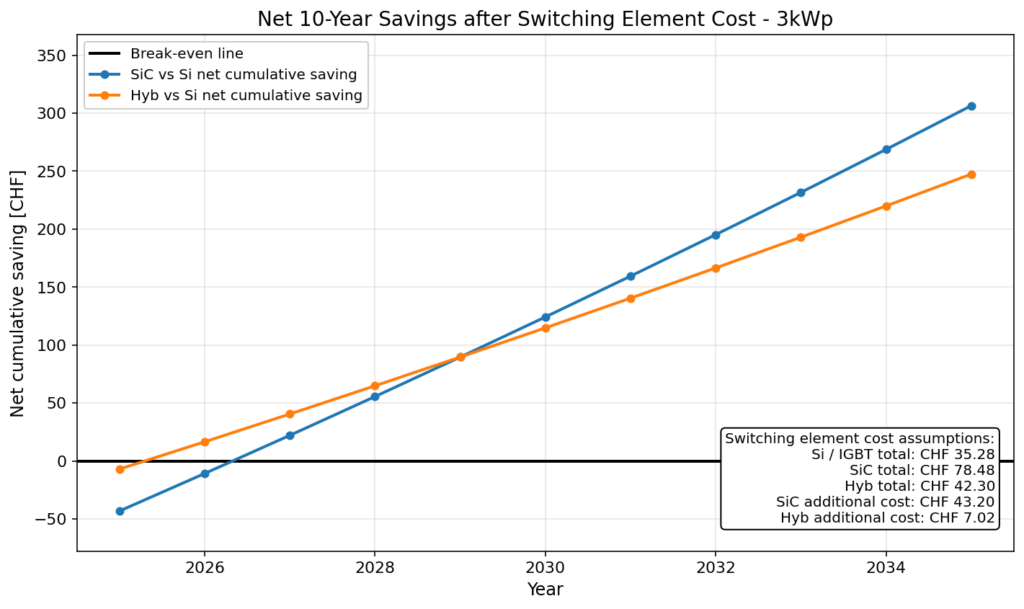
In our project, we also considered simplified switching element cost assumptions. These costs do not represent the full inverter CAPEX, but they help to show whether the higher cost of more efficient components can be compensated over time.
The results show that both SiC and Hybrid technologies can compensate their higher initial switching element costs within the first years of operation. After that point, the improved efficiency leads to increasing net savings. In the investigated 3 kWp system, SiC achieved the highest net savings after ten years, while Hybrid also showed a clear benefit compared with conventional Si technology [7].
This does not mean that every solar installation must automatically use the newest technology. But it shows that inverter choice should be part of the discussion when planning efficient PV systems.
What this means for Switzerland
For Switzerland’s energy transition, it is important to build more photovoltaic systems. But it is also important to use existing and future systems as efficiently as possible. The inverter is not the most visible part of a solar installation, but it directly influences how much electricity can finally be used.
This makes the topic relevant beyond engineering. For homeowners, it can influence long-term energy yield. For planners, it can support better system design. For municipalities and political decision-makers, it shows that the energy transition is not only about building more infrastructure, but also about improving the quality and efficiency of that infrastructure.
Our conclusion
Switzerland’s path to net zero will require more renewable energy and better energy efficiency. Photovoltaic systems are an important part of this path. But to make the best use of solar power, it is not enough to only look at the panels.
The inverter also matters.
Our project shows that advanced inverter technologies, especially SiC, can reduce conversion losses and increase the amount of usable solar electricity. Hybrid technology also offers an improvement compared with conventional silicon-based inverters.
To reach Switzerland’s climate and energy goals, we should not only install more solar panels. We should also make every solar system work as efficiently as possible. Better inverters can help us get more solar power from the same roof.
This article was written by the students Andrea Jud, , Cayetana Fernández Mora and Mirco Silvestri as part of the EUT Project 4.
Bibliography
[1] Federal Office for the Environment FOEN, “Net-zero target 2050,” Swiss Confederation, 2025. [Online]. Available: FOEN website. [Accessed: May 22, 2026].
[2] Swiss Federal Office of Energy SFOE, “Monitoring Energy Strategy 2050,” Swiss Confederation. [Online]. Available: SFOE website. [Accessed: May 22, 2026].
[3] U.S. Department of Energy, “Solar Systems Integration Basics,” Office of Energy Efficiency and Renewable Energy. [Online]. Available: U.S. Department of Energy website. [Accessed: May 22, 2026].
[4] C. Noble, “Micro Inverter vs String Inverter: Which Is Better for Your Solar System?,” Spheral Solar, Nov. 30, 2023. [Online]. Available: Spheral Solar website. [Accessed: May 22, 2026].
[5] International Energy Agency, “Renewable electricity,” in Renewables 2025, IEA, Paris, 2025. [Online]. Available: IEA website. [Accessed: May 22, 2026].
[6] IEA Photovoltaic Power Systems Programme, “National Survey Report of PV Power Applications in Switzerland 2024,” IEA PVPS, 2025. [Online]. Available: IEA PVPS website. [Accessed: May 22, 2026].
[7] M. Silvestri, A. Jud, and C. Fernández Mora, Evaluation of Different PV Inverter Technologies for Switzerland, P4 Project Report, FHNW School of Engineering and Environment, Windisch, Switzerland, 2026.
Kommentare
Keine Kommentare erfasst zu More solar power from the same roof: why inverters matter