Skip to main contentSkip to search barSkip to navigationSkip to footer
Logo of the University of Applied Sciences and Arts Northwestern Switzerland
  • DE
  • EN
  • Home

Ten Schools One Goal

The FHNW comprises 10 schools with different specializations. Select a school to see its specific courses, study programmes and information.

Applied Psychology

Architecture, Construction and Geomatics

Art and Design

Music

Computer Science

Life Sciences

School of Education

Social Work

Engineering and Environment

Business

  • Study offerings

    • All degree programmes
    • Bachelor of Arts
    • Master of Arts
    • CoCreate programme
    • PHD programmes
    • MDes programme
    • Integral HGK Basel
    • Guest Auditors
    • Info events
  • All about studying

    • Enrolment at the HGK Basel
    • Fees and scholarships
    • Degree programme administrations
    • Semester dates
    • Tools for studying
    • Counselling services
    • German language courses
    • Insurance and pensions
    • Civilian and military service
    • Legal and formal matters
    • Course catalogue
  • Study Internationally

    • International students
    • Incoming students
    • Outgoing students
    • Internship
    • Partner universities
    • German language courses
  • Continuing education offerings

    • All continuing education programmes
    • MAS - Master of Advanced Studies
    • CAS - Certificate of Advanced Studies
    • Modules
    • Info events
  • All about continuing education

  • International Office

    • Mobility for academics and staff
    • Study Internationally
  • Research

    • Research fields
    • Projects
    • PhD Projects
  • Collaboration

    • Services
  • Updates and insights

    • News and stories
    • Applause
    • Publications
    • Newsletter (DE)
  • Events

    • All events
    • Info events
  • Media

  • About the Basel Academy of Art and Design

    • Management and organisation
    • People directory
  • Institutes

    • Institute Art Gender Nature
    • Institute Arts and Design Education
    • Institute Contemporary Design Practices
    • Institute Digital Communication Environments
    • Institute Experimental Design an Media Cultures
  • Campus and Infrastructure

    • CIVIC
    • Media Library Basel
    • der TANK
    • FoodCultureLab
    • Café Freilager and Bistro of the Arts
    • Sport
    • Studi-Lounge
    • Accessibility & Facilities
  • Campus.Workshops

    • Sculptor’s studio
    • Bookbinding
    • Digital Fabrication Lab
    • Woodworking
    • Plastics
    • Paint shop
    • Media.Workshop
    • Metalworking
    • Sewing.Island
    • Screen printing
Logo of the University of Applied Sciences and Arts Northwestern Switzerland
  • About the School
    • HGK Basel
    • Degree Programmes
    • Continuing Education
    • Research
    • News & Stories
    • Events
    • NEXT Generation Degree Projects
  • Social Media
    • Instagram
    • LinkedIn
  • About FHNW
    • Organisation
    • Schools
    • Locations
    • FHNW Library
    • Media Relations
  • Support
    • IT Support
    • Inside FHNW
    • Webmail
  • Data Protection
  • Imprint
  • Accessibility
  • Study offerings

    • All degree programmes
    • Bachelor of Arts
    • Master of Arts
    • CoCreate programme
    • PHD programmes
    • MDes programme
    • Integral HGK Basel
    • Guest Auditors
    • Info events
  • All about studying

    • Enrolment at the HGK Basel
    • Fees and scholarships
    • Degree programme administrations
    • Semester dates
    • Tools for studying
    • Counselling services
    • German language courses
    • Insurance and pensions
    • Civilian and military service
    • Legal and formal matters
    • Course catalogue
  • Study Internationally

    • International students
    • Incoming students
    • Outgoing students
    • Internship
    • Partner universities
    • German language courses
  • Continuing education offerings

    • All continuing education programmes
    • MAS - Master of Advanced Studies
    • CAS - Certificate of Advanced Studies
    • Modules
    • Info events
  • All about continuing education

  • International Office

    • Mobility for academics and staff
    • Study Internationally
  • Research

    • Research fields
    • Projects
    • PhD Projects
  • Collaboration

    • Services
  • Updates and insights

    • News and stories
    • Applause
    • Publications
    • Newsletter (DE)
  • Events

    • All events
    • Info events
  • Media

  • About the Basel Academy of Art and Design

    • Management and organisation
    • People directory
  • Institutes

    • Institute Art Gender Nature
    • Institute Arts and Design Education
    • Institute Contemporary Design Practices
    • Institute Digital Communication Environments
    • Institute Experimental Design an Media Cultures
  • Campus and Infrastructure

    • CIVIC
    • Media Library Basel
    • der TANK
    • FoodCultureLab
    • Café Freilager and Bistro of the Arts
    • Sport
    • Studi-Lounge
    • Accessibility & Facilities
  • Campus.Workshops

    • Sculptor’s studio
    • Bookbinding
    • Digital Fabrication Lab
    • Woodworking
    • Plastics
    • Paint shop
    • Media.Workshop
    • Metalworking
    • Sewing.Island
    • Screen printing

Type a search term and search continuing education,degree programmes, events, documents and other content.

  • Art and Design
  • Continuing education
  • Continuing education offerings
  • All continuing education programmes
All continuing education programmes

Creative Coding, Basel Academy of Art and Design

Basel Academy of Art and Design


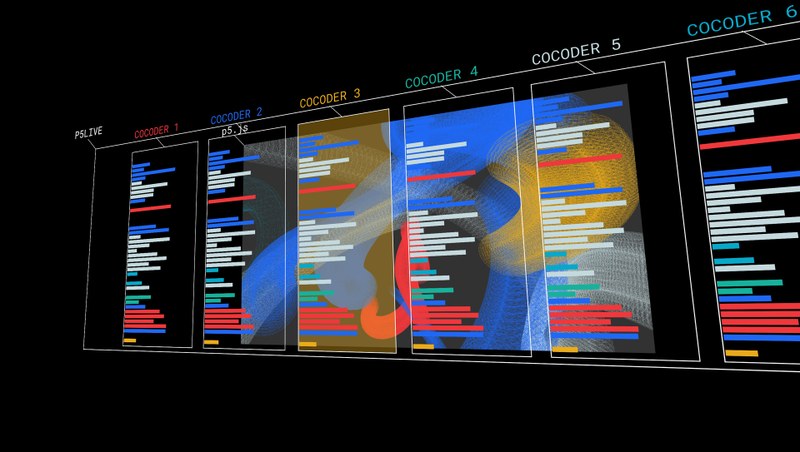
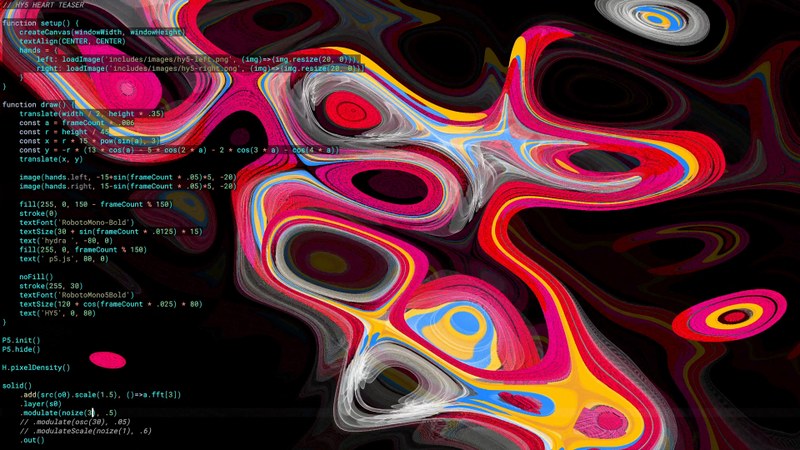
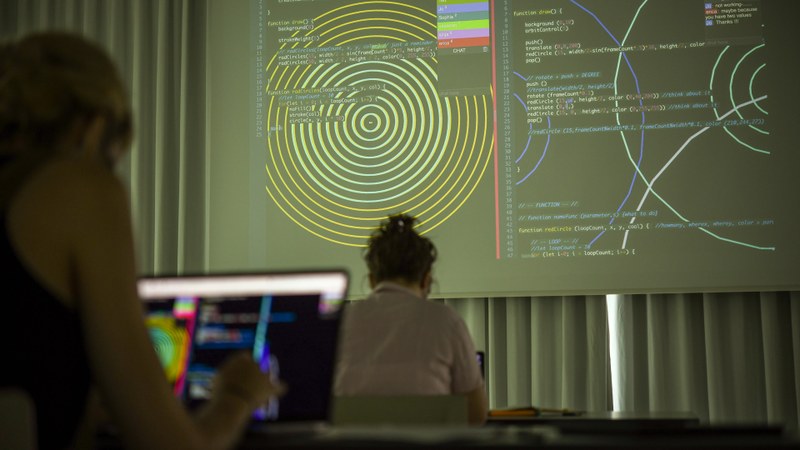
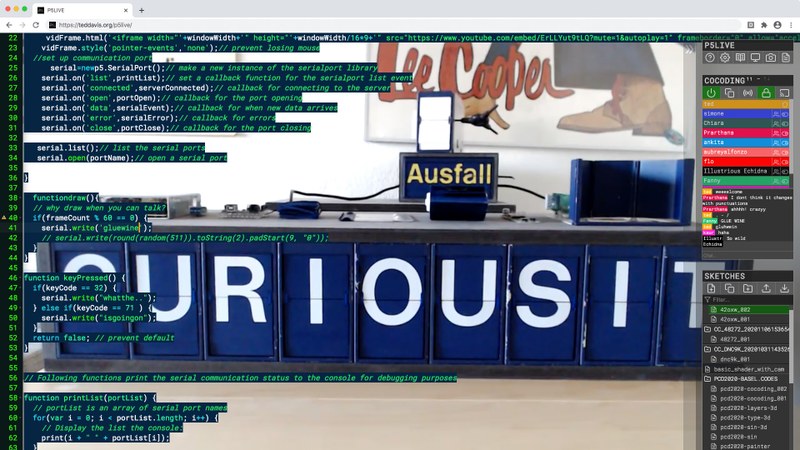
In this continuing education module, visual designers learn the fundamentals of generative design and creative coding. In a live coding environment, they develop algorithmically generated forms and typography, experiment with animation, interaction, and audio-reactive visualizations, and design their own digital tools for visual communication.

header_image_creative-coding.png

Factsheet

Learning environment
Onsite
ECTS points
2
Next start
6.7.2026
Duration
1 week
Teaching languages
English
Venues
Basel, Campus Dreispitz
Fee
CHF 900

At a glance

  • Introduction to Creative Coding: Design is enhanced through programming – the p5.js framework allows you to implement visual ideas directly in the browser.
  • Understand and apply generative design: Shapes, typography, and graphics are not only designed but also generated by code and can look different with each iteration.
  • Develop interactive and dynamic visualizations: Designs react to inputs such as mouse movements, randomness, time, or audio, becoming dynamic and vibrant.
  • Create your own digital design tools: Participants learn to program interactive tools and visuals for the web, visual communication, or experimental projects (e.g., VJ visuals).
  • image_creating_coding_01.jpeg
  • image_creative_coding_02.jpeg
  • image_creative_coding_03.jpeg
  • image_creative_coding_04.jpeg
  • image_creative_coding_05.jpeg
  • image_creative_coding_06.jpeg
  • image_creative_coding_07.jpeg
  • image_creative_coding_08.jpeg

Aims and benefits

The workshop offers a well-founded examination of the design of typefaces through theory and creative practice. The topics covered are Procedure from hand sketches to digital final artwork and form variants, the Latin alphabet, typology of letterforms, font character, font classification, development of our typesetting fonts, optical laws and phenomena, font terminology, etc.


Structure and programme contents

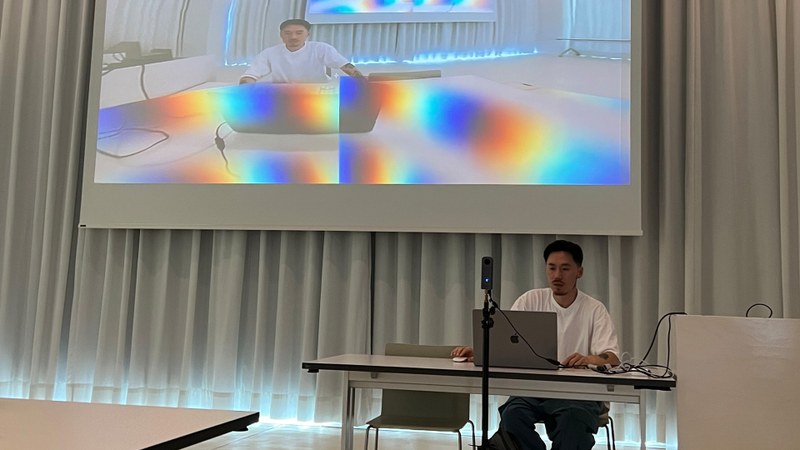
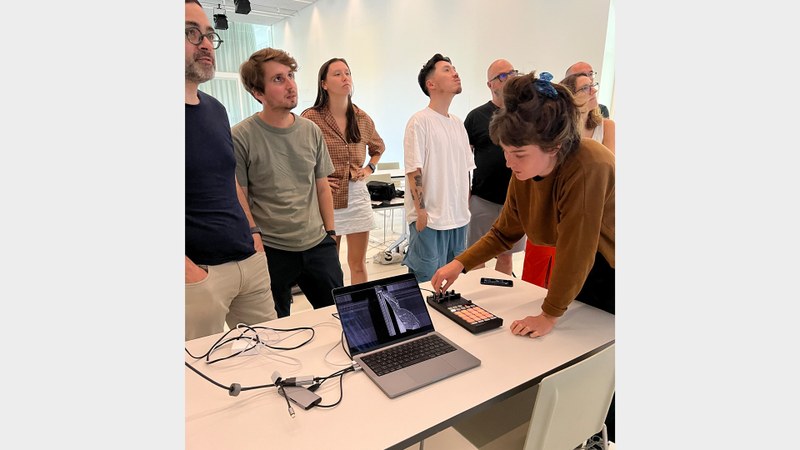
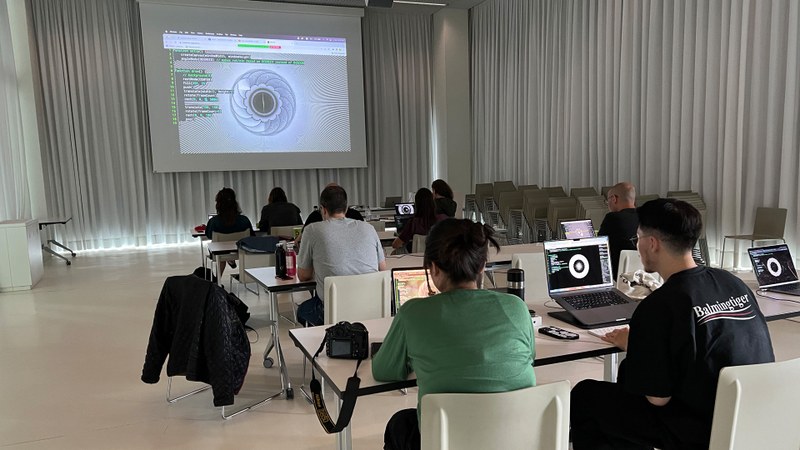
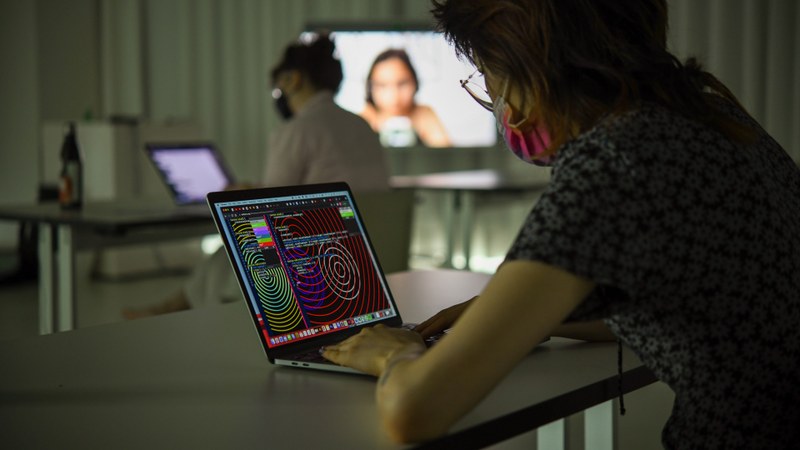
As designers embraced the computer decades ago, the mouse became a crucial tool to implement one’s ideas in the digital domain. From the early 2000s, programming frameworks enabled artists and designers to express themselves and create their own tools, commonly referred to ascreative coding. Since the 2010s, a new era of frameworks has taken advantage of web browsers’ increased speed and capability, utilizing the HTML5 Canvas element as a sandbox for interaction. With the help of one of those frameworks, p5.js, one can quickly get up and running to code motion graphics, interactive visuals for a website, custom tools with GUI elements, and much more! By using dynamic inputs such as mouse movements, random chance, or time of day, one can influence parameters controlling the design of images, shapes, typography, to name just a few. This exciting realm of infinite possibilities, where every rendering can be unique, is what we mean by generative design. In this workshop (intended for both absolute beginners and experienced coders alike), we shall dive right into key functions for generating forms and type, setting them into motion, allowing user interaction to influence them and design our own digital tools for visual communication. In this workflow, we shall explore live coding, using a custom environment, where one sees instantaneous visuals as the code changes. Therefore, we shall have to take it one small step further and make our sketches audio-reactive, just in case you plan to VJ on the weekend.

Programme

In this advanced training module, visual designers learn the fundamentals of generative design and creative coding. The course is suitable for both beginners and participants with programming experience. The focus is on the algorithmic generation of shapes and typography, as well as their animation and interactive control. Participants work in a live coding environment where changes to the code are immediately visible. Building on this foundation, they develop their own digital tools for visual communication and experiment with audio-reactive visualizations.

Further Education Options

Modules/workshops worth 2 or 1 ECTS credits areoffered, which can be combined with each other and, in addition, with an individually supervised final thesis (5 ECTS credits) to lead to a Certificate of Advanced Studies (CAS).

General Information Workshops Institute Digital Communication Environments (IDCE)

The Institute Digital Communication Environments (IDCE) offers workshops for students, educators and graphic designers.

The workshops afford insights into topical themes of visual communication for analogue and digital communication channels in a study programme reflecting the rich tradition of the Basel School of Design. Practical exercises with a high level of professionalism form the core of the workshops focus. Reflection as well as contextual knowledge will be conveyed by way of input sessions, allowing participants’ work to be judged within a contemporary, future-oriented context relevant to professional practice.

The trinational Rhine River Valley is a unique cultural environment with easy access to France and Germany and to sites such as the Vitra Design Museum (G), the Isenheimer Alter (F), or Ronchamps (F). In Basel, the Fondation Beyeler, Tinguely Museum, Museum of Fine Arts, Schaulager, and Museum of Contemporary Art are world-renowned. Besides its museums, Basel offers a rich mixture of cultural events.


Lecturers

  • Ted Davis
    Ted Davis

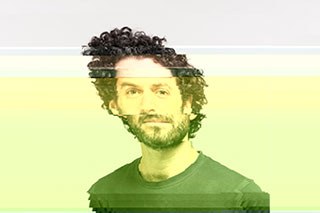
Ted Davisis a media educator / artist / designer originally from the United States and based in Basel, Switzerland. Since 2010, he teaches interaction design and co-ordinates the UIC/HGK International Master of Design programme within the Institute Digital Communication Environments IDCE, HGK Basel FHNW. His work and teachings explore the volatility of digital media through glitch and reactivating older ‘new media’ through newer programming means. His open-source projects (basil.js, XYscope, P5LIVE, p5.glitch) enable designers to program within Adobe InDesign, render vector graphics on vector displays, collaboratively live code visuals with p5.js, and glitch any media in real-time within the web browser. In 2021, he received the Basel Media Art Prize (Basler Medienkunstpreis) for p5.glitch and was a Processing Foundation Teaching Fellow. With international exhibits, lectures, and workshops, he empowers students to take hold of the computer’s ability to design possibilities beyond that of the hand or mouse. teddavis.org


Requirements and admission

The continuing education programs are primarily aimed at individuals with an academic degree from a recognized university and relevant professional experience after graduation.Individuals with equivalent qualifications will be admitted if their eligibility for participation is demonstrated by other evidence.

For further questions, please contact the Continuing Education Department, Ralf Michel


Organisational matters

Fees

Multiple Bookings:
2 ECTS   CHF   900
4 ECTS   CHF 1700
6 ECTS   CHF 2400
8 ECTS   CHF 3000
10 ECTS CHF 3500

20% discount with a valid student ID (MA/PhD). This must be sent in with the registration (pdf).

Information and regulations

Terms of participation (PDF)
Information on continuing education FHNW (fhnw.ch)
Continuing education regulations of the universities FHNW (fhnw.ch)


Advising and information events

Contact
Dr. Ralf Michel

Fachstelle Weiterbildung
Phone
+41 61 228 41 47
E-Mail
ralf.michel@fhnw.ch

Registration

Creative Coding
6 July 2026

Date
6.7.2026–10.7.2026
Duration
5 days
School days
Thursday, Wednesday, Monday, Tuesday and Friday
Place
Hochschule für Gestaltung und Kunst Basel FHNW
Freilager-Platz 1
4142 Münchenstein b. Basel
Register

Basel Academy of Art and Design FHNW University of Applied Sciences and Arts Northwestern Switzerland

  • About the School
    • HGK Basel
    • Degree Programmes
    • Continuing Education
    • Research
    • News & Stories
    • Events
    • NEXT Generation Degree Projects
  • Social Media
    • Instagram
    • LinkedIn
  • About FHNW
    • Organisation
    • Schools
    • Locations
    • FHNW Library
    • Media Relations
  • Support
    • IT Support
    • Inside FHNW
    • Webmail
Logo FHNW - 20 Years
Logo Swiss Universities
Logo European University Association
© University of Applied Sciences and Arts Northwestern Switzerland (FHNW)
  • Data Protection
  • Imprint
  • Accessibility
  • DE
  • EN