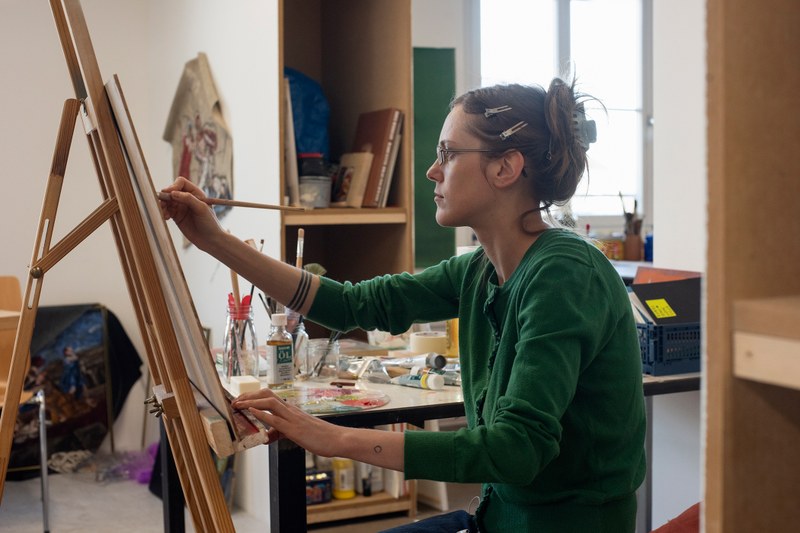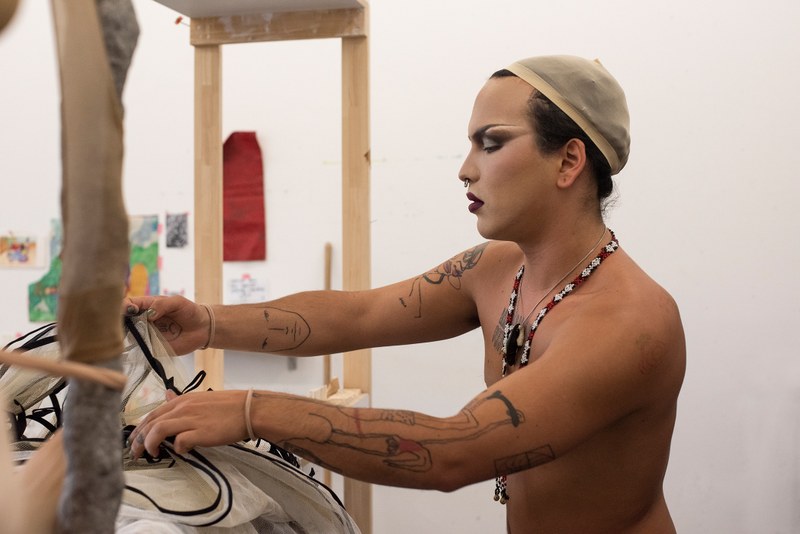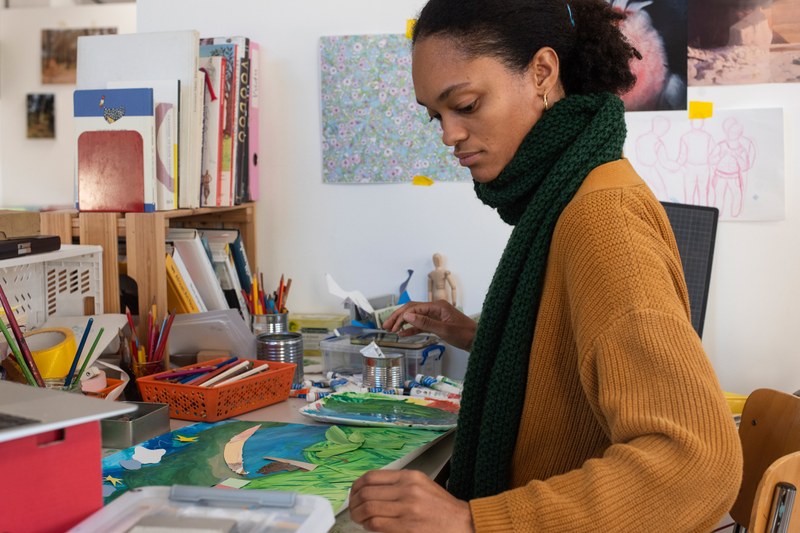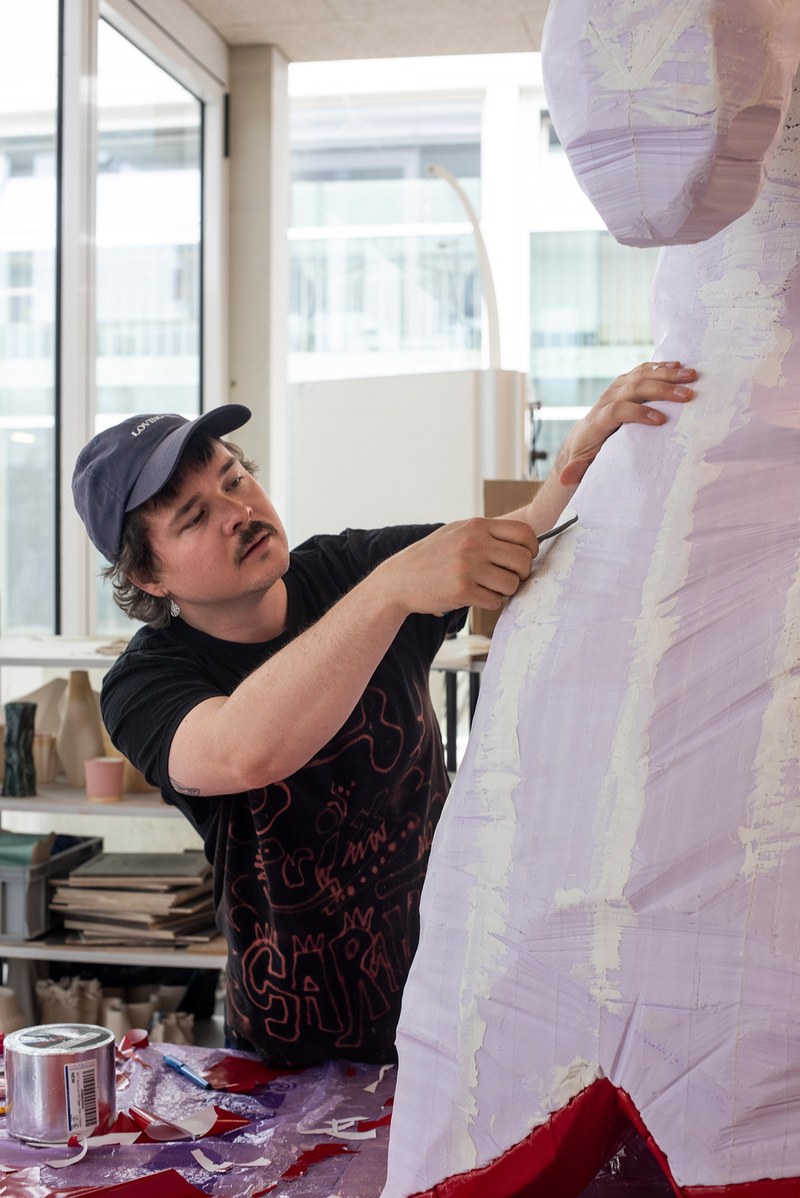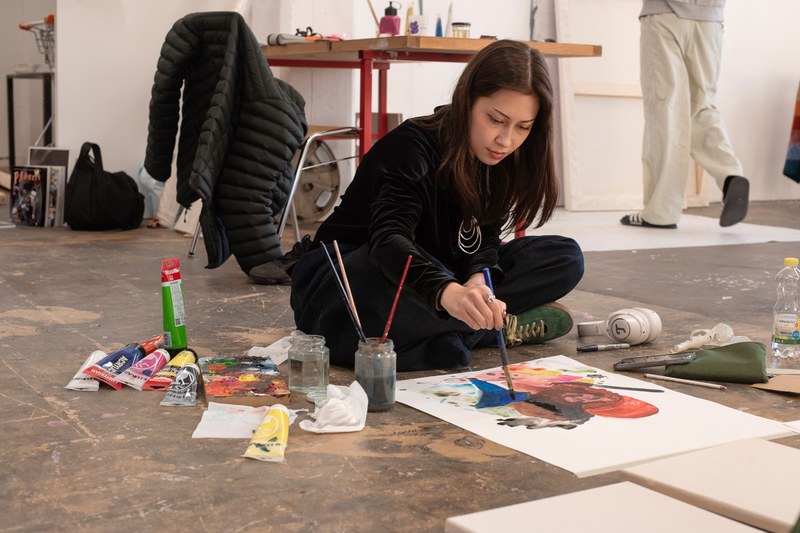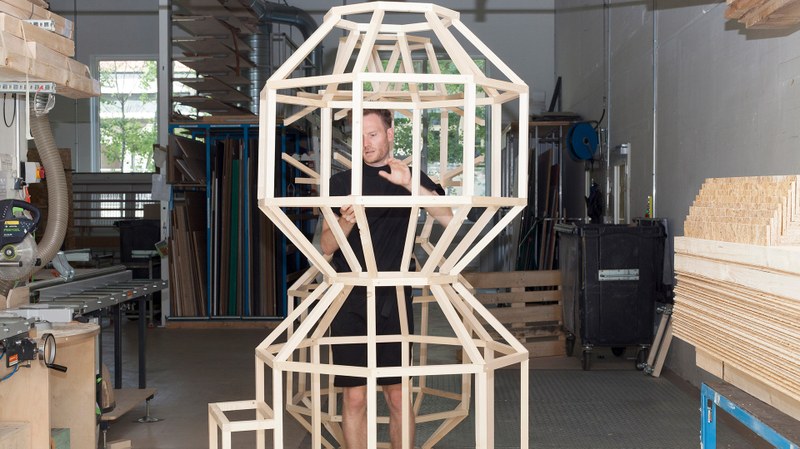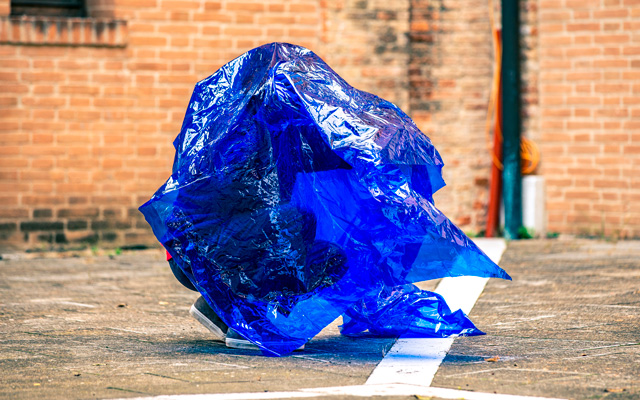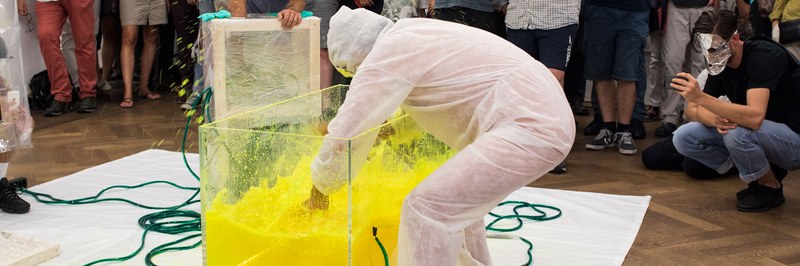
Studying Fine Arts fosters the develop of a distinct, individual artistic position. In the studio, in workshops, in project work and in the context of exhibitions students gradually develop their own artistic language.
Factsheet
- Degree
- Bachelor of Arts FHNW
- Study mode
- Full-time
- Learning environment
- Onsite
- ECTS points
- 180
- Next start
- 14.9.2026
- Duration
- 6 Semester
- Language
- German (B2 or equivalent), partly in English
- Place
- Campus HGK Basel
- Staying abroad
- Possible
- Application fee
- CHF 200.- (incl. aptitude assessment and enrolment)
- Semester fee
- CHF 750 (CH); CHF 1.000 (EU); CHF 1.250 (Not-EU/EFTA)
At a glance
- Studying Fine Arts fosters the development of a distinct, individual artistic position.
- Studying art means becoming familiar with art.
- The cultural city of Basel offers an inspiring environment with a lively art scene and cultural diversity.
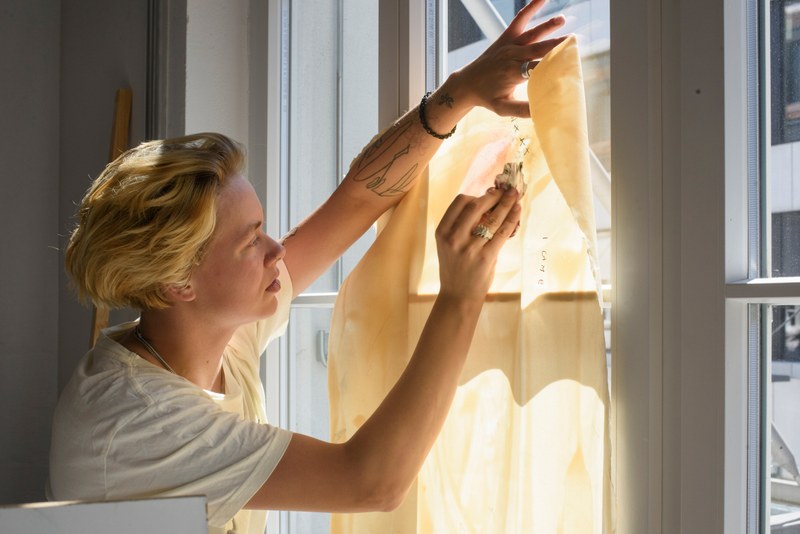
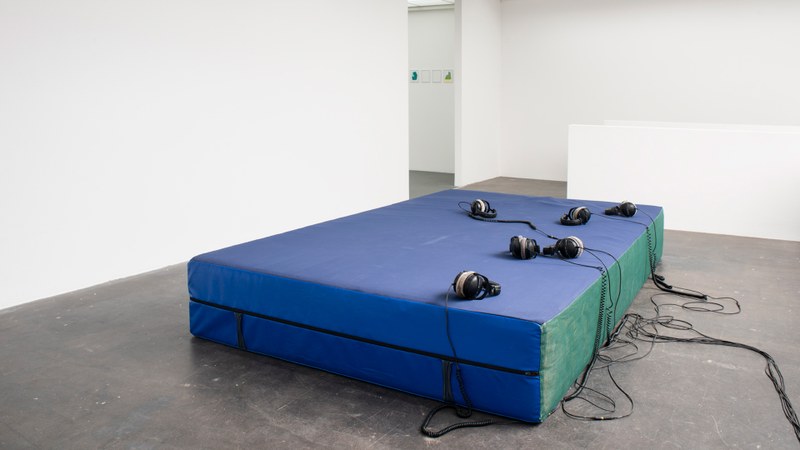
Cheyenne Oswald, verbandet, 2020, Installationsansicht Life, Love, Justice, Diplomausstellung Institute Art Gender Nature, Kunsthaus Baselland, 2020
Foto: Christian Knörr
Silent opening Life, Love, Justice, Diplomausstellung Institute Art Gender Nature, Kunsthaus Baselland, 2020
Foto: Christoph Bühler
Why study this?
Goals and benefits
The three-year Bachelor course introduces you to issues of current-day art practice and helps you to develop your own work approach. It is not a training in art history; instead you gather experience and are confronted with a wide array of ideas, forms, media, materials and questions relating to matters such as individuality. Apart from working in the studio, group discussions with other students and lecturers form a core of the course. On a regular basis artists and art theoreticians from Switzerland and abroad are invited as visiting scholars to support you in your studies. In the three-year BA course you acquire technical skills and expand your knowledge concerning the questions and topics that drive today’s art practice.
Career prospects
The BA degree programme in Fine Arts lays the foundation for understanding oneself as an emerging artist.

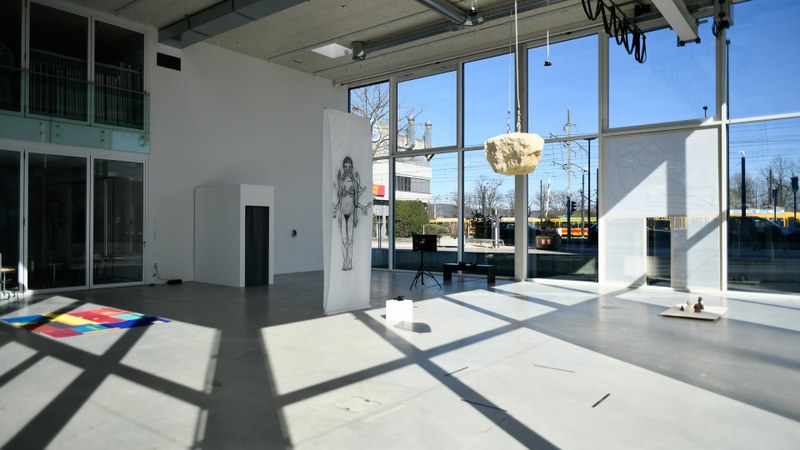
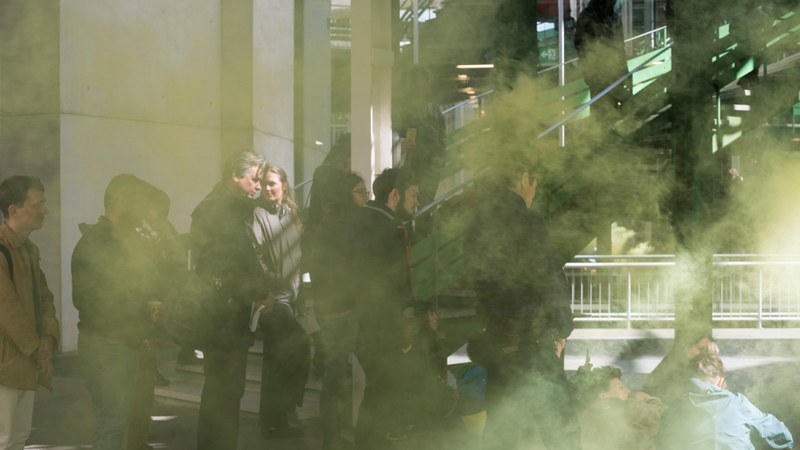
Anita Mucolli, I used to stand by the window and the sun would almost burn my face, but that day, I remember clearly, it actually did., 2020, Installationsansicht Life, Love, Justice, Diplomausstellung Institute Art Gender Nature, Kunsthaus Baselland, 2020
Foto: Christian Knörr
Foto: Christian Knörr 
Foto: Christian Knörr
Structure and programme contents
The study programme
In the studio, in project work and in the context of exhibitions students gradually develop their own artistic language and handwriting. The study course demands a high degree of self-initiative. Studying art means becoming familiar with art. Artists are pioneers who seek to link up apparently disparate worlds in new ways and by new means. They redefine the language of traditional media, materials and technologies by creating artworks, developing concepts, writing essays, exploring archives and choreographing bodies in space. Artists are captivated by the never-ending task of experiencing and representing what we call reality in new ways. In the studio, in project work and in the context of exhibitions students gradually develop their own artistic language and handwriting. The study course demands a high degree of self-initiative. Studying art means becoming familiar with art. Artists are pioneers who seek to link up apparently disparate worlds in new ways and by new means. They redefine the language of traditional media, materials and technologies by creating artworks, developing concepts, writing essays, exploring archives and choreographing bodies in space. Artists are captivated by the never-ending task of experiencing and representing what we call reality in new ways.
Study structure
The content of the three years of study is divided into modules: ‘Art and Practice’, ‘Art and Communication’, ‘Art and Reflection’, ‘Art and Presentation’, as well as the ‘Basic Thesis’ in the first and second years and the ‘Bachelor Thesis’ in the third year. These furnish you with sound practical and theoretical knowledge for your artistic practice. Each module consists of a variety of classes. In addition, you will attend CoCreate, the programme featuring courses and lectures offered by all the bachelor degree programmes. The 140 or so CoCreate courses offered every year find students working in collaborative, interdisciplinary and experimental groups. Representatives of all the degree programmes and students are involved in the development of the teaching content and formats.
Modules
Art and Practice
This module comprises the semester presentations as well as a written assignment in the fourth semester and the preparation for the bachelor thesis in the sixth semester. This module comprises the semester presentations as well as a written assignment in the fourth semester and the preparation for the bachelor thesis in the sixth semester.
Art and Communication
Since the ability to engage in discourse and handle critique competently are important in the development of artistic processes, students learn to master these skills in regular discussions with lecturers as well as in sessions with co-students, allowing them to talk about their own artistic work, as well about art in general in exhibition contexts. Art and Reflection In this module students work on their reflective skills and theoretical knowledge with regard to their own work as well as general methodology. In particular, they acquire knowledge in basic cultural-scientific fields and specific art theoretical issues.
Art and Reflection
In this module you develop reflective theoretical knowledge with regard to your own work and gain a sound foundation in general theory. Emphases include basic knowledge in cultural history and selected art theoretical questions.
Art and Presentation
In addition to the work presentations each semester, this module comprises all the important exams in the three-year BA degree course, including the Basic thesis and the BA thesis. Apart from showcasing their own artistic work in the context of a presentation or exhibition, students are asked to write a mentored paper to test their written reflective skills.
Basic Thesis
The students develop an artistic assignment for the exhibition 'BASIS’, which takes place at the end of the first and second year. They are supervised by the Forum’s lecturers as well as technical staff.
Bachelor Thesis
The Bachelor Thesis module comprises the planning and realisation of an artistic assignment to be presented to the public in the diploma exhibition, the writing of a written assignment, as well as the examination preparation and the oral examination. As part of this project work, you will learn to develop solution strategies based on a specific question and to design, test, implement, communicate and analyse open, dynamically developing projects in interdisciplinary teams.
Target audience
We expect of our students a high degree of curiosity and a willingness to develop an enhanced sense of what they themselves create and what others bring into being. Prerequisite is the ability to think differently. We expect from students to be able to comprehend modes of thought different to their own. The Institute of Art appreciates students who feel drawn to the unknown and who wish to join the debates on creating art.
Finding one’s own voice takes time. The Institute of Art is willing to support you on this journey when and wherever it can. Studying art offers no clear-cut answers but it can you help find and formulate the right questions. We want you to understand that these questions – the questions of art – lead a public life
Infrastructure
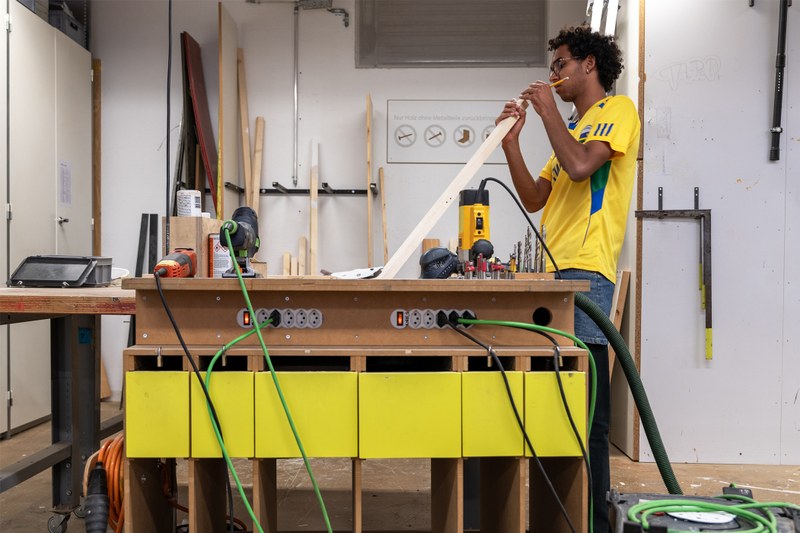
With its studios and central Campus.Workshops, HGK offers ideal conditions for combining craft curiosity, the acquisition of technical skills, and the necessary digital know-how. In addition, all students have their own 24/7 workspace in one of the spacious studios. Students also have access to the Institute’s internal workshops for analogue and digital media as well as the required equipment and software. On top of that, the institute also has its own exhibition space – the TANK – which can be used by students.
Newsletter
We would be happy to keep you up to date with the activities of the Basel Academy of Art and Design FHNW with our monthly newsletter. Newsletter registration here.
Blog
Further information on our events, projects and publications can be found on our blog.

Gerome Johannes Gadient, causal flow, 2019, Installationsansicht I-Hood, Kunsthaus Baselland, 2019
Foto: Christian Knörr
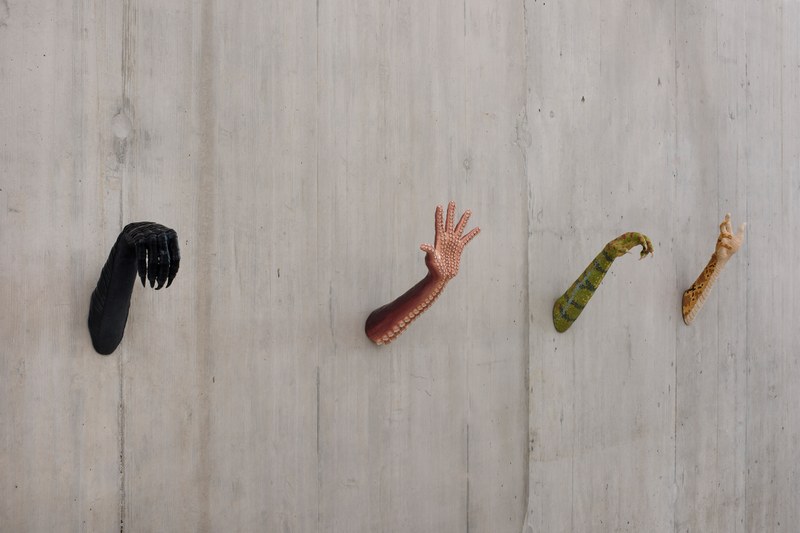
Installationsansicht WE SAID WE NEEDED SPACE, Carolina Brunelli, Laura Bolliger, Claudia Jenni Palma, Marlijn Karsten, Sarah Malomo, Anita Moser, Anita Mucolli, Anina Müller, Cheyenne Oswald, Jaana Rau, der TANK, Basel, 2020
Foto: die Künstler:innen
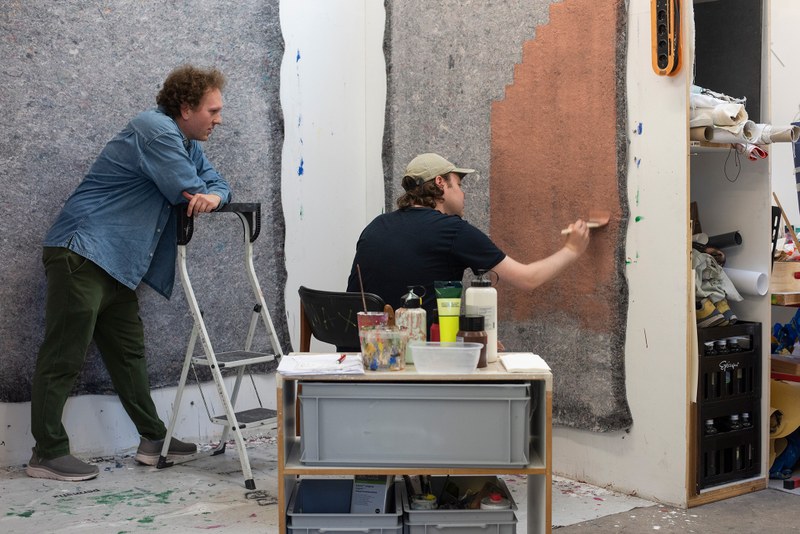
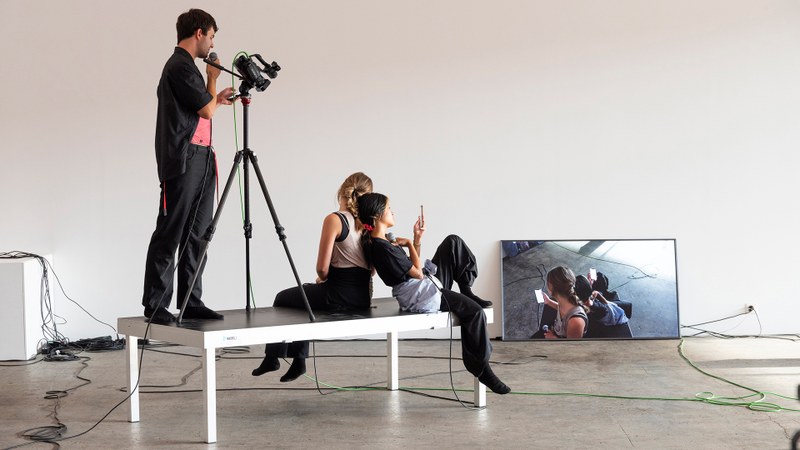
Workshop Raum / Video, 2019
Foto: Christian Knörr
International

International Office
Programme Head & Lecturers

ACT Basel, 2019
Foto: Christian Knör
Franca Fay Zanetti, monologue of a mother, lover, daughter or just your personal chair / loveletters, 2024, Performance, Vernissage You Can Break a Rock With an Egg, Diplomausstellung Bachelor und Master Institut Kunst Gender Natur HGK Basel FHNW, Kunsthaus Baselland, 2024
Foto: Christoph Bühler
Vorbereitungen für die Diplomausstellung (Till Langschied), 2019
Foto: Guadalupe Ruiz
Vorbereitungen für die Diplomausstellung (Anina Müller), 2020
Foto: Christian Knörr
Requirements and admission
Admission requirements
Educational requirements
Admission to the aptitude assessment for the bachelor’s degree in Fine Arts requires one of the following qualifications:
- a certified vocational baccalaureate
- a certified specialized baccalaureate
- a certified upper secondary school (level II) baccalaureate
- proof of an equivalent educational degree at an upper secondary school (level II) obtained otherwise (Swiss education system)
Language of tuition
The language of tuition is German (B2 or equivalent) and partly English. Proof of language proficiency is required at the start of the degree programme.
Workplace experience or preparatory course in design.
One year of practical workplace experience or completion of a preparatory course are not mandatory, but recommended.
is a list of approved vocational trainings and professional fields, respectively
Catching up on the vocational baccalaureate
Applicants who have not completed at least three years of upper secondary schooling (level II) are not legally entitled to admission to a Bachelor's degree programme. Information concerning full-time or part-time on-the-job training courses focusing on a vocational, design-based or specialized baccalaureate is provided by the local vocational colleges.
Admission on the basis of exceptional talent (1)
In exceptional cases, applicants can be admitted to the Bachelor’s degree programmes without being in possession of an upper secondary school (level II) certificate (Swiss education system), namely if they can provide proof of exceptional talent, either in a design-related or an arts-related field.
Note: We recommend that you make enquiries by means of an email to the office of the respective degree programme at admission.BA-kunst.hgk@fhnw.ch at least two weeks prior to the application deadline (15 February), or arrange an appointment with the Head of the degree programme.
____________
(1) If you are in possession of one of the following educational degrees, you are eligible for this mode of admission:
Federal Certificate of Vocational Proficiency EFZ (apprenticeship), Professional Certificate EBA, Specialized Secondary School (FMS), Compulsory Schooling, no educational qualification
Information of the aptitude assessment + dates + study regulations
To apply for a place at the HGK, the required documents must be submitted by 15.02.2026.
Please send the specific enquiries to email address.
Dates 2026
- 01.11.2025
Publication of the detailed information on the aptitude assessment - 22.02.2026
Registration deadline and deadline for submitting the required documents for the aptitude assessment. - 07.- 11.09.2026
Introductory weeks at the HGK Basel (mandatory) - 14.09.2026
Fall Semester begin 2026/27
FAQ online registration
Organisational matters
Additional Costs
Apart from the enrolment and tuition fees, reckon with the following further costs:
Bachelor Thesis fee: CHF 300.-
For materials, travels, excursions, books, storage media, etc. students must reckon with the following additional costs:
Semesters 1 – 5: ca. CHF 2,700.- per semester;
Semester 6 ca. CHF 4,400.-
These are approximate amounts and may vary.
Living costs such as insurance, rent or food etc. are not included.
Advising and information events
Contact

Prof. Dr. Chus Martínez
- Phone
- +41 61 228 41 62
- chus.martinez@fhnw.ch

Team Institute Art Gender Nature (IAGN)
- Phone
- +41 61 228 40 77 (Central office)
- info.iagn.hgk@fhnw.ch
Information events
Loading...
Registration
Structure and programme contentsSeptember 2026
- Date
- 14.9.2026
- Duration
- 6 Semester
- Place
- Campus HGK Basel
- Application start
- 1.11.2025
- Final application date
- 22.2.2026
Structure and programme contentsSeptember 2027
- Date
- 20.9.2027
- Duration
- 6 Semester
- Place
- Campus HGK Basel
- Application start
- 1.11.2026
- Final application date
- 15.2.2027
Campus HGK Basel
FHNW University of Applied Sciences and Arts Northwestern Switzerland
Basel Academy of Art and Design
Freilager-Platz 1
4142 Münchenstein near Basel