
Digital development and additive manufacturing of patient- and application-specific medical devices
Our research group develops innovative medical devices across the entire clinical process chain – from digital data capture and virtual planning to additive manufacturing. Our portfolio includes implants, surgical instruments, surgical guides, anatomical planning models, as well as orthoses and prostheses.
We use medical imaging data (e.g. CT, MRI) and optical 3D scans to create personalised, functionally optimised solutions. State-of-the-art methods in simulation, design automation and artificial intelligence enable us to precisely adapt medical devices to anatomical, biomechanical and functional requirements.
A particular focus is the development of functionally integrated and structurally optimised medical devices, such as patient-specific implants and surgical instruments, as well as biomechanically adapted orthoses and prostheses.
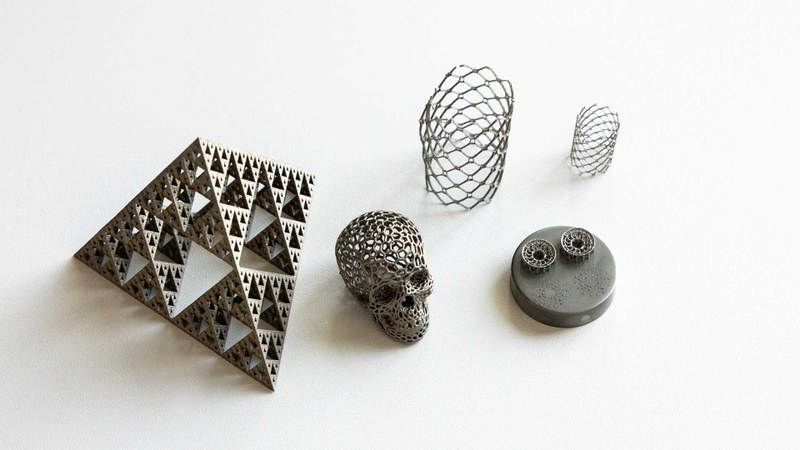
Our core competencies include additive manufacturing of metallic and ceramic biomaterials for bone replacement structures. In addition to dense components, we are researching biomimetically designed, open-pored 3D lattice structures which, through their internal architecture and external form, act as intelligent implants and enable both improved mechanical adaptation and optimised osseointegration.
In addition, we contribute to the continuous development, adaptation and redesign of additive manufacturing processes and their associated equipment. This work is often carried out in close cooperation with industrial partners whose biomaterials are already clinically established and for which new additive manufacturing processes must be validated.
Our research group is part of the Institute for Medical Engineering and Medical Informatics, a leading player in medtech.
Research focus areas
3D digitisation
Choosing the right digitisation method depends on patient and object geometry, accessibility, material properties, and the required data quality. High-resolution optical 3D surface scanners are used for external geometries and surfaces, whereas CT, micro-CT or MRI data are used for internal anatomical structures.
Our expertise encompasses the acquisition, preparation and processing of medical and technical 3D data across end-to-end digital workflows, including:
- Reverse engineering: Creation of structured 3D datasets for further processing in CAx systems
- Development and testing of digital planning and design processes for implants, instruments and templates
- Orthotic and prosthetic concepts: Development and evaluation of digital workflows for data capture, design and simulation through to additive manufacturing of demonstrators and prototypes
- Quality assurance and process evaluation
- 3D comparisons between manufactured components and CAD reference models for dimensional, geometric and process analysis
Reverse engineering
Starting with polygonised 3D data, we can generate a CAD surface or solid model through a surface reconstruction process. Surface reconstruction makes the model accessible for further processing in any CAx system.
Using modern image processing software, we process slice image data from medical computed tomography (CT) and magnetic resonance imaging (MRI) scanners, as well as measurement points from 3D scanners. Processed datasets form the basis for surface reconstruction.
Applications:
- 3D data for the virtual fitting of patient-specific implants
- Bone databases for the development of anatomically accurate, standardised implants
- CAD models for FEM analyses
- Design optimisation or functional optimisation of digital master models for the manufacture of orthoses and prostheses
Design automation using custom design software
We develop custom design software and AI‑driven parametric automation frameworks that translate patient‑specific anatomical and clinical input data into reproducible, scalable design solutions for customised implants, surgical instruments, orthoses, and prostheses.
- 3D scans of body parts combined with dynamic pressure measurements
- Integration of large-scale clinical data
- Artificial intelligence models and algorithms to automatically design customised implants and orthodics
Preoperative models for surgical planning
We have many years of experience in segmenting medical image data and producing anatomical models for research, development, training and demonstration purposes.
Our 3D-printed models can be used to evaluate planning, design and manufacturing processes. A variety of materials, colours and material combinations enable the realistic representation of complex anatomical structures.
In accordance with your requirements, we can rapidly produce prototypes for the pre-operative planning of any type of procedure. The prototypes have a yellowish-transparent appearance, familiar from stereolithographic models of the past twenty years. The advantage of this colour scheme is that the thickness of existing bone structures can be inferred from the varying colour appearance.
Virtual surgical planning (VSP)
Using segmented CT and MRI image data, as well as optically captured surface data, we develop and evaluate virtual surgical planning methods. We analyse, simulate and optimise surgical procedures within the context of research and development projects.
In close collaboration with clinical partners and the medtech industry, we develop and validate digital tools, workflows and product concepts for the virtual planning and implementation of surgical scenarios. Our output includes proprietary design software and automation, virtual models, design studies and physical demonstrators.
Interactive simulation environments enable the manipulation of anatomical structures using virtual instruments, such as digital cutting or milling tools. This allows surgeons to examine and evaluate accessibility, positioning, reconstruction strategies and process flows in a realistic manner.
Our prototypes of templates, guides and instruments help translate virtual planning results into physical applications. Similarly, design and evaluation of implant-related solutions form an integral part of the virtual planning methodology.
Design, development and structural optimisation of orthoses and prostheses
Our expertise encompasses the digital development of patient- and application-specific orthotic and prosthetic systems across an end-to-end, data-driven process chain. The focus is on functional, biomechanical and structural optimisation using modern CAx methods, simulation, design automation and additive manufacturing.
Using medical imaging data (CT, MRI), optical 3D scans and functional measurement data (e.g. pressure and motion analyses), we develop customised solutions that specifically take into account anatomical conditions, load paths and patient-specific requirements.
Innovation in medical device design, optimisation and testing
Our integrative approach to innovation in medical device development combines design, simulation-based optimisation and physical testing. Starting from application- and clinically-driven product concepts, we systematically translate requirements into digital development and simulation models.
We use numerical methods such as finite element analysis (FEM) for the targeted optimisation of function, strength and usability. We develop and deploy specialised in vitro test setups and functional testing methods to validate design and simulation assumptions. These insights are iteratively incorporated into the further development and functional validation of medical devices.
Rapid prototyping (RP) and rapid manufacturing (RM)
The use of rapid prototyping models has become an integral part of the digital product development process chain.
Initially used as concept models in the early stages of development, high-quality components made from plastics or metal alloys are now being used in small production runs. Rapid manufacturing represents the latest development in this field.
In all product development phases, rapid prototyping can be used to verify function, proportions, ergonomics, handling and design. Variant studies can also be completed quickly and easily without tooling or programming costs, and made available to user groups for evaluation.
These technologies enable the production of simple, higher-quality and more precise plastic models, right through to fully-fledged components made from various metal alloys and ceramics.

Digital 3D scanning of real-world objects 
Preoperative models for surgical planning 
Reverse engineering 
Rapid prototyping (RP) and Rapid manufacturing (RM) 
Medical rapid prototyping
Projects

3D-printed biodegradable metallic Mg scaffolds
- Institute
- Institute for Medical Engineering and Medical Informatics
- Research field
- Functional materials and surfaces, Design and additive manufacturing of medical devices

Porous shape-memory scaffolds as mechanically active bone implants
- Institute
- Institute for Medical Engineering and Medical Informatics
- Research field
- Functional materials and surfaces, Design and additive manufacturing of medical devices
Real-time control of micro selective laser melting
- Institute
- Institute for Medical Engineering and Medical Informatics
- Research field
- Functional materials and surfaces, Design and additive manufacturing of medical devices

Spirits
- Institute
- Institute for Medical Engineering and Medical Informatics
- Research field
- Functional materials and surfaces, Design and additive manufacturing of medical devices, Computer aided surgery, Minimally invasive systems

Titanium bone scaffolds
- Institute
- Institute for Medical Engineering and Medical Informatics
- Research field
- Functional materials and surfaces, Design and additive manufacturing of medical devices
Publications
Contact

Daniel Seiler
- Phone
- +41 61 228 58 48
- daniel.seiler@fhnw.ch
Team

News and stories

Stepping up 3D printing of orthopaedic insoles
- Date
- 30.4.2025
- Institute
- Institute for Medical Engineering and Medical Informatics

3D printed implants
- Date
- 12.12.2017
- Institute
- Institute for Medical Engineering and Medical Informatics

