
Let’s make maths fun!
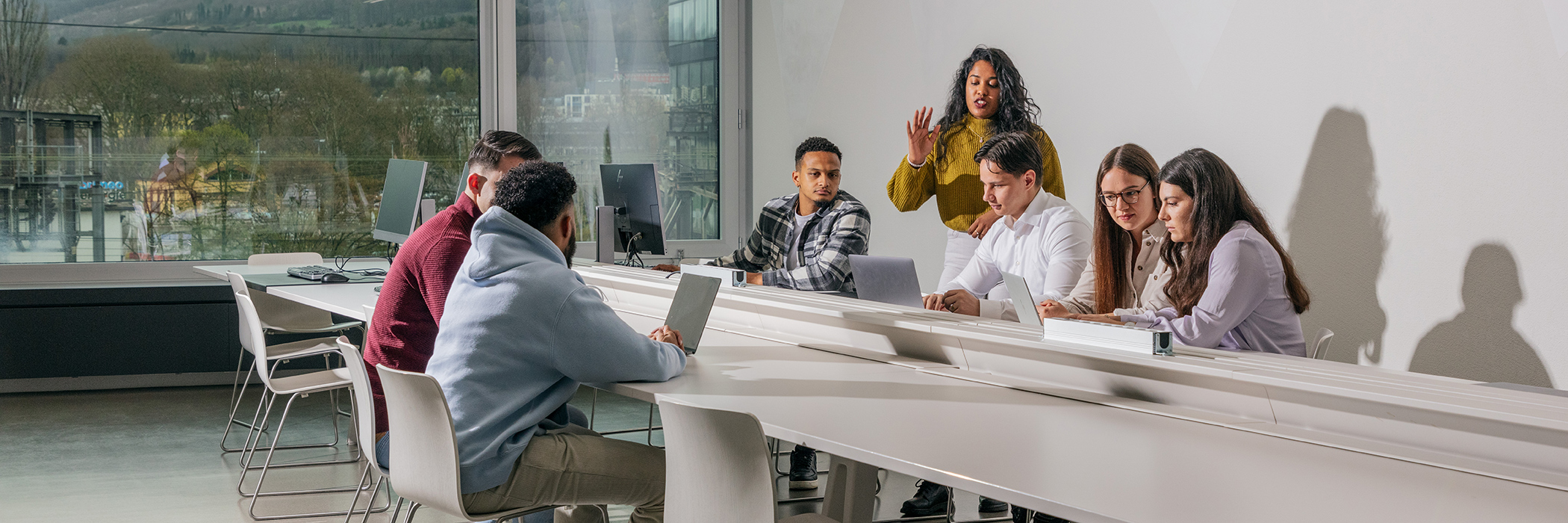
What does the Netflix recommendation «Money Heist» have to do with vectors and matrices? And what is the connection between linear algebra and the «Matte Schnägg» in Berne? Classes in Business Mathematics 2 by Patrik Christen at FHNW are far from dry and boring.
For the past two years, classes in Business Mathematics 2 in the study programme BSc in Business Information Technology (BIT) at the FHNW School of Business take place in a whole new format. Videos, scripts, exercises and coaching have replaced teacher-centric teaching. And instead of having to pass an exam, students hand-in their own documentation to be graded by the lecturer. What do the students think of this learning format? Stefan, student in the 6th semester of the study programme BSc BIT, shares his experience.
What was your initial reaction when you learned that this module does not have fixed hours and classic lectures?
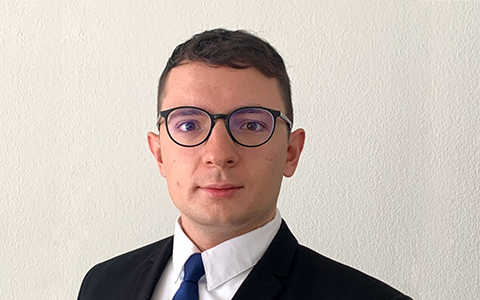
I was happy about the prospect of studying on my own terms. The whole structure of the module is very inspiring. It allowed me to work when I was motivated and when I could fully concentrate. As a pleasant side-effect, I was able to study more efficiently than in a regular classroom setting.
Was there no danger of postponing studying until the very end of the semester?
The module is structured in five thematic blocs, you have to hand-in your documentation every other week and discuss it with Patrik. There is no chance to procrastinate. The feedback per bloc is very valuable because it shows me where I am at and where I have to invest more. There is no fear of failing an examination at the end of the semester, because there are no exams, but ongoing coaching and grading.
What do you like most about this studying format?
We compile a personal documentation which is a handy reference for later. I have already used it for questions in my current position as Application Specialist at Dufry.
Furthermore, we have the task to research ideas from our environment following given case studies. That is how I looked into applications of face recognition on smartphones by dividing a face up into vectors and creating a matrix. Working on a subject I was really interested in allowed me to better process the content than if it was just a standard exercise from an area I am not familiar with.
What was the most challenging part of the module for you?
Definitely «Computational Exploration». Following certain guidelines, we worked with a software (MathWorks MATLAB) to see what happens when you play around with vectors. That was very involved, but exciting, too, because we were free to experiment.
What would you change regarding the studying format?
After these past two years, I really want to stress the importance of being present on campus to physically meet your colleagues and lecturers. I would not want every module to be taught this way. I think it is a good fit for Business Mathematics 2, but I would welcome the possibility to have some of the coaching sessions with our lecturer in a physical classroom.
Finally, can you answer the questions concerning Netflix and the «Matte Schnägg»?
(Almost) everything can be described in terms of vectors and matrices: a landscape, a road system, light, temperature, a tree, preferences, an excursion, a construction…
The «Matte Schnägg» learns how to drive autonomously in the Matte neighbourhood in Berne by continuously collecting, analysing and processing data like length and width of the road, one-way street or not, distance to the sidewalk, positions of obstacles, etc. These machine learning methods are based on linear algebra.
Netflix creates a matrix of the behaviour of its users, which then leads to calculating further recommendations.
After studying in the module Business Mathematics 2, these questions are easy.